
Side Trips from Coimbra
Within easy reach of Coimbra you will find gleaming lagoons, colourful fishing villages, exotic forests, and the most extensive Roman ruins in the country.
Main Attractions
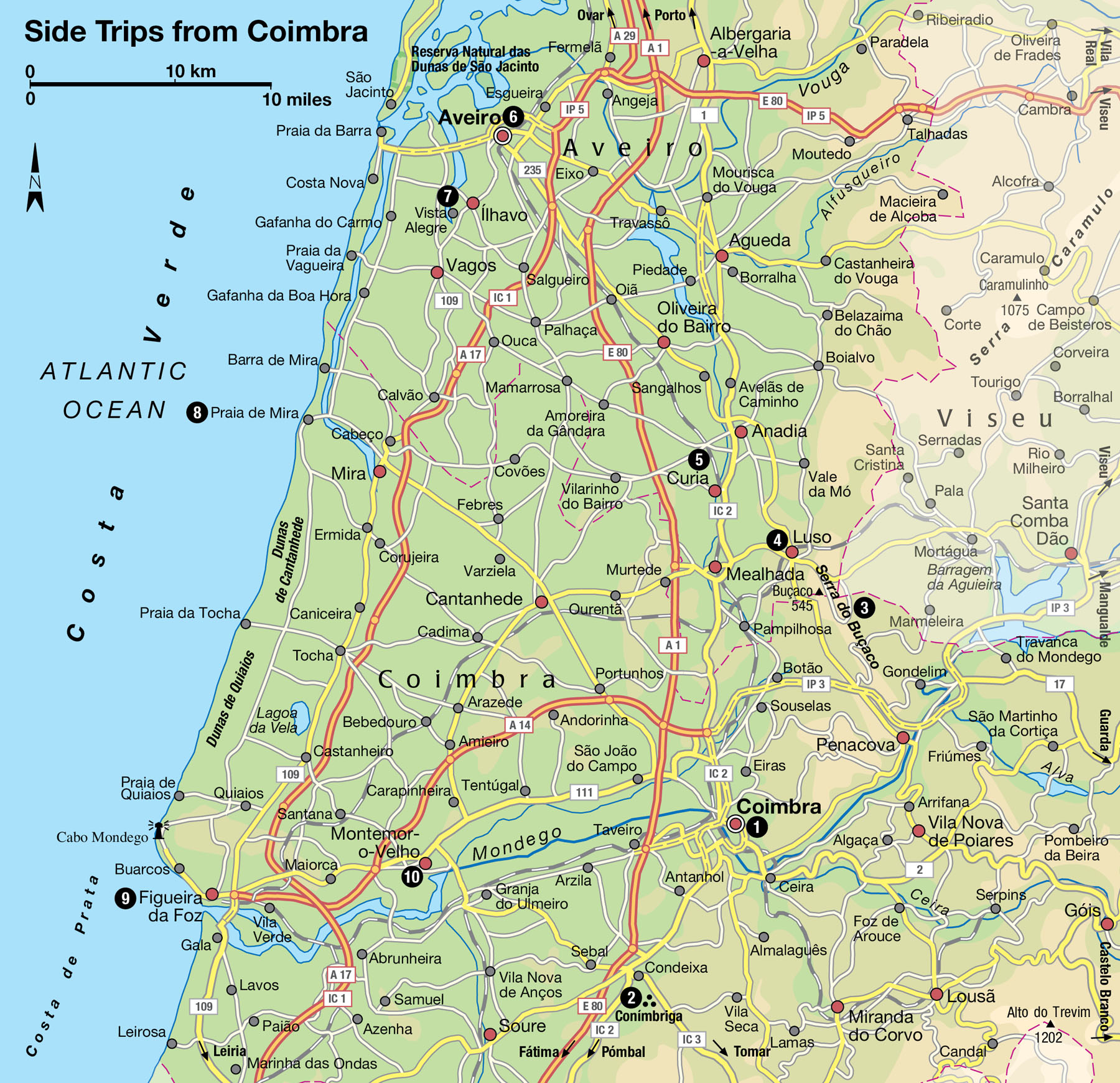
Coimbra 1 [map] might be the main focus of interest in this vicinity, but there are plenty of opportunities for short excursions to other noteworthy places. The countryside towards the coast is especially bucolic with an old-fashioned rural way of life. The coast also offers plenty to see, especially Aveiro with its canals and lagoons. Castles and palaces feature too, as well as Roman ruins.
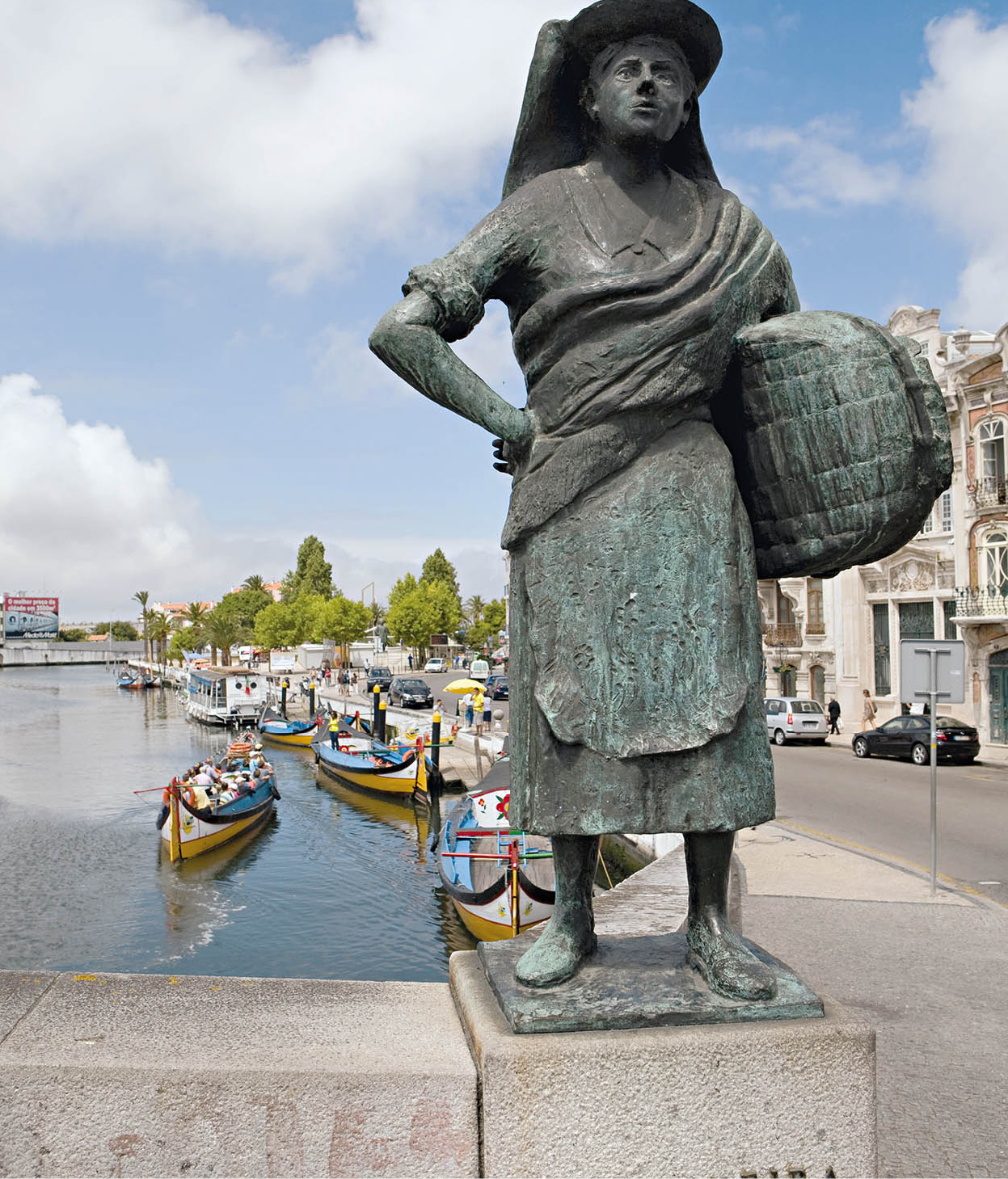
The Salineira statue in Aveiro.
Lydia Evans/Apa Publications
Conímbriga
Portugal’s largest excavated Roman ruins are at Conímbriga 2 [map] (daily 9am–7pm; charge), 15km (9 miles) south of Coimbra, near the town of Condeixa; the drive is easy, and there is a bus service. The site is complemented by the Museu Monográfico de Conímbriga (daily same hours), one of the country’s finest museums.
Conimbriga’s Past
Conímbriga was probably settled as early as the Iron Age (800–500 BC), and it was not until the latter part of the 2nd century BC that the Romans arrived. Conímbriga profited from its location by the Roman road between Olisipo (Lisbon) and Bracara Augusta (now Braga), and around AD 70 was designated a municipium.
Conímbriga’s prosperity was not to last. Crises in the empire and Barbarian incursions prompted the construction of the defensive wall, still prominent today, but despite this, in 464 the Suevi successfully attacked the city. Conímbriga continued to be inhabited, but lost to neighbouring Aeminium (Coimbra) its status as an important centre.
Only part of the estimated 13-hectare (32-acre) site has been excavated.

A Roman mosaic, Conímbriga.
Lydia Evans/Apa Publications
As you enter the site, you are walking down the road that gave Conímbriga its original importance: the highway from Olisipo to Bracara Augusta. In front of you is an enormous wall. Passing through the main entrance and continuing along the path to the right, you will come to the arch of the aqueduct (rebuilt), parts of the aqueduct itself, and the remains of several buildings that were possibly small shops.
The building known as Cantaber’s House stretches to the south. The house is full of ornamental fountains and pools, but more interesting are the baths, which lie at the extreme south end. They are easily recognisable by their hexagonal and round shapes, and by the piped heating system (that great Roman innovation), visible through the stone grid covering the floors. Around the other side of the wall you can see more baths: public ones. For Romans, bathing was an important daily ritual, and the bathroom was also a place to discuss politics. Beyond the baths is an area of marvellously patterned mosaics; some are covered to protect them from the elements. The museum is small but carefully designed. A long case displays ceramics, jewellery, and artefacts relating to weaving, agriculture, lighting, writing and hygiene. There are also statues and a model of the forum and temple.
Fact
After taking a bath, the Romans would cover themselves with olive oil and then scrape their skins clean with a curved blade called a strigil. Those who could afford it would bring a slave along to perform this service for them.

Details from Hotel Buçaco Palace.
Lydia Evans/Apa Publications
Serra do Buçaco
Northeast of Coimbra lies the Serra do Buçaco 3 [map] (Buçaco Forest), a darkly haunting area which for centuries has been protected, enabling 700 varieties of native and exotic trees to flourish. Benedictine monks established a hermitage here in the 6th century. The Carmelites, who built a monastery in 1628, began cultivation of the forest, planting species brought back from sea voyages, including Himalayan pines, monkey puzzles, Japanese camphor trees, huge Lebanese cedars, and ginkgoes. In 1643 the pope threatened to excommunicate anyone harming the trees.
A royal hunting lodge was built in neo-Manueline style at the end of the 19th century, next to what remained of the convent. The Italian architect Luigi Manini, somehow managed to inject his own interpretation of Romantic Revivalism into the construction and the intended modest hunting lodge turned into a sumptuous palace. After the fall of the monarchy in 1910, it became the spectacular and luxurious Palace Hotel do Buçaco (where you may still, at a price, lodge in the suite of the last king, Manuel II). A small church, the cloister, and several monks’ cells remain from the monastery. In one of these cells the Duke of Wellington spent the night before the Battle of Buçaco on 27 September 1810. His victory in this battle was the first serious setback suffered by Napoleon’s army, as the French attempted for the third time to conquer Portugal. The victory is still celebrated annually on the anniversary, with a re-enactment of the battle, in full period costume. A military museum is among a host of sights.
A high-quality wine is produced on the estate and is available in the restaurant. If you are keen to try it, book yourself in for lunch at the hotel and enjoy a real treat (www.palacehoteldobussaco.com).
Downhill from Buçaco is the village of Luso 4 [map], renowned as a spa for the water that flows freely from fountains and which is available bottled throughout Portugal. A common sight here is of local people overburdened with an assortment of plastic water bottles jostling to fill them at Fonte de São João (St John’s Fountain).
The N1/IP2 north towards Aveiro leads through the heart of the Barraida wine country. A slight diversion into Curia 5 [map] allows the opportunity of picking up a special map of the region from the Turismo. Armed with this, you can find your way to the local winery at Sangalhos, Caves Aliança (www.alianca.pt), where you can taste wine or visit the fabulous museum in its cellars, which displays beautiful artefacts collected by José Berardo, one of Portugal’s richest men. The collection includes 1,500-year-old phallic symbols from Niger and a fine collection of fossils and ethnographical items. .

Colourful moliceiros take to the water in Aveiro.
Lydia Evans/Apa Publications
To the coast and Aveiro
Aveiro 6 [map] has been described as the Venice of Portugal. The comparison, although exaggerated, stems from the canals that traverse the city and the boats that ply them. The canal system is modest, however: there is only one main canal, with two smaller ones along the edges of town. But they are linked with the ria, the lagoon that extends 47km (29 miles) just inland of the Atlantic and is fringed by dunes and long sandy beaches. Known to the Romans as Talabriga, Aveiro once lay directly on the ocean, but over the centuries a strip of sediment has built up, creating the ria but blocking ships and trade.
The lagoon plays a significant part in Aveiro’s economic importance as an expanding port for fishing fleets and industrial cargoes. Other important local industries include wood, cork, and ceramics from nearby Vista Alegre. Next to the canals are large saltpans, another local resource. Once the lagoon was famous for brightly painted moliceiros, the boats with large graceful prows that were widely used to gather moliço (seaweed) for fertiliser, and which today are used for transporting tourists.
Aveiro was a small settlement during the Middle Ages. It was designated a town in the 1200s, and in 1418 was encircled by fortified walls, at the suggestion of Infante Prince Pedro after whom the city park is named. Shortly after this, Aveiro was granted the concession of a town fair; the March Fair continues to this day with local produce on display.
The 16th century was a time of growth and expansion for the town. With dredged access to the sea and to the interior, Aveiro became a trade centre from which products of the entire Beira region were exported. In 1575, a violent storm shifted the sandbanks in the lagoon, blocking the canal from the sea. The inevitable decline in Aveiro’s importance encouraged emigration, which caused a dramatic decrease in population (to about one-third). In 1808, another storm reopened the sea passage, but it was not until the last half of the 19th century that Aveiro’s fortunes picked up.

Public art in Aveiro.
Lydia Evans/Apa Publications
Exploring Aveiro
Aveiro makes a good base for a trip on the ria or to nearby beaches, but the city is worth exploring as well. The best way to get around Aveiro is to pick up a free bicycle from a BUGA park, under a local scheme to encourage cycling in the town. Aveiro is divided in two by the principal canal. The southern part is where the aristocracy once lived; the northern half is the old fishermen’s section.
The southern half centres around the Praça da República. In the simple square, the nicest building is the solid and rather prim town hall. On the east side of the square, the 16th- and 17th-century Misericórdia church has a lovely Renaissance portal and 19th-century tiles on its facade. In a square further south the 17th-century Carmelite Convent once housed the barefoot Carmelite order, who embraced a simpler way of life, focusing on solitude. Note the paintings on the ceiling, which depict the life of St Teresa of Avila.
The town’s Museu de Aveiro (Tue–Sun 10am–5.30pm) is housed in the 15th-century Convento de Jesus. The convent has some fine 17th-century paintings and its church is effusively gilded. Arching over the choir are lovely hand-painted ceilings, and off the choir is a chapel with beautiful tiles. Just outside is the tomb of Santa Joana Princesa, daughter of Afonso V and patron of the city, who lived in the convent for 14 years until her death in 1489. Intricately carved in coloured marble and delicate inlays, with statues supporting and crowning it, the tomb took 12 years to construct.
The São Domingos Cathedral is near the museum. Its Baroque facade has twisted columns and sculpted figures of Faith, Hope and Charity. Inside, an enormous skylight over the altar lends the church an airiness that many Baroque churches lack. The huge blue altar rises strikingly in the all-white interior. The tomb of Catarina de Ataíde is here, a woman honoured, under the name Natércia, by the poet Luís Camões in his sonnets. The church was founded in 1423 and remodelled during the 16th and 17th centuries.
Several blocks away is the refreshing Parque Dom Infante Pedro, in the grounds of the old Franciscan Monastery. Colourful flowers, lush trees, fountains, and a small lake where you can hire paddle boats make this a nice spot for a break.
The old quarter
North of the canal lies the fishermen’s section, where narrow houses support facades that sometimes rise beyond roof levels. The arches and curves on these false fronts are reminiscent of the fishing boats and their curved prows. The fish market, where the catch is sold each morning, is in this area. There is also the white, oddly shaped chapel of São Gonçalinho and the church of São Gonçalo. Inside this 17th- and 18th-century building gleam a gilt altar and newly placed tiles.

The striped houses of the Costa Nova.
Pictures Colour Library
The beautiful ria is a prime reason for coming to Aveiro. You can tour its length by boat, car or bus, although boat is by far the most rewarding. The lagoon and its subsidiary canals extend as far south as Mira and as far north as Ovar. There is a fair range of hotels in the area and many campsites. You will see traditional colourful moliceiros (the annual regatta is in July), shorelines dotted with saltpans, forests and villages, glorious sea birds plummeting into the water, and the sandbar that blocks the city’s access to the sea. A road bridge takes you over the mouth of the estuary to Costa Nova, where there are brightly coloured traditional houses and excellent fish restaurants. Just 3km (2 miles) north of here, Praia da Barra is home to the Iberian peninsula’s tallest lighthouse and (together with Costa Nova) is famed for its great surfing conditions. For information on the town, head to the tourist office, in an Art Nouveau building at Rua João Mendonça 8.
Tip
Several companies run boat trips on the ria, including Memórias da Ria (tel: 234 482 365) and Ecoria (tel: 234 425 563). You can choose between a traditional moliceiro and a modern panoramic boat; either way, trips typically last around an hour, longer if a meal is included.
Continuing north, São Jacinto is a bustling port and part of the Reserva Natural das Dunas de São Jacinto (www.icnf.pt), an inviting little nature reserve with ponds and trails, which is famed for its birdlife. Visitor numbers are limited, so it is advisable to reserve online in advance.
Castles and candy stripes
From Aveiro a good road leads south to Figueira da Foz and back to Coimbra along the riverside. Fairly soon after leaving Aveiro, past Ilhavo, divert right to Vista Alegre 7 [map] for its porcelain factory (www.vistaalegreatlantis.com; Mon–Fri 9am–noon, 2–5pm). Famous throughout Portugal, it started production in 1842 and is still run by the same family. There is a shop and small museum (Tue–Fri 9am–6pm, May–Sept Sat–Sun 9am–12.30pm, 2–5pm, Oct–Apr Sat–Sun from 10am).
Mira lies close to the road a little further south. Keep going through the town and head for Praia de Mira 8 [map] on the coast. This is the most southerly point of the lagoon and canal system that surrounds Aveiro. Candy-striped beach huts add a jaunty air to the resort, but the main attraction is the inland lagoon, where there is safe boating and where picnickers enjoy shade from the surrounding pine trees.
Heading south, dip into the attractive quieter beach at Praia de Quiaios, situated just 10km (6 miles) north of the major holiday resort of Figueira da Foz 9 [map]; the latter is favoured by both Portuguese and Spanish visitors. Turn a blind eye to the high-rise blocks and look at the broad expanse of beach and the gaily coloured beach huts, again in delightful candy stripes.
There is a fast road along the north side of the river to Montemor-o-Velho ) [map], dominated by a 14th-century castle (daily May–Sept 10am–8pm, Oct–Apr 10am–5pm; free) on a prominent mound. Like many in Portugal, it was held by the Moors before being taken by the Christians. Within the walls are gardens, the ruins of a 16th-century Manueline palace and the restored Igreja de Santa Maria da Alcáçova, built around the time the castle was restored. To enjoy a rural atmosphere on the return to Coimbra, take the road from here along the south side of the river.
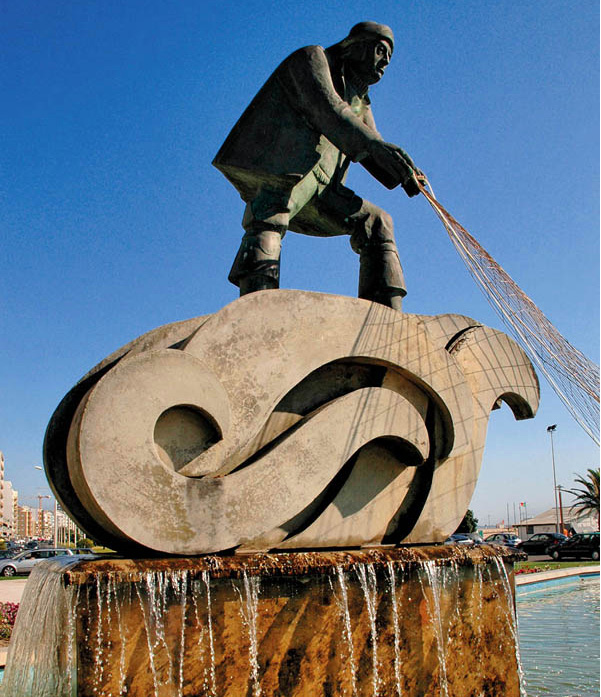
A tribute to the fishermen of Figueira da Foz.
Alamy

Ruins in the vicinity of Monsanto.
Lydia Evans/Apa Publications