
Portuguese Food
If you like fresh fish, succulent pork and hearty soups, laced with plenty of garlic, you will find Portuguese food to your taste.
To dine in Portugal is to taste the presence of other countries, other cuisines. It is to conjure up images of empire: Brazil, Angola, Mozambique, Goa and Macau. These and others all “belonged” to Portugal once and, in a manner of speaking, foods from four continents helped to stir the pot.
The period of Portuguese empire, when this small nation reached out across the terrifying “Green Sea of Darkness”, as the Atlantic was called, has long passed. Yet Portugal, left with only the Azores and Madeira, has preserved the flavours of other cultures in its cooking.

Portuguese sardines are plump and succulent.
Lydia Evans/Apa Publications
Prince Henry the Navigator, less than 30 years old when he began to promote exploration, was a true scientist in an age of superstition. He ordered his explorers to bring back from new lands not only riches and wild tales, but also fruits, nuts and plants. In 1420 he sent settlers to colonise the newly discovered island of Madeira. With them went plants he believed would thrive in Madeira’s volcanic soil and subtropical climate, including grape vines from Crete and sugar cane from Sicily. Even more significant for Portuguese cooking was Vasco da Gama’s discovery of the sea route to the east in 1497–8, only five years after Christopher Columbus’s discovery of the West Indies.
The Portuguese word for tea – chá – is almost identical to the Cantonese one – ch’a – from which is derived the colloquial English term “char”.
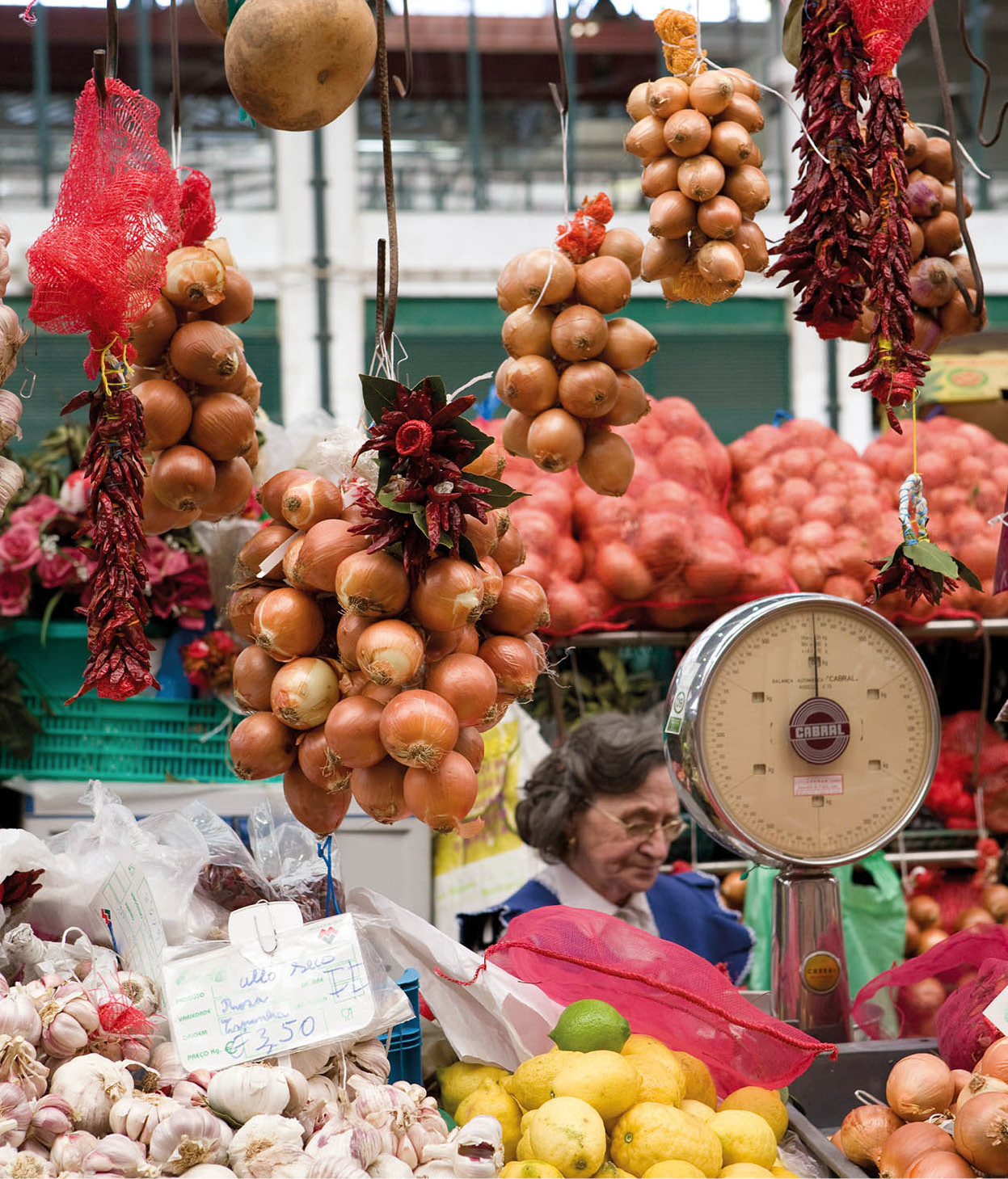
Lisbon’s Mercado da Ribeira.
Lydia Evans/Apa Publications
Spices of the Orient
Black pepper was what Vasco da Gama sought, but cinnamon, which he also found in Calcutta, would soon become equally precious to Portuguese cooks. Indeed, one boatload of cinnamon sticks fetched enough money to pay for an entire expedition to India. Cinnamon is perhaps the most beloved spice in Portugal today, certainly for the famous egg sweets (doces de ovos, for more information, click here). Spaniards, on the other hand, prefer vanilla for their puddings and flans. There is a good historical reason for this: it was the Spaniards who found Montezuma sipping vanilla-spiked hot chocolate in Mexico and learned the trick of curing vanilla beans, the seed pods of a wild orchid. Perhaps this is why chocolate, too, is more popular in Spain than in Portugal.
The spiciest Portuguese dishes, incidentally, are not found on the mainland but in the Azores and Madeira. These islands were ports of call for the early navigators, who would barter with the native people, offering spices in exchange for fresh fruits, vegetables, meat and the local brew.

Portuguese food is rustic.
Dreamstime
New food for old
During Portugal’s lavish Age of Empire, its navigators became couriers, bringing New World foods to the Old and vice versa. Mediterranean sugar cane, for example, was cultivated in Brazil. Brazilian pineapples were introduced to the Azores, a colony established under Prince Henry. They still flourish there in hothouses, ripening under wafting wood smoke. Azorean pineapples, chunky, honey-sweet and tender to the core, are teamed today with rosettes of Portugal’s mahogany-hued, air-cured presunto (prosciutto-like ham) and served as an elegant appetiser in fashionable Lisbon restaurants.
Tiny, incendiary Brazilian chilli peppers took root in Angola, another important Portuguese colony, early on, and became so essential to cooks there that today they’re known by their African name, piri-piri. Since Angola ceased to be a Portuguese colony in the mid-1970s, the subsequent influx to Lisbon of thousands of Angolan refugees has meant that piri-piri sauce (an oil and vinegar mixture strewn with minced chillies) is as popular a table condiment in mainland Portugal as salt and pepper.
Other exchanges were African coffee, transplanted to Brazil, which today produces about half of the world’s supply; Brazilian cashews, which landed in Africa and India; and Oriental tea plants, which were taken to the Azores.
All this transporting of seeds, leaves, barks, roots, stalks and cuttings by Portuguese explorers across oceans and continents dramatically affected Portuguese cooking. New World tomatoes and potatoes came to Portugal about the same time as they did to Spain, in the 16th century. Portuguese cooks might drop a few garlic cloves into the soup or stew along with the tomatoes and potatoes, or tuck in a stick of cinnamon.
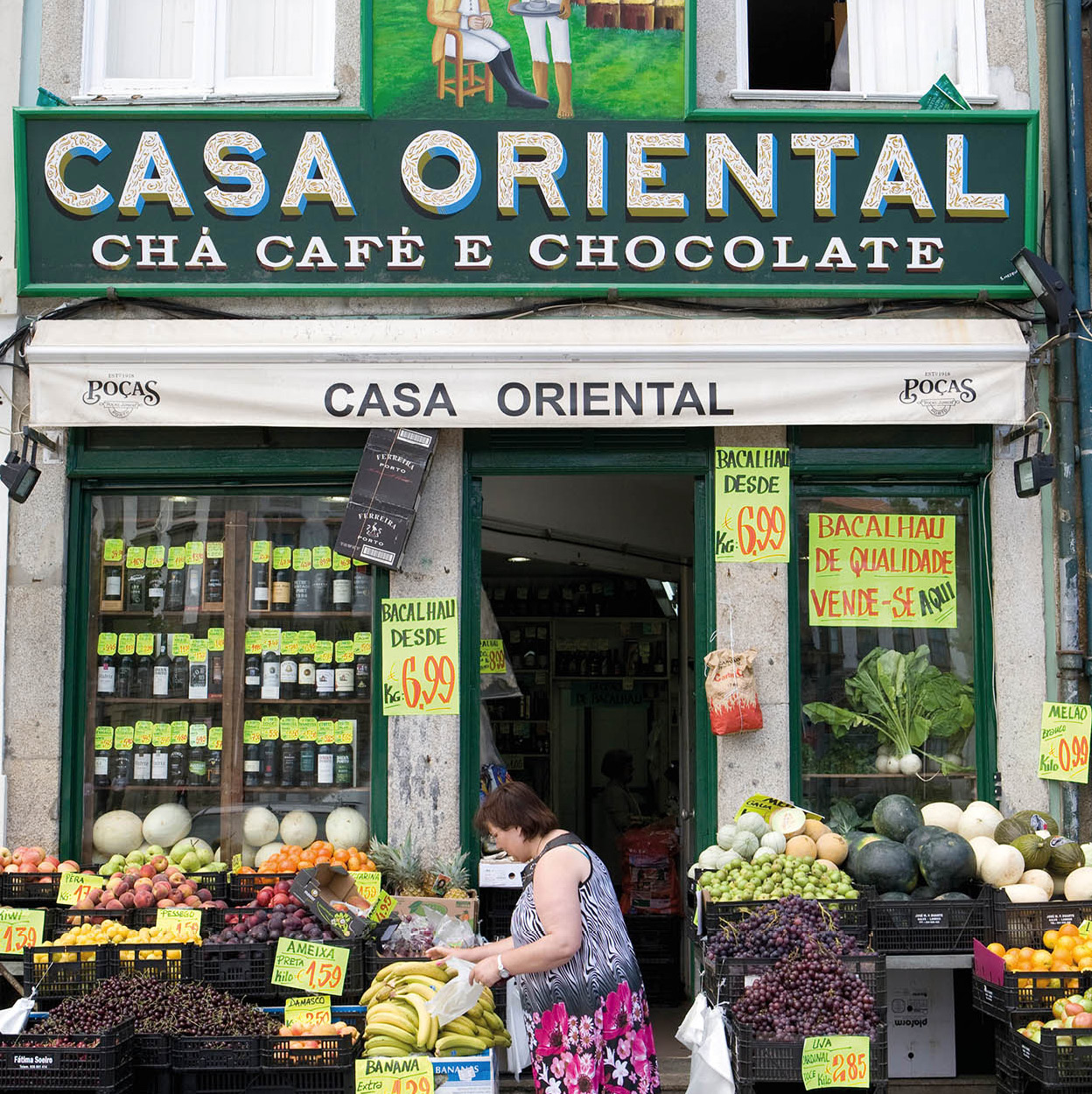
Shopping at Casa Oriental, Porto.
Lydia Evans/Apa Publications
A la Portugaise
It is unlikely that anyone grows nuttier, earthier potatoes today than the Portuguese. Indeed, along the New England coast in the United States, where so many Portuguese families have settled, there is an old saying: “If you want your potatoes to grow, you must speak to them in Portuguese.” Tomatoes respond to the Portuguese touch, too, and those harvested in the vast Alentejo province, east of Lisbon, are as juicy, red and tasty as any on earth. Not for nothing does the phrase found on French menus, “à la Portugaise”, mean a dish that is richly sauced with tomatoes.
Onions and garlic, indispensable to any respectable Portuguese cook, were probably introduced by the Romans, who are believed to have brought wheat here, too. They aimed to make the Iberian peninsula the granary of Rome. They also probably introduced olives (a major source of income today) and grapes. From shards found in Alentejo, it is known that the Romans were making wine there as early as the 2nd century AD.
The Moors, who occupied a large chunk of Portugal from the early 8th to the mid-13th centuries, enriched the pot even more than the Romans. The southern provinces were the Moorish stronghold – the Algarve and Alentejo, in particular – and many traces of North Africa can still be seen.
It was the Arabs who dug irrigation ditches, who first planted rice (it now grows up and down the west coast), and who also covered the Algarve slopes with almond trees. The Algarve’s almonds were ground into paste, sweetened, and shaped into delicate miniature fruits, birds and flowers displaying intricate detail that are still produced today.
The Moors also introduced figs and apricots to the Algarve, together with the trick of drying them in the sun. They planted groves of lemons and oranges and, as was their custom, they combined fish with fruit and fruit with meat.
It was the Arabs who invented the cataplana, a hinged metal pan, a sort of primitive pressure cooker shaped like an oversize clam shell that can be clamped shut and set on a quick fire. The food inside – fish, shellfish, chicken, vegetables or a medley of all – steams to supreme succulence. What goes into a cataplana depends on the whim of the cook (and on what is available), but the most famous recipe is amêijoas na cataplana, clams tossed with rounds of sausage and cubes of ham in an intensely garlicky tomato sauce. This unlikely pork and shellfish combination was supposedly created at the time of the Inquisition as a test of true Christianity. Pork and shellfish, of course, were forbidden to Jews and Muslims alike.
There is no shortage of examples of Portugal’s culinary ingenuity. Thrifty Portuguese cooks with an eye on their wallets made bread a main course by layering yeast dough into a pan with snippets of chicken and sausage and two kinds of ham – a classic from the remote northern Trás-os-Montes which is called folar. And when times were particularly hard they would crumble yesterday’s bread into shrimp cooking water and come up with the Estremadura favourite known as açorda de mariscos.
Most supposedly vegetable dishes include meat fat or stock; even a salad is not considered complete without a sprinkling of tuna. Vegetarians may prefer self-catering, shopping at markets for fruit, vegetables and bread.
Less economical but equally inventive is the Serra da Estrela recipe, which involves braising duck with bacon and rice; or smothering red mullet the Setúbal way, with tiny tart oranges; or scrambling flakes of salt cod with eggs and shoestring potatoes (thinly cut and crisply fried), as is done all over the country.

Classic cod dish.
iStockphoto.com
Cod country
Dried salt cod, or bacalhau (pronounced buckle-yow), is a purely Portuguese invention. António M. Bello, first president of Portugal’s gastronomic society, wrote in his Culinária Portuguesa, published in Lisbon in 1936, that the Portuguese were fishing Newfoundland’s Grand Banks for cod within just a few years of Columbus’s discovery of America.
New fishing rules impose restraints and quotas, and cod fishing especially is much altered. Yet Portuguese poems, stories, folk sayings and fado songs still maintain a bittersweet seafaring tradition:
O waves from the salty sea,
From whence comes your salt?
From the tears shed on the
Beaches of Portugal.
It was in the 16th century that Portuguese fishermen learned to salt cod at sea to make it last the long voyage home, and to sun-dry it into board-stiff slabs that could be kept for months then soaked in cool water before cooking.
Sardine Season
Nearly as popular as salt cod are the sardines netted off the Atlantic coast. These are what the fishermen of Nazaré go out looking for day after day – although the men are less likely now to wear their traditional tartan, and the flat-bottomed boats have mostly given way to motorised craft. Portuguese sardines are considered the sweetest and fattest in the world, and local women grill them right on the streets, using little terracotta braziers. But you will only see this going on in spring, summer and early autumn, the “sardine season’’. As every right-minded Portuguese knows, sardines are too bony to eat from November to April.
Fish is still sun-dried on racks in the old way on the beach at Nazaré, although much less cod is available now. The Grand Banks have become so over-fished that the Portuguese have taken to importing bacalhau from Norway, just to be able to meet their annual demands. This, of course, prices salt cod – once an inexpensive staple of the national diet – beyond the reach of the very people it sustained for centuries.
The best and most famous dishes are bacalhau à Gomes de sá (cod cooked in a casserole with thinly sliced potatoes and onions, garnished with hard-boiled eggs and black olives), bacalhau à brás and bacalhau dourado (two similar recipes composed of scrambled eggs, onions and shoestring potatoes), bacalhau à Conde de Guarda (salt cod creamed with mashed potatoes) and bolinhos de bacalhau (cod fish balls, a very popular hors d’oeuvre). All these once-humble recipes are served today in the most expensive restaurants. Prepared properly, they are delicious, but if too little care is taken they can be very salty.
Someone once said that the Portuguese live on dreams and subsist on salt cod. They do claim to know 365 ways to prepare it, one for each day of the year.
King carne
If salt cod and sardines share top billing as the favourite fish, pork reigns supreme as the king of carne (meat). Portuguese pork is incomparably sweet and tender because of the pigs’ agreeable diet and life of leisure. In the northerly Trás-os-Montes province, they say that if you want good pork in the autumn you must feed your pigs twice a day in August. Some farm women even go so far as to cook potatoes for their animals.
Small wonder the hams (presunto and fiambre) and sausages (salsichas) are so highly prized here (the best of all are said to come from Chaves). Small wonder, too, that charcuterie figures so prominently in the regional soups and stews. Cooks here will wrap freshly caught brook trout in slices of presunto, then bounce them in and out of a skillet so hot the ham is transformed to a crisp, deeply smoky sort of pastry.
But Portugal’s most famous pork dish comes from the Alentejo. It is porco à alentejana, for which cubes of pork are marinated in a paste of sweet red peppers and garlic, browned in the fruity local olive oil, then covered and braised with baby clams, still in the shell. The clams open slowly under the gentle heat, spilling their briny juices into the ambrosial red mixture. The secret behind achieving the distinctive nut-like flavour of Alentejo pork is that the pigs are turned loose each autumn to forage among the cork oaks. Here they nibble on acorns and wild herbs, as well as the occasional truffle.
Sausage-making is also highly prized in the Alentejo, and this region’s garlicky chouriços, linguiças, farinheiras (sausages plumped up with cereal) and chunky, smoky paios are without peers. As one of Portugal’s food authorities, Maria de Lourdes Modesto, writes in Cozinha Tradicional Portuguesa, “The grand destiny of the pig in the Alentejo is to become sausage.”
Here, every part of the pig is used – ears, snout, tail, feet – even, it would seem, the squeal. At carnival time, for example, the centrepiece of each banquet festa is pezinhos de porco de coentrada, dainty pigs’ feet braised with onions, garlic and fresh coriander.
Another province famous for its pork is the coastal Beira Litoral, particularly the little town of Mealhada, which is not much more than a wide place in the road about 20km (12 miles) north of Coimbra. Here both sides of the highway are lined with restaurants that make suckling pig (leitão assado) a speciality. The piglets are rubbed with secret blends of oil and herbs, skewered from head to tail, then spit-roasted over white-hot hardwood coals until their skin is as crisply brittle as an onion’s and their milk-white flesh so meltingly tender it falls from the bones at the touch of a fork.

Caracóis (snails) are popular in Portugal.
Lydia Evans/Apa Publications
Cabbage patch
The Portuguese national dish is built neither upon salt cod nor pork. Its key ingredient is cabbage, specifically a richly emerald, tender-leafed variety (couve galega). The dish itself is called caldo verde, a bracing, jade-green soup which is brimming with potatoes, onions, garlic and filament-thin shreds of green cabbage. Sometimes the soup may be fortified with slices of chouriço or linguiça, although in the humblest Minho versions (it is here that the recipe originated) it often contains nothing more than water, potatoes, onions, garlic, cabbage and perhaps a tablespoon or two of robust azeite (olive oil).
The preparation of couve galega, the minutely shredded vegetables that go into the soup, is something passed on from generation to generation in the countryside. The trick is to shred it with the speed of light: the leaves are stacked, perhaps five or six deep, rolled into a fat cigar, then literally shaved as a razor-sharp knife is whisked back and forth across the end of the cabbage roll so fast the movements are scarcely visible. The fineness of the cut is what makes a bowl of caldo verde resemble molten jade; also the cabbage is tossed into the pot just minutes before serving so that its colour intensifies rather than turning to a paler shade.
Soups and stews
Next to caldo verde, Portugal’s most famous soup is probably açorda à alentejana, a coriander-strewn, bread-thickened, egg-drop soup seasoned, as someone once remarked, “with enough garlic to blow a safe”.
The soups and stews of Portugal – whether they’re made of chickpeas and spinach (another Alentejo classic), of tomatoes and eggs (a Madeira speciality), of pumpkins and onions (a Trás-os-Montes staple), or of dried white beans and sausages (the universally beloved feijoadas) – are frugal and filling, nourishing and soul-satisfying. To make a meal, all they need for accompaniment are a glass of wine, a chunk of cheese and a crust of bread.

Making bread the traditional way in Estremadura.
Lydia Evans/Apa Publications
Bread and cheese
Portugal’s simple country breads usually contain only the usual four ingredients – flour milled from hard wheat, water, yeast and salt – but they are kneaded until their dough fairly springs to life. And because they are baked in wood-stoked brick or stone ovens, they have a faintly smoky flavour. There are fancier breads, to be sure, notably the sweet festival breads, the pão doce of Easter and the fruit-studded bolo rei of Christmas. There are huskier breads, too, the rough round barley breads and, most famous of all, the broas – yeast-raised corn breads of the Minho that are sold by the truckload at the market in the river town of Barcelos.
Cheeses can be bought at country markets everywhere. The queen of them all is the ivory-hued queijo da serra, a cheese so strictly demarcated it can be made only from the milk of sheep grazing on the wild mountain herbs of the Serra da Estrela. At the peak of its season – winter – a properly ripened serra is as biting, buttery and runny as the finest Brie.
Portugal also produces a number of other delectable cheeses: the nutty, semi-dry serpa from the Alentejo town of the same name, which is cured in caves and brushed regularly with paprika-laced olive oil; beja, a buttery semi-hard cheese from Beja, near Serpa; azeitão, lovely little rounds of gold cheese, tangy and creamy, that come from the village of Azeitão on the Arrábida Peninsula just across the Tejo from Lisbon. Finally, there are the queijos frescos, snowy, uncured cheese much like cottage cheese, which calorie-conscious Portuguese sprinkle with cinnamon.

Freshly baked pastéis de Belém.
Lydia Evans/Apa Publications
Egg desserts
The Moors are thought to have introduced egg sweets and tarts to Portugal during their 500-year occupation. But it was the 17th- and 18th-century nuns of Portugal who glorified them (see panel on Pastéis de Belém). This is one reason, no doubt, why so many egg desserts bear such names as “bacon from heaven” (toucinho do céu), “nuns’ tummies” (barriga-da-freira) and “angels’ cheeks” (papos d’anjo).
Regardless of their names, what the dozens of different egg sweets have in common is a prodigious use of egg yolk and sugar. Many are flavoured with cinnamon, others with lemon or orange or almonds, and each is shaped in its own traditional way: like little bundles of straw, for example, miniature haystacks, or even lamprey eel. The Portuguese so love this ugly river fish they make golden egg effigies of it for festive occasions.
For dessert, you might encounter sunny little hillocks bathed in clear sugar syrup, flans decorated with cinnamon, individual goblets of rice pudding (arroz doce) as radiant as molten gold, flat yellow sponge cakes twirled around orange or lemon custard fillings, tiny translucent tarts (queijadas) and a snowy, poached meringue ring known as pudim molotov (one of the few egg desserts that is made out of the whites rather than the yolks).
The Portuguese find that nothing complements – or follows – an egg sweet so well as a silky, syrupy wine, usually a vintage port, or a Madeira, but better still will be a good, strong cup of coffee to cut the sweetness.
Pastéis de Belém
Constant queues testify to the success of Casa Pastéis de Belém in Lisbon. The light-as-air custard tarts on sale here, pastéis de Belém, were first created nearby by nuns at the Mosteiro dos Jeronimous, who used the egg whites to starch their habits and so began making the tarts to use up the excess yolks (handily there was a sugar-cane refinery next door). When the liberal revolution in 1820 saw all the convents and monasteries shut down, the monastery began to sell pastries in a bid for survival. Obviously God was on their side: these are some of the finest custard tarts in Portugal, still made to the original secret recipe.
Coffee
Coffee houses are a Portuguese national institution, a gathering place morning, noon and night, where people meet to talk and read newspapers while they drink coffee. This is not surprising in a country whose former colonies – Brazil and Angola – still produce some of the finest coffee beans in the world. The choice may be a bica, a powerful espresso-type brew, or a café, which is closer to percolated or filter coffee. Or you can order carioca, which is half café, half hot water (it is also the colloquial name for a resident of Rio de Janeiro); it will still be pretty strong and very good indeed.