
Natural Portugal
This is a land where complex forces of nature have created diverse environments andopportunities for different lifestyles.
For a country no more than 565km (350 miles) long and 220km (137 miles) wide, at best, and edged by the Atlantic Ocean, Portugal enjoys a surprising diversity of topography, geography and climate. Half a day’s journey in almost any direction leads through climatic zones, from wet to dry, hot to cool, through mountains to plains, from rich pastures to poor, from large estates to small farms, and from affluence to poverty. Adaptation, community by community and region by region, to the heterogeneous forces of nature has fashioned a country set apart from its neighbours and unique in Europe.
Portugal is home to Europe’s largest artificial lake, formed by stemming the Guadiana river with the Alqueva dam, at a cost of $1.7bn (for more information, click here for details).
Climate
Portugal is the mixing pot for three powerful climatic regimes. It is attacked from the west by moist westerlies from the Atlantic, carrying rain deep into the country. These are arrested by a dry continental climate giving hot dry summers and cold dry winters in the interior. From the south a Mediterranean climate invades, bringing hot dry summers and cooler, moist winters.
The high landmass of Serra da Estrela acts as a fulcrum point for all these climatic types. Descend from the mountain at any point and you will find a different country on the other side. The biggest contrast is from the wet northwest to the drier southeast.

Olive grove.
Dreamstime.com
Rain patterns vary from north to south, with the north receiving the highest rainfall, especially between November and March. Summer conditions are not too dissimilar, with all regions generally enjoying high temperatures tempered in coastal regions by Atlantic influences. Inland regions, particularly in the port-wine areas and Alentejo, suffer very high temperatures in summer.
One of the most useful indicators of a Mediterranean climate is the olive tree. This grows happily throughout most of Portugal with the exception of the mountainous regions and the most northerly part of Trás-os-Montes.
However, only Algarve enjoys anything approaching a truly Mediterranean-type climate and this has allowed its development as a year-round destination for holiday-makers. Even Algarve is not immune from Atlantic westerlies which sometimes bring spells of wet weather in winter.
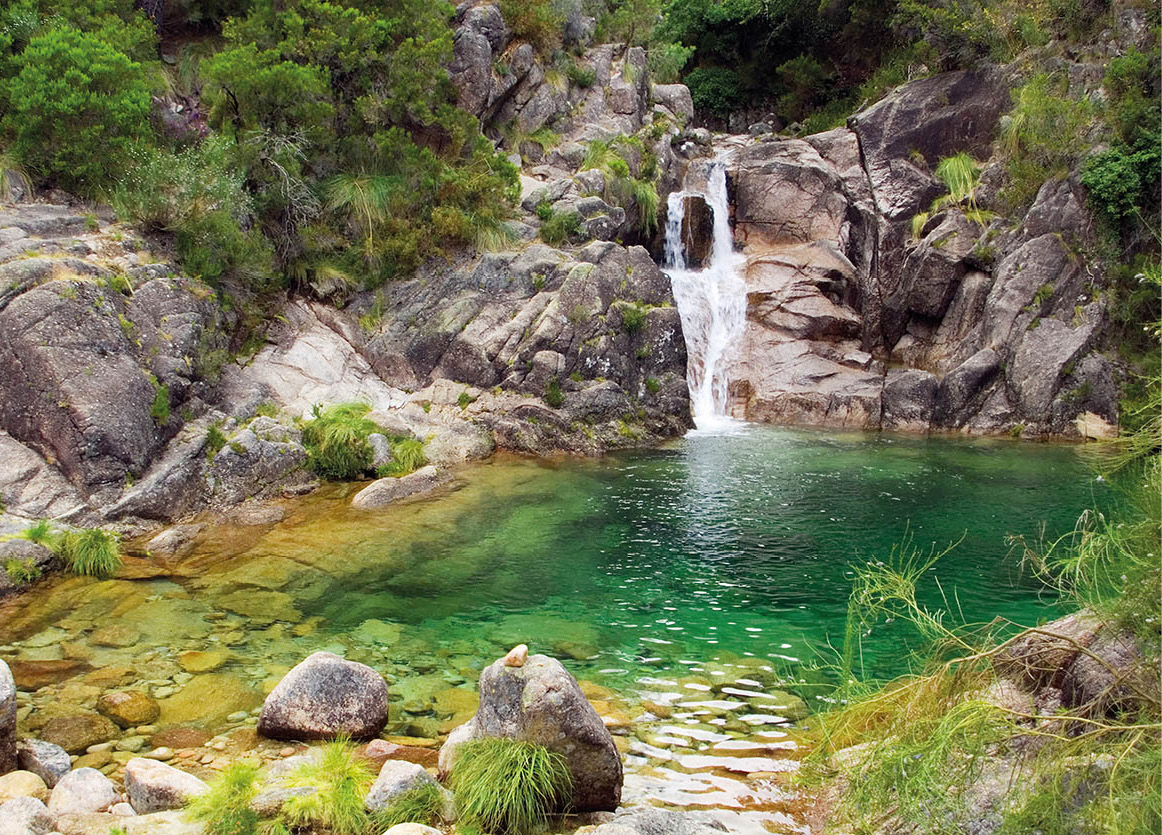
Waterfall in the Peneda-Gerês National Park.
Dreamstime.com
Mountain life
Rolling granite mountains, safe refuges in ancient times, dominate the north. Many settlements from those early days remain even today. Here residents eke out an existence in a harsh environment using tools (adapted for their own needs) which have hardly changed over the centuries.
Although most of the mountain areas are lightly populated, there is an area of near-wilderness tucked away on the northern border of the country. Recognised as a sanctuary for wildlife and valued for the traditional way of life that persists in the villages on the fringes, the Parque Nacional Peneda-Gerês area, covering 720 sq km (278 sq miles), was opened in 1971. It is the country’s only national park although other areas of natural beauty have been designated natural parks and are also protected, but by less stringent regulations.
Most of the highest peaks in the northern mountains lie within the park. Many of these exceed 1,300 metres (4,265ft), with Nervosa reaching a height of 1,545 metres (5,070ft). But although this region is the most mountainous in the country, it is not home to the highest peak of all. This distinction is reserved for the Serra da Estrela (Mountain of the Stars), an isolated, majestic mountain range in the centre of the country, which rises from the plains of Alentejo. Here, Torre, at 1,993 metres (6,539ft), marks the summit of Portugal. This area, too, enjoys protection but as a natural, not a national, park.
Geology
Considering its size, Portugal has remarkably diverse geology. Ancient crystalline rocks of granite and gneiss predominate in the mountainous regions, often presenting a landscape of grey rounded hills and steep valleys. For many inhabitants, it is the only natural building material available and they have perfected the tools and ways to work this material to an art form. Granite is a hard material but it has just enough malleability to make it workable. The evidence is all around, especially in the north. Farms, churches, water mills and fencing posts for the vines are all solidly constructed from granite.
Limestone and marble are found in the central region, especially near Évora, where it is mined commercially, and near Coimbra. The latter is particularly valued by sculptors, who have used it extensively. There is another significant limestone region, now protected as the Parque Natural das Serras de Aire e Candeeiros (for more information, click here), an area riddled with deep caves, three of them open to the public.
The Story of Maize
The introduction of maize in the 16th century proved a lifeline for the people of the hill villages, for here was a crop they could adapt to their own situation. Land around the villages was pressed into use for maize and animals were moved to still higher pastures for the summer. More changes were demanded to store the crop and grind the corn. This resulted in granite-built stores perched on mushroom-shaped legs, espigueiros, as seen at Soajo. Water provided the power for grinding the corn. Water mills, again built of granite, were erected in profusion, often with the water of a single stream powering a succession of mills.
River communities
Many of the rivers arising in the mountainous interior on the western side of the Iberian peninsula flow to the Atlantic through Portugal. In fact, only one, the Mondego, is truly Portuguese, rising in the region of Serra da Estrela and flowing into the sea at Coimbra. Some of these rivers were once navigable, allowing boats access deep into the countryside. Early settlers were not slow to use the Rio Guadiana in this way to penetrate inland in search of metal ores. Mértola in Alentejo developed as a port under the Romans, to ship ores down the Guadiana from nearby São Domingos, and there are significant remains of the port area to be seen.
The Romans were overwhelmed by the beauty of the Rio Lima in the north. This, for them, was the Lethe, the mythical River of Forgetfulness. This meandering river has created a fertile valley as beautiful as any you’ll see in Portugal, where productive farming has been practised for centuries. In modern times, the Rio Douro has played a significant role in the development of the port-wine trade. Good roads now penetrate the area but at the height of the port trade, all the wine had to be shipped down this difficult and dangerous river.
Perhaps the largest remaining river community is Lisbon itself, on the shores of the Rio Tejo (Tagus). The mouth of the Tejo proved a natural harbour offering safe anchorage to early traders. The prosperity of Lisbon has barely faltered throughout the ages.

The Douro River plays a major part in Porto’s port industry.
Lydia Evans/Apa Publications
Coastal life
With 832km (516 miles) of coastline, it is not surprising that the Portuguese are people of the sea. Fishing has sustained them over the centuries, providing an industry which has grown large, especially through cod fishing, yet also remained a small local activity. The coast is still littered with villages that rely heavily on reaping the sea’s harvest, and especially on the sardine, which keeps many small fishermen in business. Tuna fishing is another sector that grew to massive proportions. Shoals of tuna migrate along the southern shoreline towards spawning grounds in the Mediterranean. Floating traps were used to catch the fish and fishermen were on hand to complete the job, but over-fishing led to a decline in numbers and the industry collapsed.
Fish (there is reckoned to be more than 200 species off these shores) is not the only commercial product. Algarve has produced salt from ancient times; the Romans salted fish here to export back to Rome, and there are still saltpans in operation. Seaweed for fertiliser is now less of an industry at Aveiro than it once was. Here, specially shaped boats, moliceiros, were used to collect seaweed from the extensive system of lagoons in the area.
The magnificent beaches adorning much of the coastline are now the basis for another important industry: tourism.

Beach flora.
Lydia Evans/Apa Publications
Flora
With so many different habitats, climates and microclimates in this hugely diverse country, the flora responds with equal diversity. Many species simply reflect the climatic influence of the region. Certain erica heaths, green lavender (Lavendula viridis), and ulex species (gorse) typify western Atlantic plants and are found almost exclusively in the far west of the country. They can coexist with Mediterranean cistus species. Algarve offers the best display of Mediterranean flora, including wild orchids, like the bumblebee orchid (Ophrys bombyliflora) and the yellow bee orchid (Ophrys lutea).
Narcissus is associated with the Iberian peninsula and many are endemic, although some are found throughout the Mediterranean. Portugal has its fair share, from the diminutive jonquil, Narcissus gaditanus, to more popular garden species like N. bulbocodium and N. triandrus.
Fauna
Wild boars are one of the largest mammals roaming Portugal. Their foraging marks can be seen in many parts of the country, from the golf courses of Algarve – much to the fury of the green keepers – to the inland forests. Boar hunting is a form of tourism Alentejo is keen to develop. The best wildlife sanctuary is the Parque Nacional Peneda-Gerês, in the north (for more information, click here). Brown bears have not been seen for centuries but there are still some wolves, and plenty of beech martens, deer, badgers and otters.
Birdlife is particularly rich in some areas, especially around the saltpans in Algarve, where some 300 species have been recorded. Around Lisbon 200 sq km (77 sq miles) of the Tejo estuary are protected as one of the most important wetland areas in Europe. The west coast estuaries and wetlands are situated on some of the major migratory routes, so spring and autumn are particularly rewarding for ornithologists. Sadly, in some areas years of uncontrolled hunting have significantly reduced wildlife.
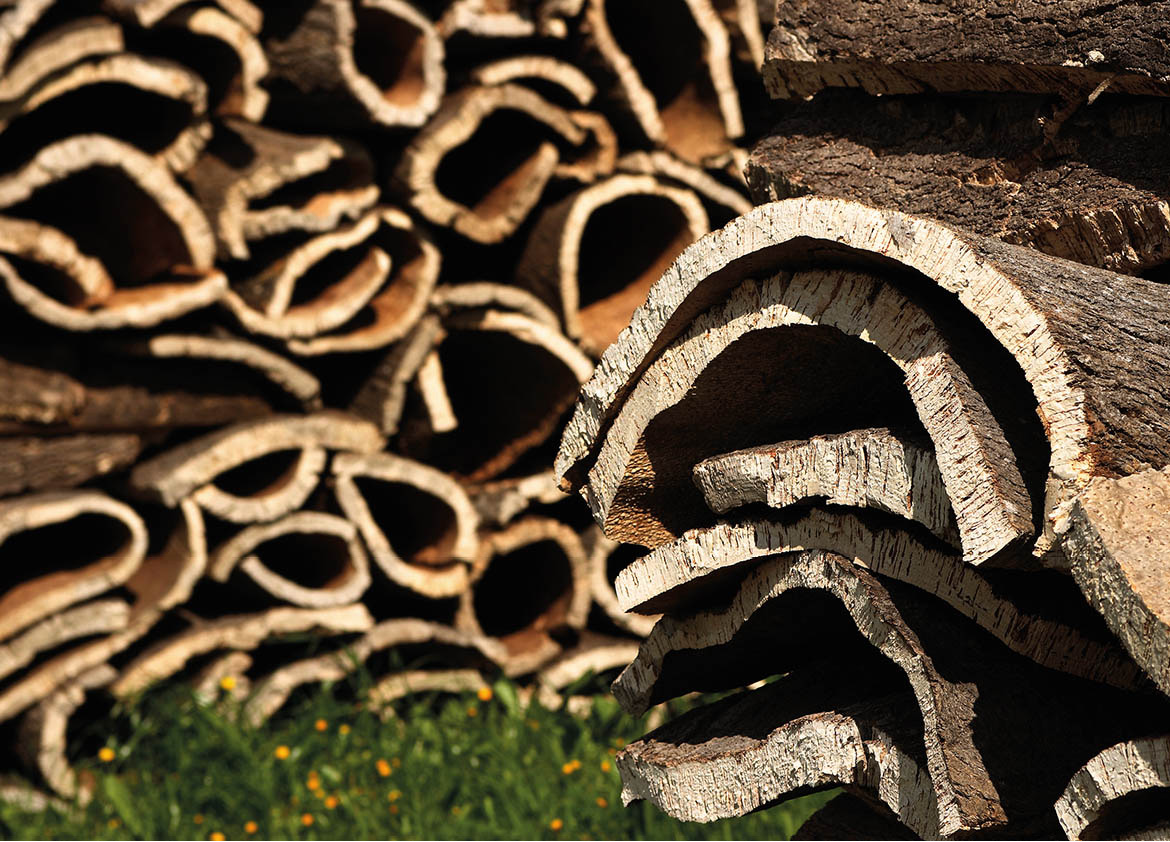
Cork bark drying in the sun.
Dreamstime.com
Trees of life
Forestry in Portugal is big business, with over one-third of the country, some 3 million hectares (7.5 million acres), under forest. Pine, said to be of use from cradle to grave, is used to produce timber for furniture and construction as well as resin for pitch and turpentine. Pine accounts for around 40 percent of the country’s wooded land. Pulp, used to manufacture paper and cardboard, is economically the most important woodland product. The Australian eucalyptus was introduced in 1856 for the paper industry, but its future is now in the balance. Environmentalists and farmers both oppose further plantations on the grounds of its destructive influence. Not only are eucalyptus rapacious in their demand for water, but they provide poor natural habitats and their litter is so slow to decompose that it further inhibits naturally occurring cycles within the soil.
The almond and the carob are indigenous to Algarve, the latter bearing long wizened beans that yield a fine variety of oil.
One major problem is forest fires, which cause widespread devastation annually, ruining huge tracts of forest land.
The Cork Industry
About half the cork in the world comes from Alentejo. The cultivation of cork is not for the impatient: there’s a wait of 25 years before the first crop is stripped from the trunk, and a further decade before the next harvest. Cork is a labour-intensive industry, as machines cannot duplicate the expertise of the men who strip bark from the trees, although the punching out of corks and stoppers is increasingly mechanised. Although plastic corks and screwtops are becoming popular for wine bottling, these artificial products have yet to make any significant impact on the Portuguese cork industry.
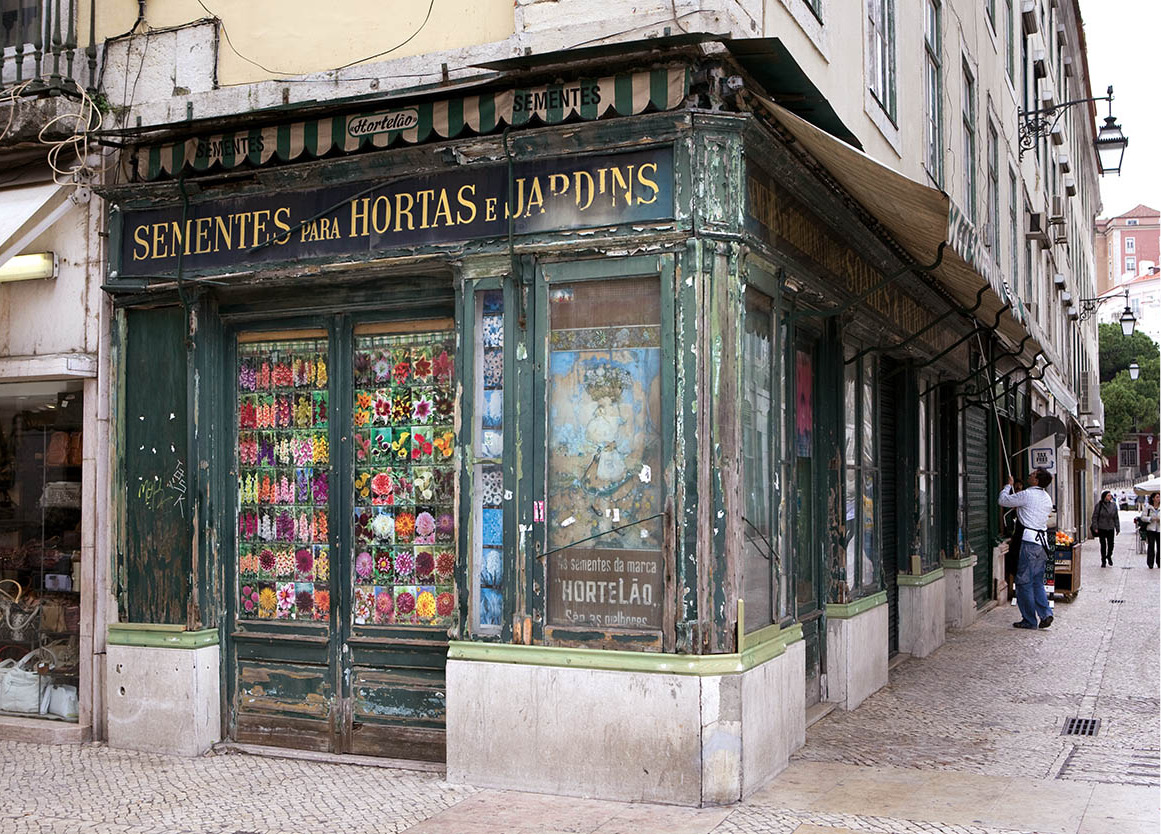
A seed shop in Figueira.
Lydia Evans/Apa Publications
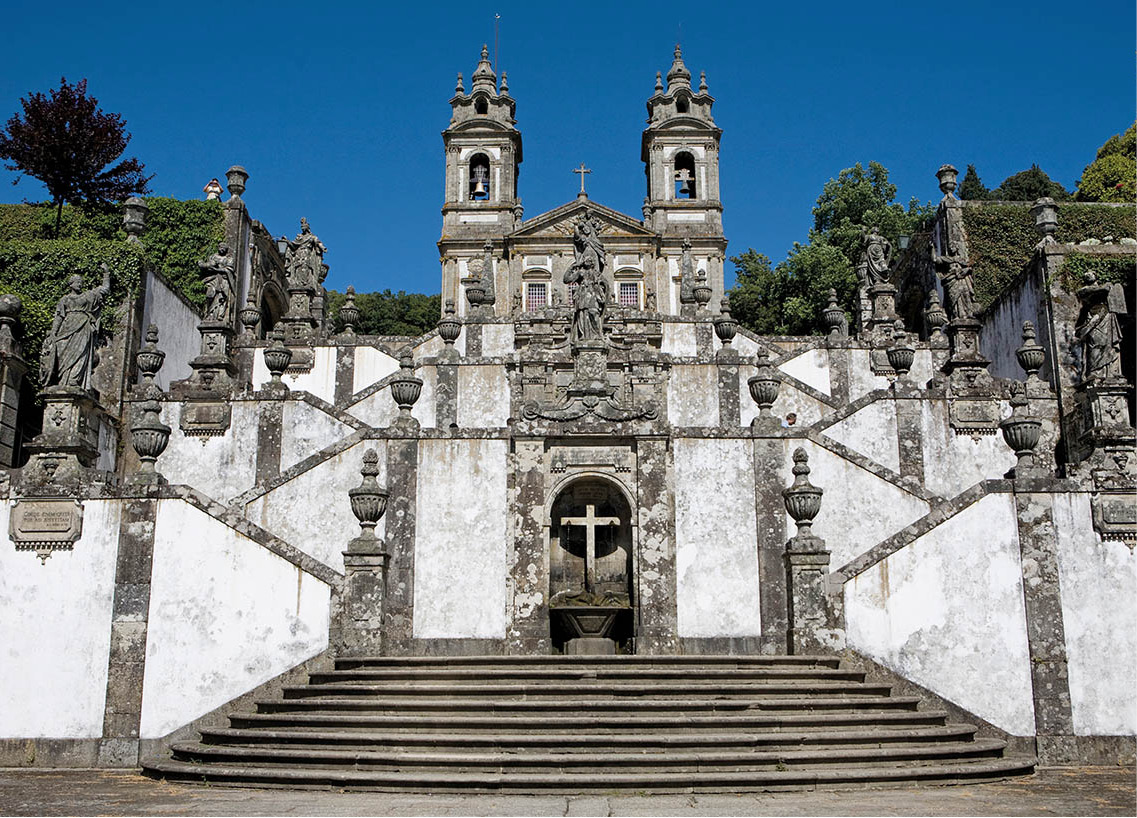
The stairway to the church of Bom Jesus do Monte, Braga.
Lydia Evans/Apa Publications

Street decorations in Tavira.
Lydia Evans/Apa Publications