
Portuguese Art Through the Ages
From rock paintings via neoclassicism to Modernist masterpieces, the country’s museums, galleries and churches cover the artistic spectrum.
Portugal has a rich collection of artworks spanning the centuries, from prehistory to modern times. In terms of masterpieces from more recent times, the 15th century was the first great age of Portuguese painting. Almost no works from the 12th to the 14th centuries have survived, although frescoes were certainly painted in churches. One interesting, rare example of an early 15th-century fresco is a surviving fragment from a secular painting – the allegory of justice entitled O Bom e o Mau Juiz (The Good and the Bad Judge), in a Gothic house in the town of Monsaráz.
Pedro and Inês’s Tombs
While little surviving painting predates the 15th century, some lovely pieces of sculpture do. The crowning glory of 14th-century funerary sculpture is the tombs of King Pedro and his lover, Inês de Castro at Alcobaça (for more information, click here for their dramatic story).
The sarcophogi do justice to the tale: the sculptor is unknown and the influences are hybrid, but the naturalistic detail and rich symbolism are unsurpassed. Inês, surrounded by angels, is crowned queen in death as she never was in life. Pedro’s tomb displays a superb rosette, believed to symbolise a wheel of fortune, representing life’s vicissitudes.
The most notable surviving religious fresco of the same period is the Senhora da Rosa in the sumptuous church of São Francisco in Porto. It has been attributed to an Italian painter, António Florentino, who, it is thought, may also have painted the portrait of João I now at the Museu Nacional de Arte Antiga in Lisbon.
By far the most brilliant contribution to painting during this period was the introduction of Flemish-influenced painted altarpieces called retables (retábulos in Portuguese). In 1428, the Flemish master Jan van Eyck was invited to the court of João I to paint a portrait of the Infanta Dona Isabel, future wife of Philip the Good (Philippe le Bon, 1396–1467), Duke of Burgundy. The Netherlands were, at the time, under the control of the dukes of Burgundy, who were renowned for their excellent taste in art. When the Flemish artists turned from illumination to the painting of altarpieces, they added to their own love of realistic detail the Burgundian passion for gemlike decoration.
Portugal is also home to Europe’s largest collection of palaeolithic rock paintings, discovered only in the 1990s, and now in a protected site close to Museu do Côa in the Douro (for more information, click here).
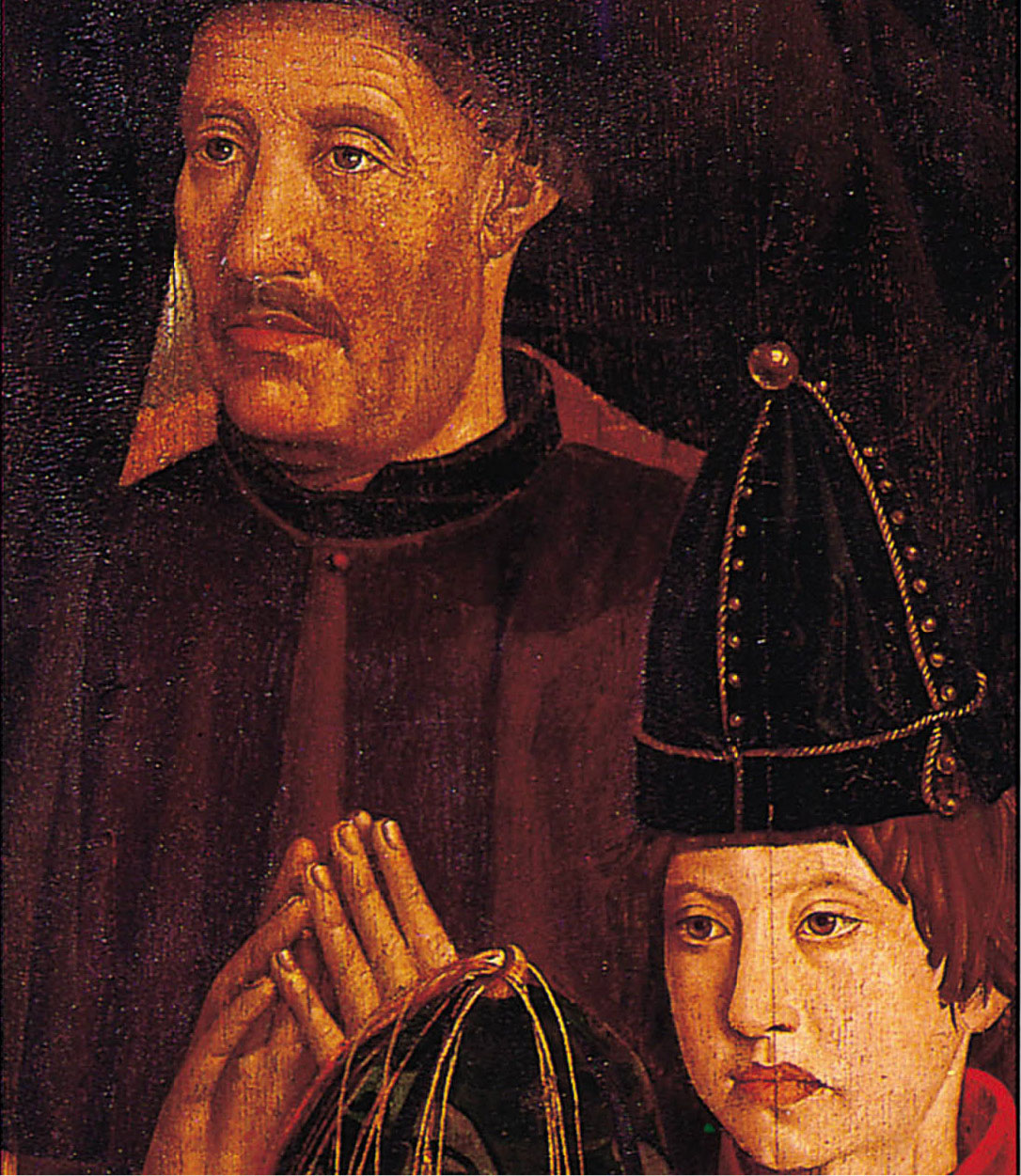
Detail from Nuno Gonçalves’ The Adoration of St Vincent polyptych, showing Henry the Navigator and the future João II.
Museu Nacional de Arte Antiga
The polyptych of St Vincent
The most outstanding retábulo of the 15th-century Portuguese School is the polyptych of St Vincent attributed to Nuno Gonçalves, in Lisbon’s Museu Nacional de Arte Antiga. The mystery that enshrouds this work has increased its aura. The panels were lost for centuries, and there are conflicting accounts of their reappearance at the end of the 19th century. No sooner were they cleaned and hung publicly than an angry controversy arose as to the identity of their creator as well as of the figures depicted. A touch of drama was added when one eminent scholar committed suicide after a dispute concerning two documents that radically altered the direction of the research. The documents were later proved false.
The theme of the polyptych has also given rise to dispute. Some see in it the veneration of the Infante Santo Fernando, uncle of Afonso V, who died at the hands of the Moors. But nowadays it is generally thought to represent the adoration of St Vincent, patron saint of the kingdom and of the city of Lisbon. The important point of departure was the identification of the Infante Henrique (Henry the Navigator) to the left of the saint in the third panel from the left.
The panels, from left to right, are known as the Panel of the Monks (of the Cistercian Order), the Fishermen, the Infante, the Archbishop, the Calvary and finally, the Relic Panel.
The real genius and originality of the work lie in the exquisiteness of the portraiture: the masterful attention to realistic detail as well as the psychological dimension. It appears to be the visual representation of King Afonso’s dreams of conquest and of the magical world of Prince Henry’s navigations, blessed by the patron saint of the kingdom.

Another detail from the polyptych, showing St Vincent and the members of the Regnant House.
Scala
The Flemish influence
During the reign of João II (1481–95), when voyages of discovery occupied the energies of the nation, there was a lull in painting activity. However, with the discovery of the sea route to India and the consequent prosperity, painted retábulos again became a dominant form of expression. At the end of the 15th century, Portugal was one of the largest importers of Flemish paintings. Many of the altarpieces in Portuguese churches were Flemish, and some can still be seen today, such as the Fons Vitae at the Misericórdia church in Porto.
Nevertheless, Portuguese painting maintained local features, giving rise to the “Luso-Flemish” style. Manueline painting evolved during the reign of Manuel I (1495–1521), although the style is more closely associated with architecture (for more information, click here). It has been characterised by features such as monumentality, a fine sense of portraiture, brilliant gem-like colours, a growing interest in the naturalistic depiction of both architectural and landscape backgrounds, and an increasing preoccupation with expressive detail. Sculpture exploded in a frenzy of detail during this period, celebrating the sea and covering buildings in a barnacle-like frenzy of exuberant detail.
During this period painting was not the expression of an individual sensibility, but more often the collaborative effort of a master and his assistants. Attribution, then, is extremely difficult, and often paintings are known as the products of particular workshops rather than artists. The two principal workshops were those of Jorge Afonso in Lisbon, and of Vasco Fernandes in Viseu.
Afonso was appointed royal painter in 1508: documents identify various projects with which he and his workshop were involved, but none shows his direct responsibility, although he is believed to have painted some of the panels in the rotunda of the Convento de Cristo in Tomar.

Detail from the sepulchre of Inês de Castro.
Lydia Evans/Apa Publications
Grão Vasco
Vasco Fernandes, better known as Grão (the Great) Vasco, is undoubtedly the most celebrated regional Manueline painter. For many years, the myth of Grão Vasco obscured his real work in a plethora of attributions – he was thought to be the author of Gothic and Renaissance paintings, although a single lifetime would not have sufficed for so large an output. But he was responsible for the altarpiece originally in Lamego Cathedral (now in the Museu Regional in that town), dated 1506–11, as well as the one for the Viseu Cathedral of a slightly earlier date.
The pronounced stylistic differences between the two works confused scholars for some time, but it is now assumed that Flemish assistants at Lamego account for the differences. The panels for the chapels of Viseu Cathedral, of which those of the Calvary and St Peter are the most renowned, are also attributed to Grão Vasco, but these date from his mature phase (1530–42).
Noteworthy for their emotional strength and drama, these works are also characterised by a denser application of paint than that used by the Flemish masters. Furthermore, the faces of the Portuguese works tend to be less stylised, more expressive, and, it would seem, often drawn from specific local models, just as the landscape backgrounds are drawn from the Beja region rather than being imaginary or purely symbolic.
The altarpiece and the panels for the chapels in Viseu Cathedral, painted by Grão Vasco, are now in the museum that bears his name.

King Sebastian, by Cristovão de Morais.
Museu Nacional de Arte Antiga
The 16th and 17th centuries
As in architecture, the Renaissance, the “rebirth” of art based on classical models, was resisted by Portuguese artists and mainly represented by those from abroad. Mannerism employed many elements of Renaissance classicism but the sense of an ordered, harmonious whole gives way to an exaggeration of those defining elements. The most characteristic feature of this style is a certain elongation, together with unexpected highlighting of seemingly incidental sections of a work.

A detail from Calvário by Gregório Lopes.
Museu de Evora, Evora
The 17th century saw the flourishing of portrait painting in Portugal as elsewhere in Europe. Perhaps the most celebrated portraitist of the period was Domingos Vieira (1600–78), known as “the Dark” to distinguish him from his contemporary Domingos Vieira Serrão. His nickname stemmed from his predilection, in works such as the portrait of Isabel de Moura (in the Museu Nacional de Arte Antiga in Lisbon), to make dramatic contrasts between the deep, velvety backgrounds and the rich, creamy whites of ruffs and headgear.
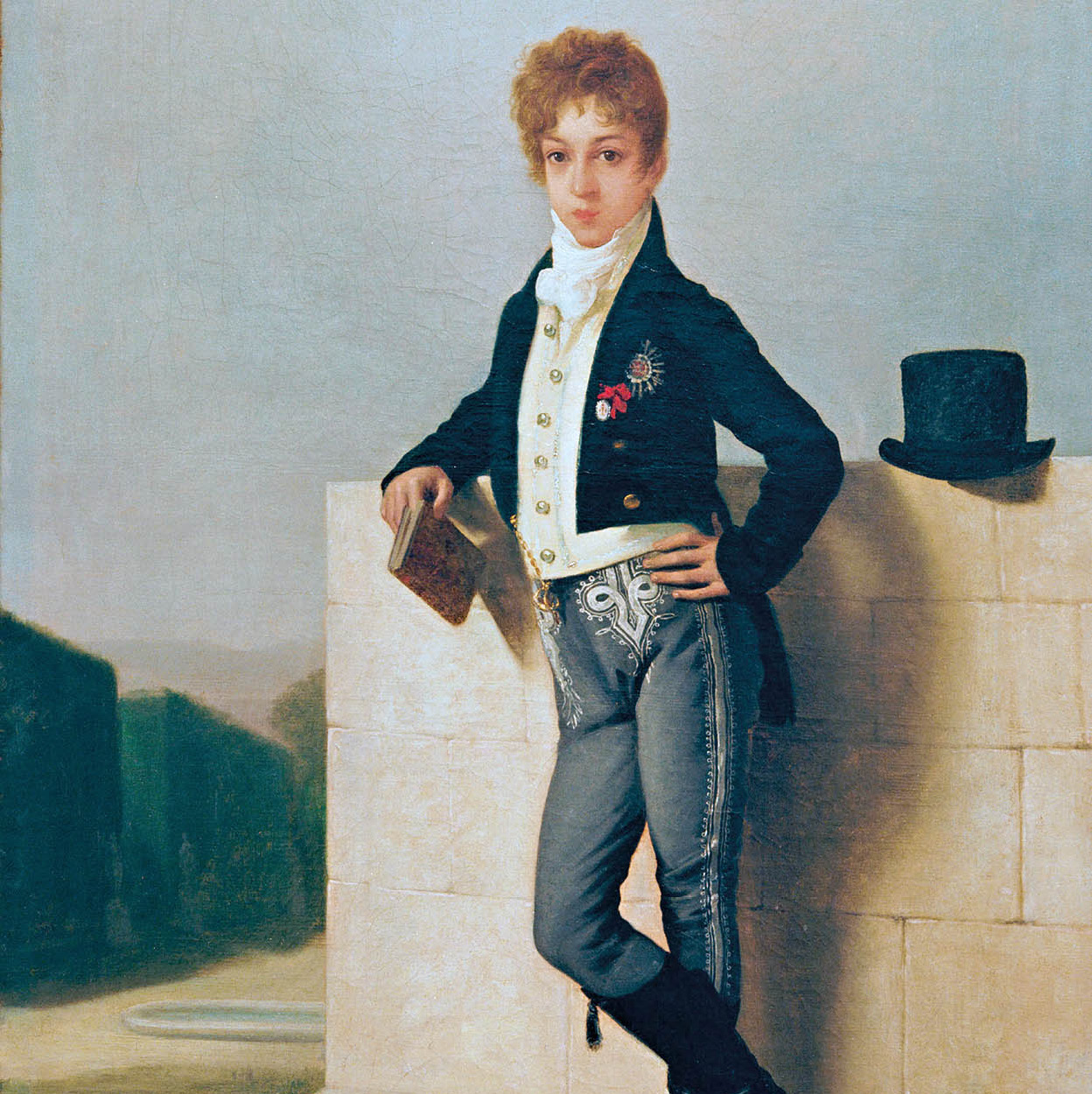
An early nineteenth-century portrait of entrepreneur Joaquim Pedro Quintela by Domingos António Sequeira.
AKG Images
Neoclassicism
During the 18th century, two outstanding painters emerged: Francisco Vieira, known as Vieira Portuense (1765–1805), and Domingos António Sequeira (1768–1837). The two met in Rome, which was the essential venue for any serious artist. Vieira Portuense also spent some time in London, where the classicising Roman influence was tempered by that of Sir Joshua Reynolds (1723–92).
The work of Sequeira is a study in the transition from neoclassicism to Romanticism, a rare example of a single life encapsulating two eras. He was nominated court painter in 1802 by João VI, and was commissioned to provide paintings for the rebuilt Ajuda Palace. Political turbulence forced Sequeira to emigrate to France, and then to Italy, where he died.
His work can be divided into three stages: the first, largely academic and neoclassical in inspiration, corresponds to the first period he spent in Rome, and to his work as a court painter. The second stage (1807–23), which includes the Alegoria de Junot (in the Soares dos Reis Museum, Porto), is stylistically freer and more individualistic, with Goyaesque contrasts of dark and light, rapid brushstrokes and sudden bursts of luminous white.
The final phase of Sequeira’s work corresponds to his visits to Paris and Rome. These late works show great painterliness and luminosity. The four cartoons for paintings in the Palmela collections, now in the Museu Nacional de Arte Antiga in Lisbon, are some of his most inspired, mystical works.
Romanticism
Romanticism was a form of escapism into medieval, oriental and mystical realms. Heroic, religious and ceremonial works gave way to more intimate and personal pieces. The mid-19th century also corresponded to the rise of the middle class. Courtly art had breathed its last. The liberal revolutions questioned the long-upheld notion of history as the unfolding of a predetermined order, in favour of a relativism which heralded modern times. Similarly, the idea that art expresses timelessly valid principles gradually gave way to the subjectivist and individualist notions which continue to hold sway in art today. Sequeira represented the mystical, religious side of early Romanticism. With his death, the movement in Portugal underwent a change: nature became the new religion.
The humbling of man before the larger, inscrutable forces of nature was already a contemporaneous theme elsewhere. Lisbon-born Tomás José da Anunciação (1818–79) became the foremost romantic landscapist of his generation, along with Luís Cristino da Silva (1829–77).
Not surprisingly, portraiture not only became the art form of the bourgeoisie par excellence, but it also gave increasing emphasis to the sitter’s inner life. In Miguel Lupi’s Sousa Martins’ Mother, painted in 1878 and now in the Museu Nacional de Arte Contemporânea in Lisbon, the illumination of the hands and face, the most expressive parts of the body, conveys a sense of pensive dignity.
At the end of the 19th century, Romanticism began to give way to naturalism in both landscapes and portraits – although the difference between the two styles was largely one of emphasis, and António Silva Porto and José Malhoa were the foremost naturalist painters. But in stark contrast to their luminous outdoor scenes, Columbano Bordalo Pinheiro (1857–1929) continued in the tradition of studio painting. Columbano, as he is known, is considered the Grand Master of Portuguese 19th-century art. He studied under Miguel Lupi at the Academy of Fine Arts (founded in 1836), and then spent three years in Paris.
His brother, Rafael Bordalo Pinheiro, was perhaps even more popular in his day. A celebrated ceramicist, he was also known for his biting political caricatures.
Modernism
The artistic ferment that gripped much of Europe and America in the first decades of the 20th century arrived late, or in a very diluted form, in Portugal. The political turmoil that ended the monarchy in 1910 did not provide a propitious context for an artistic revolution, and there was then a window of only some 20 years before Salazar’s authoritarian regime closed the door to all external cultural influences.
But some ideas took root. In 1911, the Museu Nacional de Arte Contemporânea was founded in Lisbon, and the first Salon of Humorists represented a move away from conventional salon painting. One of the most daring and interesting of this generation of painters was the Cubist Amadeo Souza-Cardoso, whose premature death in 1918 was a great loss. Many of his works are now in the Centro de Arte Moderno at the Fundaçao Calouste Gulbenkian in Lisbon, and some can be seen in a museum in his home town of Amarante. Another star was José Almada Negreiros (1893–1970), one of the most charismatic and energetic cultural figures in Portugal. His early caricatures drew the attention of the poet Fernando Pessoa, who became his friend, and whose posthumously painted portrait now hangs in the poet’s old home, with a replica in the Fundaçao Calouste Gulbenkian. One of Negreiros’ most important commissions was for the frescoes at the port of Lisbon, in 1943–8. His last major project was the mural for the lobby of the Gulbenkian Foundation.
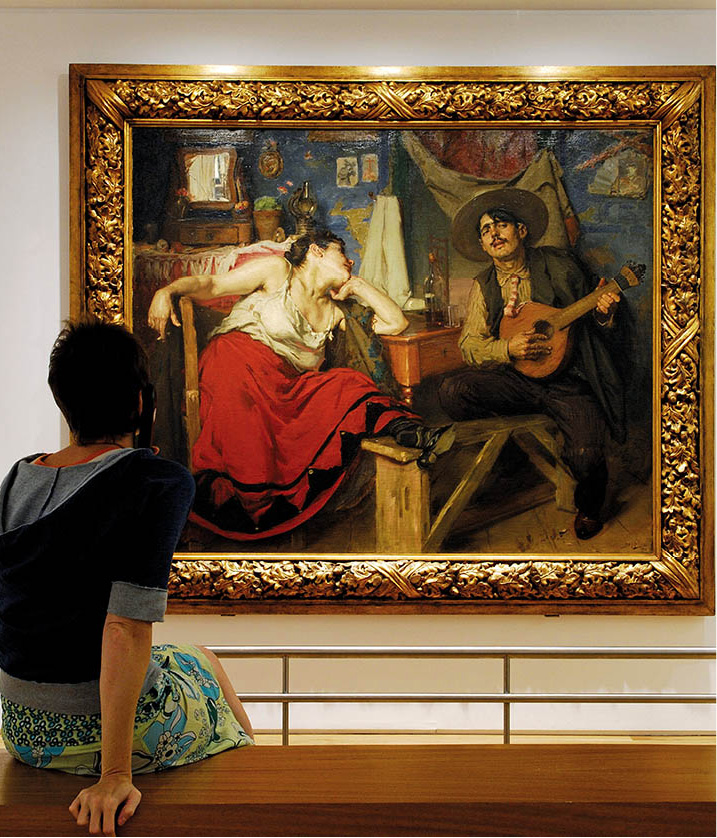
Admiring a painting in Lisbon’s Fado Museum.
Corbis
The military regime, initiated in 1926 and led by António de Oliveira Salazar from 1932–68, prevented contact with outside stimulus, so all the artistic and intellectual exchange necessary to keep the arts alive had to be clandestine during these years. The return to democracy in 1974 (six years after Salazar’s death) breathed new energy into the arts and an outburst of fervent activity echoed the sense of exhilaration after long years of repression and censorship.

Paula Rego in her London studio.
Rex Features
Among contemporary artists, Paula Rego is one of the brightest stars (see box). Another is Helen Almeida, the conceptual artist daughter of Portuguese sculptor Leopoldo de Almeida (whose works include Lisbon’s Monument to the Discoveries).
Paula Rego
Paula Rego’s art calls to mind grotesque fairy tales, psychoanalytic images, and the mysteries of childhood. Her paintings present a kind of magical realism that is uniquely recognisable, presenting a narrative and providing unsettling, intriguing subjects, such as apparently dysfunctional family relationships. Rego was born in Portugal, and grew up there during the Salazar years, but was later sent to a finishing school in England, then went on to study at the Slade. Despite having lived in London since 1976, where her work is widely exhibited, in her paintings she always seems to return to the place of her childhood.