
Estoril and Cascais
Close to Lisbon, these neighbouring resorts are well connected to the city, convenient for exploring as far north as Sintra, and also a delight for windsurfers and golfers.
Main Attractions
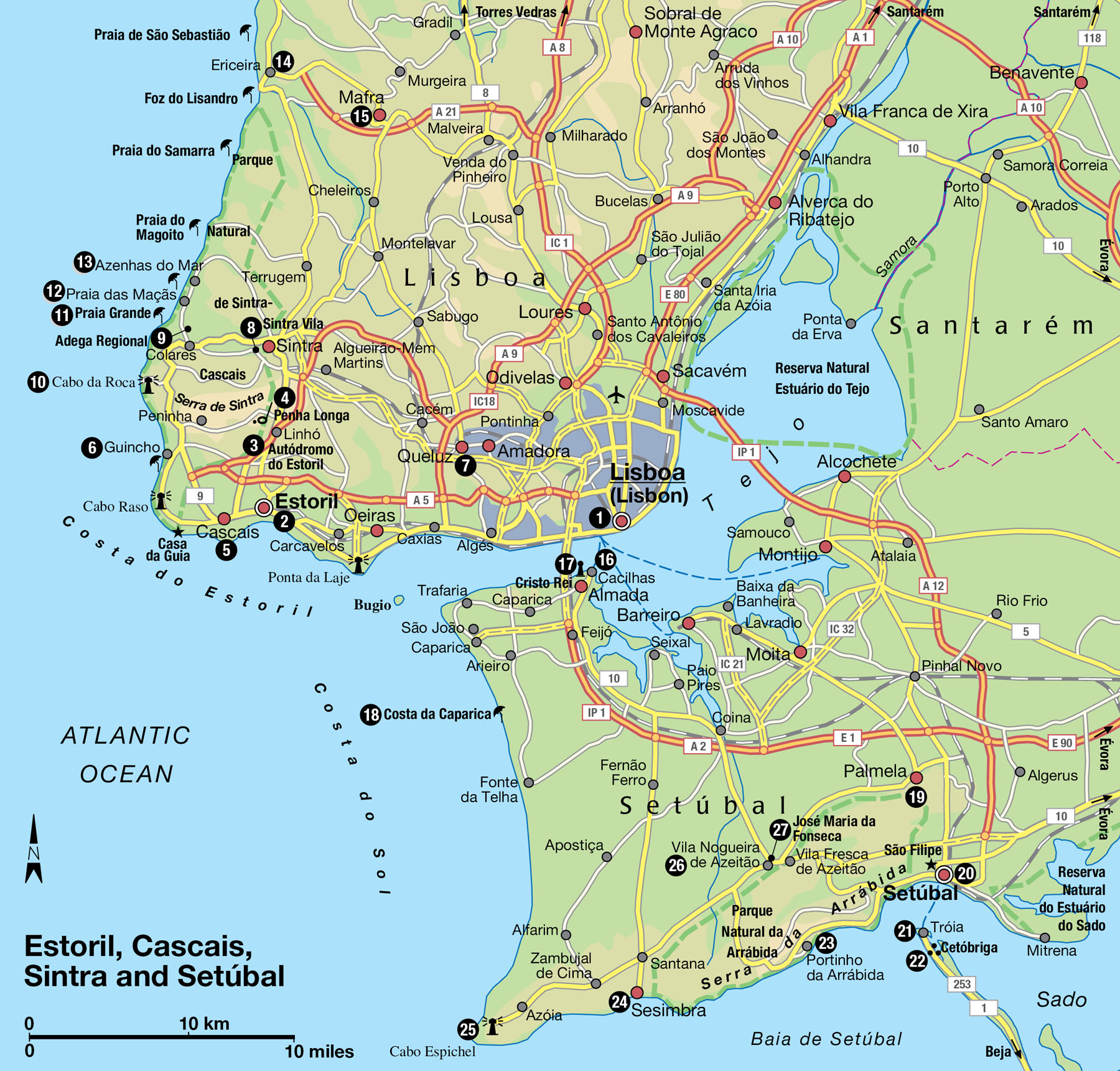
Handily located for Lisbon 1 [map], south-facing Estoril and Cascais are the most significant coastal resorts outside Algarve, although neither is especially large. They grew to prominence as a playground for Lisboetas, but modern times have witnessed a role reversal: these resorts and their environs are now dormitories for wealthy Lisbon commuters, and are the preferred places to stay for many visitors who like a tranquil base from which to explore the capital.
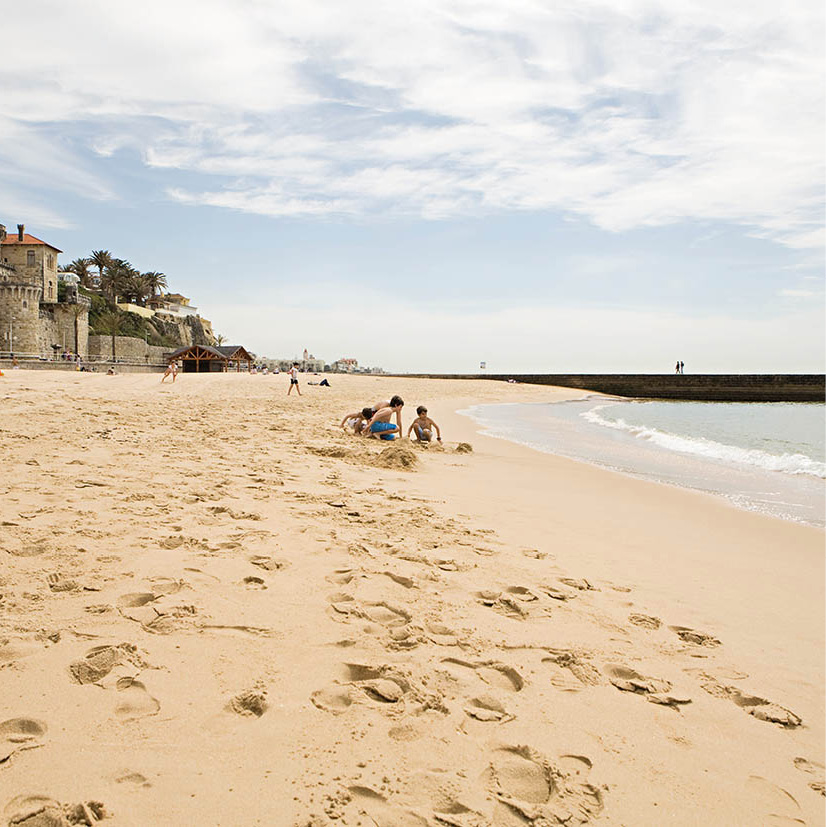
The sands of Tamariz Beach.
Lydia Evans/Apa Publications
West along the coast
The electric train offers the quickest and most convenient way of travelling the 29km (18-mile) distance between Cascais, Estoril and Lisbon. It arrives in Cais do Sodré station on the west side of the city, close to the riverside, where the green (Verde) Metro line begins. Some of the mainline trains also stop at Belém, which is convenient for visiting one of the capital’s most interesting areas. The train service between Lisbon and Estoril and Cascais is frequent, and the journey only takes about half an hour.
Driving, you can take the inland A5 route, which is faster, or the slower but more scenic Marginal (N6) route along the riverside out of Lisbon, which leads through Belém to the elegant hillside neighbourhood of Restelo, the location of many embassies and diplomatic residences. Alges is the first town outside the city limits.
The centre of Cascais.
Lydia Evans/Apa Publications
A string of small riverside towns follows. Dafundo has several splendid old mansions standing in rather sad contrast alongside dilapidated rent-controlled housing. It also has the Aquário Vasco da Gama (http://aquariovgama.marinha.pt; daily 10am–6pm), a fascinating world of sea turtles, eels, barnacles and all kinds of fish; it has been open since 1898, although it is now rather eclipsed by the Oceanarium in the Parque das Nacões. Cruz Quebrada is the site of a stone-seated soccer stadium, while Caxias is known for its flower-decked villas, 18th-century gazebos and an infamous coastal prison-fort. In Oeiras you will find a fine 18th-century Baroque church, a lovely park, modern apartment blocks and an austere 16th-century fort and vintage car museum.
Just beyond lies the 17th-century fortress of São Julião da Barra, marking the point where the Tejo meets the Atlantic. Carcavelos has several moderate hotels and a broad sandy beach.
Elegant Estoril
And so to Estoril 2 [map], the first point of what has frequently been referred to as the Golden Triangle, and which includes Cascais and Sintra. A flowering, palm-lined, pastel-coloured resort, it first gained fame at the turn of the 20th century for its therapeutic spring waters. During World War II, Estoril became well known as the low-key haunt of international spies. Later, this corner of the Atlantic, with its mild weather and gracious lifestyle, became a home from home for dispossessed European royalty and for refugees fleeing the political upheavals after the war. Among the Triangle’s illustrious residents were former kings Simeon of Bulgaria and Umberto of Italy, and Bolivia’s ex-leader, Antenor Patiño.
With changing times, local aristocrats are selling or renting out their villas. More and more Portuguese and foreigners come to the Triangle to live, retire or keep summer homes. Estoril now has the atmosphere of a rather staid, if attractive, resort – a kind of up-market, rather more glitzy version of Eastbourne.
Estoril’s fine sandy Tamariz beach is attractively set with a touch of the picturesque, added by a castellated private house surrounded by palms at the eastern end. This Atlantic location been awarded a Blue Flag for cleanliness, as have Duquesa and Conceição nearby.
The casino in the heart of the town is a low, white modern building with immaculately kept gardens. In order to gamble here, you need to show a passport, driver’s licence or identity card to get in, and the minimum age limit is 18. Some people come to the casino just to see the show, usually a colourful international extravaganza, but it’s fun to keep an eye on the betting. As in all crowded venues, keep your valuables hidden. There is also an elegant dining room, an art gallery, a cinema and a bar.
Festivals and rallies
The Estoril Music Festival takes place in July. Concerts and recitals are held in Estoril Cathedral, Cascais Cidadela (fort) and other impressive settings. The International Craft Fair has become a major production, lasting throughout the months of July and August. Located near the railway station, the fair features arts and crafts, food, wine, and folk music performances from all over the country.
There is a lot to do in the way of sports in the Triangle. The Autódromo do Estoril 3 [map], the automobile race track located inland on the road to Sintra, used to draw large crowds for the Grand Prix Formula One races but the track fails to meet current safety requirements for Formula One racing. However, it now hosts the Portuguese motorcycle Grand Prix and the Superleague Formula, both of which are popular events.
Mild winters and summers tempered by cool westerlies provide ideal weather conditions for golf all year round. There are several courses on the north side of the Tejo and four within easy reach on the south. Penha Longa Atlantic 4 [map] (see box) is one of the best.
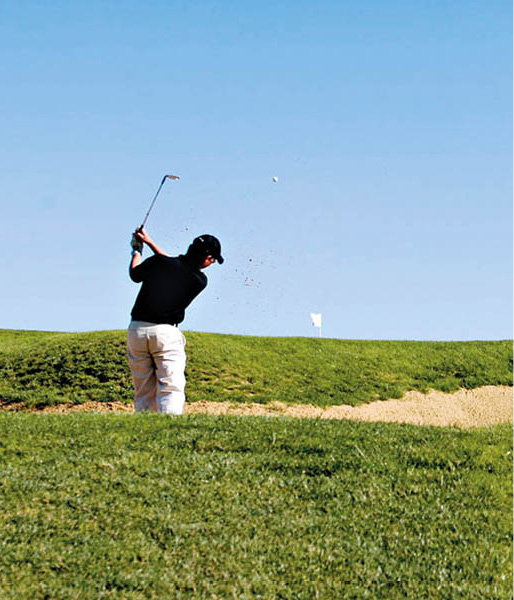
Golfing in Oitavos.
Turismo de Portugal
Golf in the Golden Triangle
The Estoril Golf Club’s course, on the outskirts of town, is one of the loveliest in Europe. It was laid out by McKenzie Ross on a hillside dotted with pine and eucalyptus groves. The smaller 9-hole Estoril-Sol Golf Course is located in a pine wood at Linhó near Sintra. Overlooking the Atlantic coast just west of Cascais is the Quinta da Marinha hotel and golf club. Designed by Robert Trent Jones, this attractive course, in a private 110-hectare (270-acre) estate, weaves through umbrella pines, water features and wind-blown sand dunes. Quinta da Beloura, designed by William Roquemore and opened in 1993, lies beneath the hills of Serra de Sintra. Six lakes provide golfers with plenty of watery challenges.
Penha Longa, built with Japanese finance, is more than a golf course; it is a country club with a whole range of sporting activities, and includes a five-star hotel. The 18-hole and 9-hole courses designed by Robert Trent Jones II embrace natural woodland and rocky outcrops. The complex is located between Serra de Sintra and the Atlantic. The Praia d’El Rey lies about an hour’s drive from Lisbon on the A8 motorway. It is a championship links course right by the sea, and here too there is luxury accommodation, tennis and other activities on offer, and a spa. (See Travel Tips for golf course contact details.)
Cascais: resort of kings
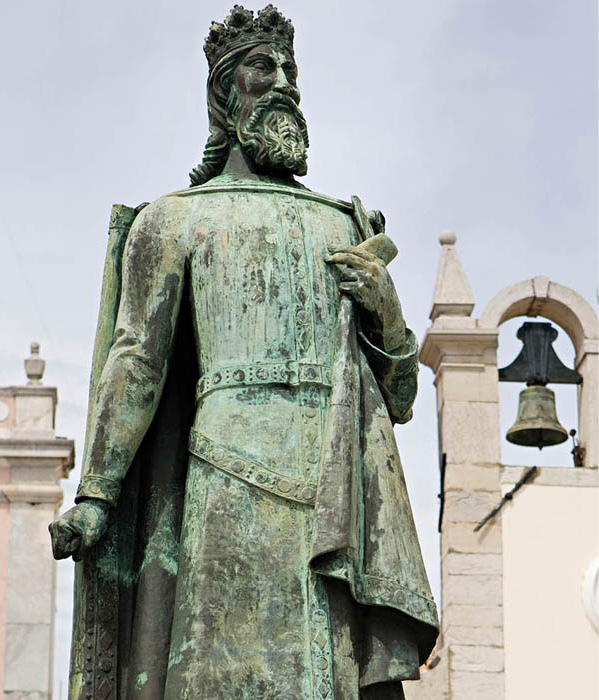
Once a royal resort, the attractive little town of Cascais 5 [map] is much livelier than its more sedate neighbour, although it still retains the laid-back atmosphere of a wealthy seaside suburb. In 1870, King Luís I established his summer residence in the 17th-century citadel on the Bay of Cascais. Before that, it was known only as a fishing port. Local people claim that it was a fisherman from Cascais, Afonso Sanches, who actually discovered America in 1482, and Christopher Columbus merely repeated the trip 10 years later and got all the glory. In 1580, the Duke of Alba attacked Cascais when Spain was laying claim to Portugal, and in 1589 the English arrived here to retaliate for the Spanish Armada’s 1588 foray. The fishing port still remains, with the comings and goings of the colourful fishing boats in the bay, the noisy nightly auction at the central fish market, and good shopping and restaurants.
Fact
Estoril and Cascais are joined by a pedestrianised promenade along the beach, which is a delight to stroll. The walk takes about half an hour without stops, but there are plenty of snack bars and restaurants along the way.
Around the port has grown a resort with all the vibrancy that Estoril lacks, and yet it has managed to avoid spilling beyond its original boundaries. Pedestrianised streets are paved with traditional black-and-white calçada blocks, re-creating dynamic wave patterns – you will spot the same paving in former Portuguese colonies such as Macau. A busy Wednesday market, where you can buy fresh fruit and vegetables as well as handicrafts, is repeated on a smaller scale on Saturday morning.
There are several old churches and chapels in Cascais, including the 17th-century Nossa Senhora da Assunção with its plain facade, lovely tiles and marble nave. It contains several paintings by the 17th-century artist, Josefa de Obidos.
On the outskirts of town, in an exotic garden, is the Museu-Biblioteca Condes de Castro Guimarães (Mon–Fri 10am–5pm, Sat–Sun 10am–1pm and 2–5pm). Housed in a candyfloss-pale, fairy-tale mansion – the former residence of the Conde de Castro Guimarães, who donated it to the people of Cascais on his death in 1927 – this museum displays 17th-century Portuguese silver, tiles and furniture, and some good 19th-century paintings, as well as prehistoric finds.
The Museu do Mar Dom Carlos (Tue–Sun 10am–5pm) is the best place to get a glimpse of the community’s past. It tells the lives of the fishermen and has many photographs of King Carlos, a keen oceanographer, who started the bathing season with his arrival here each September during the 1890s. The penultimate king of Portugal, Carlos was assassinated in Lisbon in 1908.
Dedicated to the renowned Portuguese artist Paula Rego, the Casa das Histórias Paula Rego (daily summer 10am–7pm, winter 10am–6pm; free) has a fine collection of her paintings, drawings and etchings.
There are also opportunities for horse riding around Cascais, at the Centro Hípico da Quinta de Marinha, inland from the beach at Guincho (for more information, click here).
Close to Cascais, the clifftop Casa da Guia has incredible views, some excellent restaurants, shops and more.
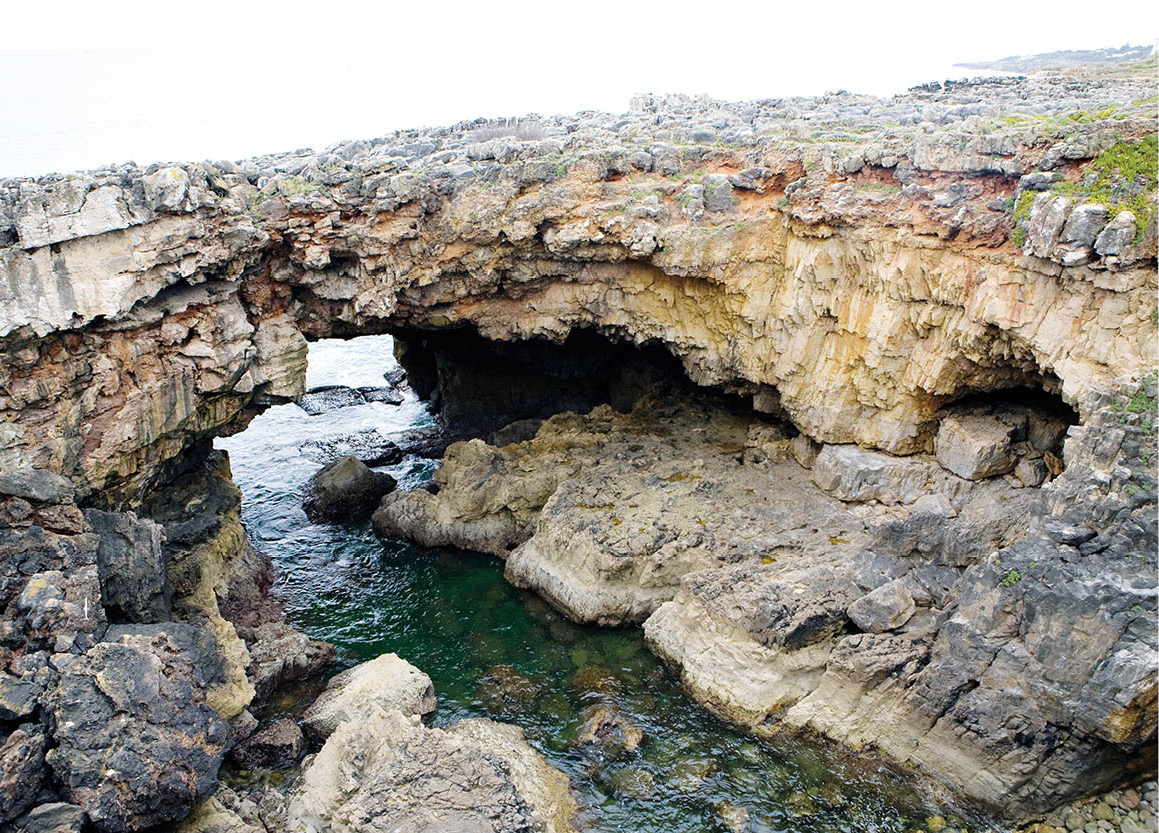
The cliffs of Boca do Inferno.
Lydia Evans/Apa Publications
The beaches
The main beaches lie between Cascais and Estoril; there is a small beach to the west, Praia de Santa Marta, but it is barely big enough for a game of volleyball. Take a short walk beyond, along the main road, and you will come to the Boca do Inferno (Mouth of Hell), a narrow inlet with arches and caverns. Waves crash into the inlet with some ferocity, especially when the Atlantic swell is running high.
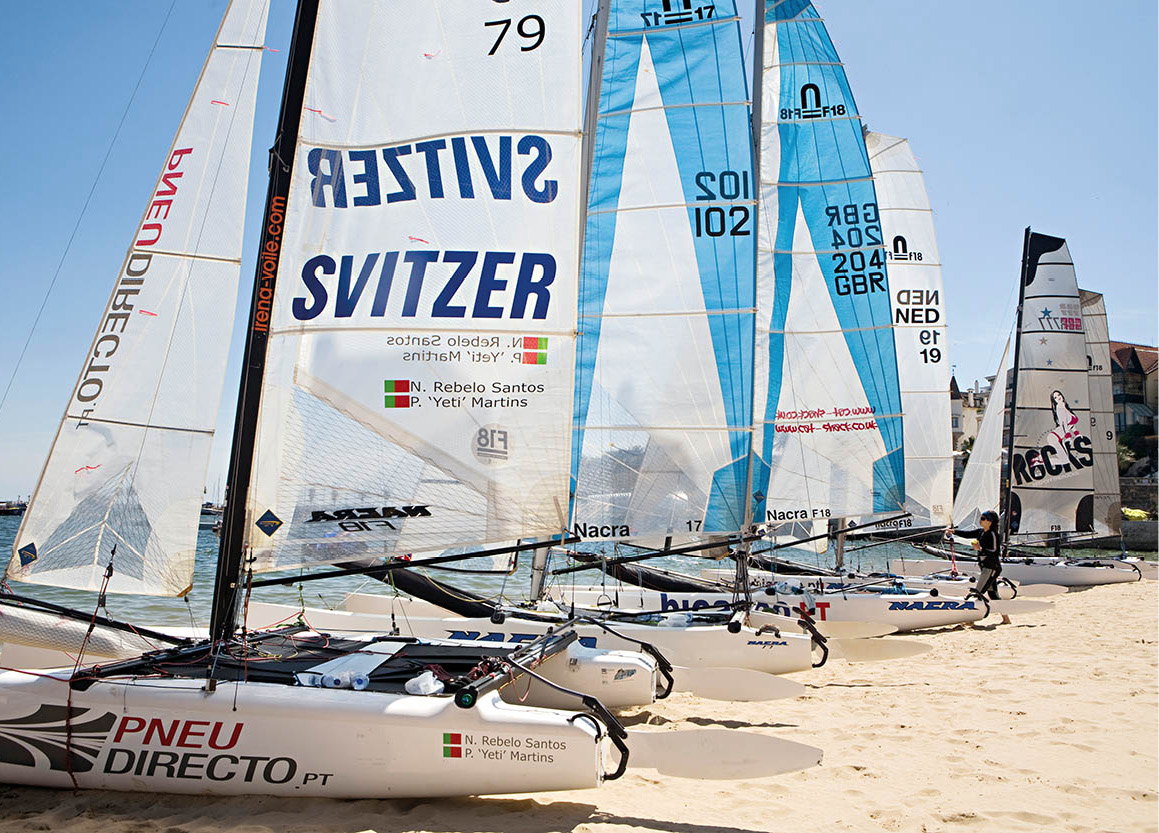
Sailboats on the Praia dos Pescadores near Cascais.
Lydia Evans/Apa Publications
Beyond here lies the rocky Atlantic coast. Lisboetas flock here at weekends to enjoy seafood lunches at several popular restaurants. Some also come to swim at the broad, clean beach of Praia do Guincho 6 [map], where the waves can be wild and the undertow fierce. Windsurfers love it. Some people, however, simply like to take the road to Sintra (for more information, click here), through the pines and along the open coast.