
A Head for Numbers
When I walked into Pierre Pica’s cramped Paris apartment I was overwhelmed by the stench of mosquito repellent. Pica had just returned from spending five months with a community of Indians in the Amazon rainforest, and he was disinfecting the gifts he had brought back. The walls of his study were decorated with tribal masks, feathered headdresses and woven baskets. Academic books overloaded the shelves. A lone Rubik’s Cube lay unsolved on a ledge.
I asked Pica how the trip had been.
‘Difficult,’ he replied.
Pica is a linguist and, perhaps because of this, speaks slowly and carefully, with painstaking attention to individual words. He is in his fifties, but looks boyish – with bright blue eyes, a reddish complexion and soft, dishevelled silvery hair. His voice is quiet; his manner intense.
Pica was a student of the eminent American linguist Noam Chomsky and is now employed by France’s National Centre for Scientific Research. For the last ten years the focus of his work has been the Munduruku, an indigenous group of about 7000 people in the Brazilian Amazon. The Munduruku are hunter-gatherers who live in small villages spread across an area of rainforest twice the size of Wales. Pica’s interest is the Munduruku language: it has no tenses, no plurals and no words for numbers beyond five.
To undertake his fieldwork, Pica embarks on a journey worthy of the great adventurers. The nearest large airport to the Indians is Santarém, a town 500 miles up the Amazon from the Atlantic Ocean. From there, a 15-hour ferry ride takes him almost 200 miles along the Tapajós River to Itaituba, a former gold-rush town and the last stop to stock up on food and fuel. On his most recent trip Pica hired a jeep in Itaituba and loaded it up with his equipment, which included computers, solar panels, batteries, books and 120 gallons of petrol. Then he set off down the Trans-Amazon Highway, a 1970s folly of nationalistic infrastructure that has deteriorated into a precarious and often impassable muddy track.
Pica’s destination was Jacareacanga, a small settlement a further 200 miles southwest of Itaituba. I asked him how long it took to drive there. ‘Depends,’ he shrugged. ‘It can take a lifetime. It can take two days.’
How long did it take this time, I repeated.
‘You know, you never know how long it will take because it never takes the same time. It takes between ten and twelve hours during the rainy season. If everything goes well.’
Jacareacanga is on the edge of the Munduruku’s demarcated territory. To get inside the area, Pica had to wait for some Indians to arrive so he could negotiate with them to take him there by canoe.
‘How long did you wait?’ I enquired.
‘I waited quite a lot. But, again, don’t ask me how many days.’
‘So, it was a couple of days?’ I suggested tentatively.
A few seconds passed as he furrowed his brow. ‘It was about two weeks.’
More than a month after he left Paris, Pica was finally approaching his destination. Inevitably, I wanted to know how long it took to get from Jacareacanga to the villages.
But by now Pica was demonstrably impatient with my line of questioning: ‘Same answer to everything – it depends!’
I stood my ground. How long did it take this time?
He stuttered: ‘I don’t know. I think…perhaps…two days…a day and a night…’
The more I pushed Pica for facts and figures, the more reluctant he was to provide them. I became exasperated. It was unclear if underlying his responses was French intransigence, academic pedantry or simply a general contrariness. I stopped my line of questioning and we moved on to other subjects. It was only when, a few hours later, we talked about what it was like to come home after so long in the middle of nowhere that he opened up. ‘When I come back from Amazonia I lose sense of time and sense of number, and perhaps sense of space,’ he said. He forgets appointments. He is disoriented by simple directions. ‘I have extreme difficulty adjusting to Paris again, with its angles and straight lines.’ Pica’s inability to give me quantitative data was part of his culture shock. He had spent so long with people who can barely count that he had lost the ability to describe the world in terms of numbers.
No one knows for certain, but numbers are probably no more than about 10,000 years old. By this I mean a working system of words and symbols for numbers. One theory is that such a practice emerged together with agriculture and trade, as numbers were an indispensable tool for taking stock and making sure you were not ripped off. The Munduruku are only subsistence farmers and money has only recently begun to circulate in their villages, so they never evolved counting skills. In the case of the indigenous tribes of Papua New Guinea, it has been argued that the appearance of numbers was triggered by elaborate customs of gift exchange. The Amazon, by contrast, has no such traditions.
Tens of thousands of years ago, well before the arrival of numbers, however, our ancestors must have had certain sensibilities about amounts. They would have been able to distinguish one mammoth from two mammoths, and to recognize that one night is different from two nights. The intellectual leap from the concrete idea of two things to the invention of a symbol or word for the abstract idea of ‘two’, however, will have taken many ages to come about. This occurrence, in fact, is as far as some communities in the Amazon have come. There are tribes whose only number words are ‘one’, ‘two’ and ‘many’. The Munduruku, who go all the way up to five, are a relatively sophisticated bunch.
Numbers are so prevalent in our lives that it is hard to imagine how people survive without them. Yet while Pierre Pica stayed with the Munduruku he easily slipped into a numberless existence. He slept in a hammock. He went hunting and ate tapir, armadillo and wild boar. He told the time from the position of the sun. If it rained, he stayed in; if it was sunny, he went out. There was never any need to count.
Still, I thought it odd that numbers larger than five did not crop up at all in Amazonian daily life. I asked Pica how an Indian would say ‘six fish’. For example, just say that he or she was preparing a meal for six people and he wanted to make sure everyone had a fish each.
‘It is impossible,’ he said. ‘The sentence “I want fish for six people” does not exist.’
What if you asked a Munduruku who had six children: ‘How many kids do you have?’
Pica gave the same response: ‘He will say “I don’t know”. It is impossible to express.’
However, added Pica, the issue was a cultural one. It was not the case that the Munduruku counted his first child, his second, his third, his fourth, his fifth and then scratched his head because he could go no further. For the Munduruku, the whole idea of counting children was ludicrous. The whole idea, in fact, of counting anything was ludicrous.
Why would a Munduruku adult want to count his children, asked Pica? The children are looked after by all the adults in the community, he said, and no one is counting who belongs to whom. He compared the situation to the French expression ‘ j’ai une grande famille’, or ‘I’m from a big family’. ‘When I say that I have a big family I am telling you that I don’t know [how many members it has]. Where does my family stop and where does the others’ family begin? I don’t know. Nobody ever told me that.’ Similarly, if you asked an adult Munduruku how many children he is responsible for, there is no correct answer. ‘He will answer “I don’t know”, which really is the case.’
The Munduruku are not alone in the sweep of history in not counting members of their community. When King David counted his own people he was punished with three days of pestilence and 77,000 deaths. Jews are meant to count Jews only indirectly, which is why in synagogues the way of making sure there are ten men present, a minyan, or sufficient community for prayers, is to say a ten-word prayer pointing at each person per word. Counting people with numbers is considered a way of singling people out, which makes them more vulnerable to malign influences. Ask an Orthodox rabbi to count his kids and you have as much chance of an answer as if you asked a Munduruku.
I once spoke to a Brazilian teacher who had spent a lot of time working in indigenous communities. She said that Indians thought that the constant questioning by outsiders of how many children they had was a peculiar compulsion, even though the visitors were simply asking the question to be polite. What is the purpose of counting children? It made the Indians very suspicious, she said.
The first written mention of the Munduruku dates from 1768, when a settler spotted some of them on the bank of a river. A century later, Franciscan missionaries set up a base on Munduruku land and more contact was made during the rubber boom of the late nineteenth century when rubber-tappers penetrated the region. Most Munduruku still live in relative isolation, but like many other Indian groups with a long history of contact, they tend to wear Western clothes like T-shirts and shorts. Inevitably, other features of modern life will eventually enter their world, such as electricity and television. And numbers. In fact, some Munduruku who live at the fringes of their territory have learned Portuguese, the national language of Brazil, and can count in Portuguese. ‘They can count um, dois, três, up until the hundreds,’ said Pica. ‘Then you ask them, “By the way, how much is five minus three?”’ He parodied a Gallic shrug. They have no idea.
In the rainforest Pica conducts his research using laptops powered by solar-charged batteries. Maintaining the hardware is a logistical nightmare because of the heat and the damp, although sometimes the trickiest challenge is assembling the participants. On one occasion the leader of a village demanded that Pica eat a large, red sauba ant in order to gain permission to interview a child. The ever-diligent linguist grimaced as he crunched the insect and swallowed it down.
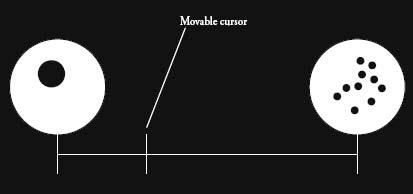
The purpose of researching the mathematical abilities of people who have the capacity to count only on one hand is to discover the nature of our basic numerical intuitions. Pica wants to know what is universal to all humans, and what is shaped by culture. In one of his most fascinating experiments he examined the Indians’ spatial understanding of numbers. How did they visualize numbers when spread out on a line? In the modern world we do this all the time – on tape measures, rulers, graphs and houses along a street. Since the Munduruku don’t have numbers, Pica tested them using sets of dots on a screen. Each volunteer was presented with the figure overleaf, of an unmarked line. To the left side of the line was one dot; to the right, ten dots. Each volunteer was then shown random sets of between one and ten dots. For each set the subject had to point at where on the line he or she thought the number of dots should be located. Pica moved the cursor to this point and clicked. Through repeated clicks, he could see exactly how the Munduruku spaced numbers between one and ten.
When American adults were given this test, they placed the numbers at equal intervals along the line. They recreated the number line we learn at school, in which adjacent digits are the same distance apart as if measured by a ruler. The Munduruku, however, responded quite differently. They thought that intervals between the numbers started large and became progressively smaller as the numbers increased. For example, the distance between the marks for one dot and two dots, and two dots and three dots were much larger than the distance between seven and eight dots, or eight and nine dots, as the following two graphs make clear.
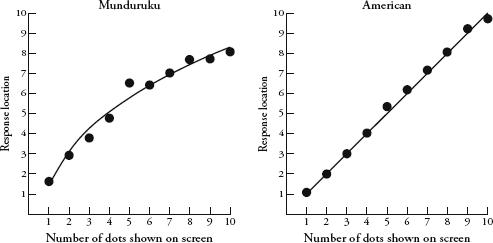
The results were striking. It is generally considered a self-evident truth that numbers are evenly spaced. We are taught this at school and we accept it easily. It is the basis of all measurement and science. Yet the Munduruku do not see the world like this. Stripped of a language of counting and number words, theyvisualize magnitudes in a completely different way.
When numbers are spread out evenly on a ruler, the scale is called linear. When numbers get closer as they get larger, the scale is called logarithmic.* It turns out that the logarithmic approach is not exclusive to Amazonian Indians. We are all born conceiving numbers this way. In 2004, Robert Siegler and Julie Booth at Carnegie Mellon University in Pennsylvania presented a similar version of the number-line experiment to a group of kindergarten pupils (with an average age of 5.8 years), first-graders (6.9) and second-graders (7.8). The results showed in slow motion how familiarity with counting moulds our intuitions. The kindergarten pupil, with no formal maths education, maps out numbers logarithmically. By the first year at school, when the pupils are being introduced to number words and symbols, the curve is straightening. And by the second year at school, the numbers are at last evenly laid out along the line.
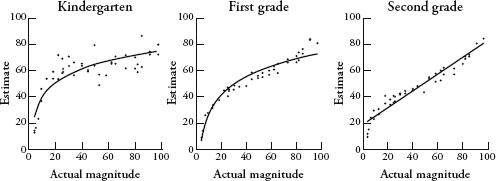
Why do Indians and children think that higher numbers are closer together than lower numbers? There is a simple explanation. In the experiments, the volunteers were presented with a set of dots and asked where this set should be located in relation to a line with one dot on the left and ten dots on the right. (Or, in the children’s case, 100 dots). Imagine a Munduruku is presented with five dots. He will study it closely and see that five dots are five times bigger than one dot, but ten dots are only twice as big as five dots. The Munduruku and the children seem to be making their decisions about where numbers lie based on estimating the ratios between amounts. When considering ratios, it is logical that the distance between five and one is much greater than the distance between ten and five. And if you judge amounts using ratios, you will always produce a logarithmic scale.
It is Pica’s belief that understanding quantities approximately in terms of estimating ratios is a universal human intuition. In fact, humans who do not have numbers – like Indians and young children – have no alternative but to see the world in this way. By contrast, understanding quantities in terms of exact numbers is not a universal intuition; it is a product of culture. The precedence of approximations and ratios over exact numbers, Pica suggests, is due to the fact that ratios are much more important for survival in the wild than the ability to count. Faced with a group of spear-wielding adversaries, we needed to know instantly whether there were more of them than us. When we saw two trees we needed to know instantly which had more fruit hanging from it. In neither case was it necessary to enumerate every enemy or every fruit individually. The crucial thing was to be able to make quick estimates of the relevant amounts and compare them, in other words to make approximations and judge their ratios.
The logarithmic scale is also faithful to the way distances are perceived, which is possibly why it is so intuitive. It takes account of perspective. For example, if we see a tree 100m away and another 100m behind it, the second 100m looks shorter. To a Munduruku, the idea that every 100m represents an equal distance is a distortion of how he perceives the environment.
Exact numbers provide us with a linear framework that contradicts our logarithmic intuition. Indeed, our proficiency with exact numbers means that the logarithmic intuition is overruled in most situations. But it is not eliminated altogether. We live with both a linearand a logarithmic understanding of quantity. For example, our understanding of the passing of time tends to be logarithmic. We often feel that time passes faster the older we get. Yet it works in the other direction too: yesterday seems a lot longer than the whole of last week. Our deep-seated logarithmic instinct surfaces most clearly when it comes to thinking about very large numbers. For example, we can all understand the difference between one and ten. It is unlikely we would confuse one pint of beer and ten pints of beer. Yet what about the difference between a billion gallons of water and ten billion gallons of water? Even though the difference is enormous, we tend to see both quantities as quite similar – as very large amounts of water. Likewise, the terms millionaire and billionaire are thrown around almost as synonyms – as if there is not so much difference between being very rich and very, very rich. Yet a billionaire is a thousand times richer than a millionaire. The higher numbers are, the closer together they feel.
The fact that Pica temporarily forgot how to use numbers after only a few months in the jungle indicates that our linear understanding of numbers is not as deeply rooted in our brains as our logarithmic one. Our understanding of numbers is surprisingly fragile, which is why without regular use we lose our ability to manipulate exact numbers and default to our intuitions judging amounts with approximations and ratios.
Pica said that his and others’ research on our mathematical intuitions may have serious consequences for maths education – both in the Amazon and in the West. We require understanding of the linear number line to function in modern society – it is the basis of measuring, and facilitates calculations. Yet maybe in our dependence on linearity we have gone too far in stifling our own logarithmic intuition. Perhaps, said Pica, this is a reason why so many people find maths difficult. Perhaps we should pay more attention to judging ratios rather than manipulating exact numbers. Likewise, maybe it would be wrong to teach the Munduruku to count like we do since this might deprive them of the mathematical intuitions or knowledge that are necessary for their own survival.
Interest in the mathematical abilities of those who have no words or symbols for numbers has traditionally focused on animals. One of the best-known research subjects was a trotting stallion called Clever Hans. In the early 1900s, crowds gathered regularly in a Berlin courtyard to watch Hans’s owner, Wilhelm von Osten, a retired maths instructor, set the horse simple arithmetical sums. Hans answered by stamping the ground with his hoof the correct number of times. His repertoire included addition and subtraction as well as fractions, square roots and factorization. Public fascination, and suspicion that the horse’s supposed intelligence was some kind of trick, led to an investigation of his abilities by a committee of eminent scientists. They concluded that, jawohl!, Hans really was doing the math.
It took a less eminent but more rigorous psychologist to debunk the equine Einstein. Oscar Pfungst noticed that Hans was reacting to cues in von Osten’s body language. Hans would start stamping his hoof on the ground and stopped only when he could sense a build-up or release of tension in von Osten’s face, indicating the answer had been reached. The horse was sensitive to the tiniest visual signals, such as the leaning of the head, the raising of the eyebrows and even the dilation of the nostrils. Von Osten was not even aware he was making these gestures. Hans was clever at reading people, certainly, but was no arithmetician.
Many further attempts were made in the last century to teach animals to count, not all for the purposes of circus-like entertainment. In 1943 the German scientist Otto Koehler trained his pet raven Jakob to select a pot with a specified number of spots on its lid from a selection of pots with a variety of numbers of spots on their lids. The bird could perform this task when the number of spots on any one lid was between one and seven spots. In recent years, avian intelligence has reached more impressive heights. Irene Pepperberg of Harvard University taught an African grey parrot called Alex numerals from 1 to 6. When shown an assortment of coloured blocks he could reply, for example, how many blue blocks there were by squawking the English number word. So renowned had Alex become among scientists and birdlovers that when he died unexpectedly in 2007, his obituary appeared in The Economist.
The lesson of Clever Hans was that when teaching animals to count, supreme care must be taken to eliminate involuntary human prompting. For the maths education of Ai, a chimpanzee brought to Japan from West Africa in the late 1970s, the chances of human cues were eliminated because she learned using a touch-screen computer.
Ai is now 31 and lives at the Primate Research Institute in Inuyama, a small tourist town in central Japan. Her forehead is high and balding, the hair on her chin is white and she has the dark sunken eyes of ape middle age. She is known there as a ‘student’, never a ‘research subject’. Every day Ai attends classes where she is given tasks. She turns up at 9 a.m. on the dot after spending the night outdoors with a group of other chimps on a giant tree-like construction of wood, metal and rope. On the day I saw her she sat with her head close to a computer, tapping sequences of digits on the screen when they appeared. When she completed a task correctly an 8mm cube of apple whizzed down a tube to her right. Ai caught it in her hand and scoffed it instantly. Her mindless gaze, the nonchalant tapping of a flashing, beeping computer and the mundanity of continual reward reminded me of an old lady doing the slots.
When Ai was a child she became a great ape in both senses of the word by becoming the first non-human to count with Arabic numerals. (These are the symbols 1, 2, 3 and so on, that are used in almost all countries except, ironically, in parts of the Arab world.) In order for her to do this satisfactorily, Tetsuro Matsuzawa, director of the Primate Research Institute, needed to teach her the two elements that comprise human understanding of number: quantity and order.
Numbers express an amount, and they also express a position. These two concepts are linked, but different. For example, when I refer to ‘five carrots’ I mean that the quantity of carrots in the group is five. Mathematicians call this aspect of number ‘cardinality’. On the other hand, when I count from 1 to 20 I am using the convenient feature that numbers can be ordered in succession. I am not referring to 20 objects, I am simply reciting a sequence. Mathematicians call this aspect of number ‘ordinality’. At school we are taught notions of cardinality and ordinality together and we slip effortlessly between them. To chimpanzees, however, the interconnection is not obvious at all.
Matsuzawa first taught Ai that one red pencil refers to the symbol ‘1’ and two red pencils to ‘2’. After 1 and 2, she learned 3 and then all the other digits up to 9. When shown, say, the number 5 she could tap a square with five objects, and when shown a square with five objects she could tap the digit 5. Her education was reward-driven: whenever she got a computer task correct, a tube by the computer dispensd a piece of food.
Once Ai had mastered the cardinality of the digits from 1 to 9, Matsuzawa introduced tasks to teach her how they were ordered. His tests flashed digits up on the screen and Ai had to tap them in ascending order. If the screen showed 4 and 2, she had to touch 2 and then 4 to win her cube of apple. She grasped this pretty quickly. Ai’s competence in both the cardinality and ordinality tasks meant that Matsuzawa could reasonably say that his student had learned to count. The achievement made her a national hero in Japan and a global icon for her species.
Matsuzawa then introduced the concept of zero. Ai picked up the cardinality of the symbol 0 easily. Whenever a square appeared on the screen with nothing in it, she would tap the digit. Then Matsuzawa wanted to see if she was able to infer an understanding of the ordinality of zero. Ai was shown a random sequence of screens with two digits, just like when she was learning the ordinality of 1 to 9, although now sometimes one of the digits was a 0. Where did she think zero’s place was in the ordering of numbers?
In the first session Ai placed 0 between 6 and 7. Matsuzawa calculated this by averaging out which numbers she thought 0 came after and which numbers she thought it came before. In subsequent sessions Ai’s positioning of 0 went under 6, then under 5, 4 and after a few hundred trials 0 was down to around 1. She remained confused, however, if 0 was more or less than 1. Even though Ai had learned to manipulate numbers perfectly well, she lacked the depth of human numerical understanding.
A habit she did learn, however, was showmanship. She is now a total pro, tending to perform better at her computer tasks in front of visitors, especially camera crews.
Investigating animals’ mastery of numbers is an active academic pursuit. Experiments have revealed an unexpected capacity for ‘quantity discrimination’ in animals as varied as salamanders, rats and dolphins. Even though horses may still be incapable of calculating square roots, scientists now believe that the numerical capacities of animals are much more sophisticated than previously thought. All creatures seem to be born with brains that have a predisposition for maths.
After all, numerical competence is crucial to survival in the wild. A chimpanzee is less likely to go hungry if he can look up a tree and quantify the amount of ripe fruit he will have for his lunch. Karen McComb at the University of Sussex monitored a pride of lions in the Serengeti in order to show that lions use a sense of number when deciding whether to attack other lions. In one experiment a solitary lioness was walking back to the pride at dusk. McComb had installed a loudspeaker hidden in the bushes and played a recording of a single roar. The lioness heard it and continued walking home. In a second experiment five lionesses were together. McComb played the roars of three lionesses through her hidden loudspeaker. The group of five heard the roars of three and peered in the direction of the noise. One lioness started to roar and soon all five were charging into the bushes to attack.
McComb’s conclusion was that the lionesses were comparing quantities in their heads. One vs one meant it was too risky to attack, but with five-to-three advantage, the attack was on.
Not all animal number research is as glamorous as camping in the Serengeti or bonding with a celebrity chimpanzee. At the University of Ulm, in Germany, academics put some Saharan desert ants at the end of a tunnel and sent them down it foragng for food. Once they reached the food, however, some of the ants had the bottom of their legs clipped off and other ants were given stilts made from pig bristles. (Apparently this is not as cruel as it sounds, since the legs of desert ants are routinely frazzled off in the Saharan sun.) The ants with shorter legs undershot the journey home, while the ones with longer legs overshot it, suggesting that instead of using their eyes, the ants judged distance with an internal pedometer. Ants’ great skill in wandering for hours and then always navigating their way back to the nest may just be due to a proficiency at counting strides.
Research into the numerical competence of animals has taken some unexpected turns. Chimpanzees may have limits to their mathematical proficiency, yet, while studying this, Matsuzawa discovered that they have other cognitive abilities that are vastly superior to ours.
In 2000 Ai gave birth to a son, Ayumu. On the day I visited the Primate Research Institute, Ayumu was in class right next to his mum. He is smaller, with pinker skin on his face and hands and blacker hair. Ayumu was sitting in front of his own computer, tapping away at the screen when numbers flashed up and avidly scoffing the apple cubes when he won them. He is a self-confident lad, living up to his privileged status as son and heir of the dominant female in the group.
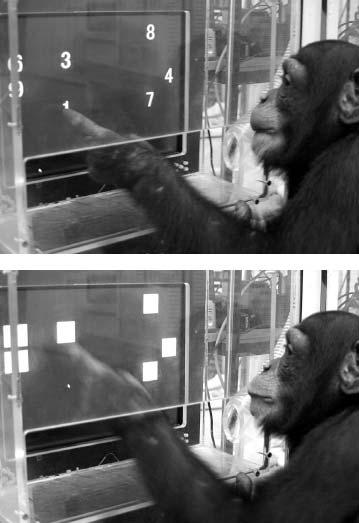
In this task Ayumu is flashed the digits 1 to 7, which then become white squares. He must remember the positions of the numbers so that he can then tap the squares in order to win the food reward.
Ayumu was never taught how to use the touch-screen displays, although as a baby he would sit by his mother as she attended class every day. One day Matsuzawa opened the classroom door only halfway, just enough for Ayumu to come in but too narrow for Ai to join him. Ayumu went straight up to the computer monitor. The staff watched him eagerly to see what he had learned. He pressed the screen to start, and the digits 1 and 2 appeared. This was a simple ordering task. Ayumu clicked on 2. Wrong. He kept on pressing 2. Wrong again. Then he tried to press 1 and 2 at the same time. Wrong. Eventually he got it right: he pressed 1, then 2 and an apple cube shot down into his palm. Before long, Ayumu was better at all the computer tasks than his mum.
A couple of years ago Matsuzawa introduced a new type of number task. On pressing the start button, the numbers 1 to 5 were displayed in a random pattern on the screen. After 0.65 seconds the numbers turned into small white squares. The task was to tap the white squares in the correct order, remembering which square had been which number.
Ayumu completed this task correctly about 80 percent of the time, which was about the same amount as a sample group of Japanese children. Matsuzawa then reduced the time that the numbers were visible, to 0.43 seconds, and while Ayumu barely noticed the difference, the children’s performances dropped significantly, to a success rate of about 60 percent. When Matsuzawa reduced the time that the numbers were visible again – to only 0.21 seconds, Ayumu was still registering 80 percent, but the kids dropped to 40.
This experiment revealed that Ayumu had an extraordinary photographic memory, as do the other chimps in Inuyama, although none is as good as he is. Matsuzawa has increased the number of digits in further experiments and now Ayumu can remember the positioning of eight digits made visible for only 0.21 seconds. Matsuzawao reduced the time interval and Ayumu can now remember the positioning of five digits visible for only 0.09 seconds – which is barely enough time for a human to register the numbers, let alone remember them. This astonishing talent for instant memorization may well be because making snap decisions, for example, about numbers of foes, is vital in the wild.
Studies into the limits of animals’ numerical capabilities bring us naturally to the question of innate human abilities. Scientists wanting to investigate minds as uncontaminated as possible by acquired knowledge require subjects who are as young as possible. As a result, infants only a few months old are now routinely tested on their maths skills. Since at this age babies cannot talk or properly control their limbs, testing them for signs of numerical prowess relies on their eyes. The theory is that they will stare for longer at pictures they find interesting. In 1980 Prentice Starkey at the University of Pennsylvania showed babies between 16 and 30 weeks old a screen with two dots, and then showed another screen with two dots. The babies looked at the second screen for 1.9 seconds. But when Starkey repeated the test, showing a screen with three dots after the screen with two dots, the babies looked at it for 2.5 seconds: almost a third longer. Starkey argued that this extra stare-time meant the babies had noticed something different about three dots compared to two dots, and therefore had a rudimentary understanding of number. This method of judging numerical cognition through the length of attention span is now standard. Elizabeth Spelke at Harvard showed in 2000 that six-month-old babies can tell the difference between 8 and 16 dots, and in 2005 that they can distinguish between 16 and 32.
A related experiment showed that babies had a grasp of arithmetic. In 1992, Karen Wynn, at the University of Arizona, sat a five-month-old baby in front of a small stage. An adult placed a Mickey Mouse doll on the stage and then put up a screen to hide it. The adult then placed a second Mickey Mouse doll behind the screen, and the screen was then pulled away to reveal two dolls. Wynn then repeated the experiment, this time with the screen pulling away to reveal a wrong number of dolls: just one doll or three of them. When there were one or three dolls, the baby stared at the stage for longer than when the answer was two, indicating that the infant was surprised when the arithmetic was wrong. Babies understood, argued Wynn, that one doll plus one doll equals two dolls.
The Mickey experiment was later performed with the Sesame Street puppets Elmo and Ernie. Elmo was placed on the stage. The screen came down. Then another Elmo was placed behind the screen. The screen was taken away. Sometimes two Elmos were revealed, sometimes an Elmo and an Ernie together and sometimes only one Elmo or only one Ernie. The babies stared for longer when just one puppet was revealed, rather than when two of the wrong puppets were revealed. In other words, the arithmetical impossibility of 1 + 1 = 1 was much more disturbing than the metamorphosis of Elmos into Ernies. Babies’ knowledge of mathematical laws seems much more deeply rooted than their knowledge of physical ones.
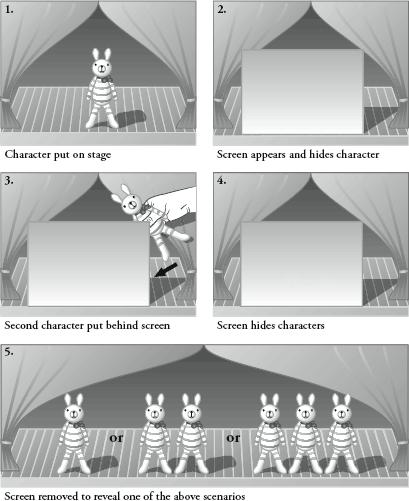
In Karen Wynn’s experiment, babies were tested on their ability to distinguish the correct number of dolls behind a screen.
The Swiss psychologist Jean Piaget (1896–1980) argued that babies build up an understanding of numbers slowly, through experience, so there was no point in teaching aithmetic to children younger than six or seven. This influenced generations of educators, who often preferred to let primary-age pupils play around with blocks in lessons rather than introduce them to formal mathematics. Now Piaget’s views are considered outdated. Pupils come face to face with Arabic numerals and sums as soon as they get to school.
Dot experiments are also the cornerstone of research into adult numerical cognition. A classic experiment is to show a person dots on a screen and ask how many dots he or she sees. When there are one, two or three dots, the response comes almost instantly. When there are four dots, the response is significantly slower, and with five slower still.
So what! you might say. Well, this probably
explains why in several cultures the numerals for 1, 2 and 3 have
been one, two and three lines, while the number for 4 is
not four lines. When there
are three lines or fewer we can tell the number of lines straight
away, but when there are four of them our brain has to work too
hard and a different symbol is necessary. The Chinese characters
for one to four are  ,
, ,
, and
and  . Ancient Indian numerals were
  ,
,  ,
,  and
and  . (If you join the lines, you
can see how they turned into the modern 1, 2, 3 and 4.)
. (If you join the lines, you
can see how they turned into the modern 1, 2, 3 and 4.)
In fact, there is some debate about whether the limit of the number of lines we can grasp instantly is three or four. The Romans actually had the alternatives IIII and IV for four. The IV is much more instantly recognizable, but clock faces – perhaps for aesthetic reasons – tended to use the IIII. Certainly, the number of lines, dots, or sabre-toothed tigers that we can enumerate rapidly, confidently and accurately is no more than four. While we have an exact sense of 1, 2 and 3, beyond 4 our exact sense wanes and our judgements about numbers become approximate. For example, try to guess quickly how many dots are at the top of the page opposite.
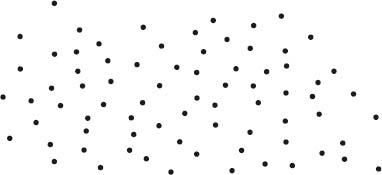
It’s impossible. (Unless you are an autistic savant, like the character played by Dustin Hoffman in Rain Man, who would be able to grunt in a split second ‘Seventy-five’.) Our only strategy is to estimate, and we’d probably be far off the mark.
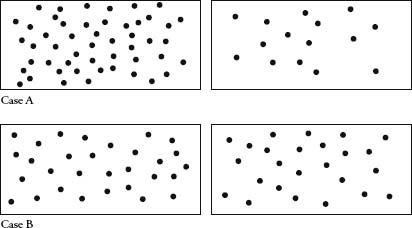
Researchers have tested the extent of our intuition of amounts by showing volunteers images of different numbers of dots and asking which set is larger, and our proficiency at discriminating dots, it turns out, follows regular patterns. It is easier, for example, to tell the difference between a group of 80 dots and a group of 100 dots than it is between two groups of 81 and 82 dots. Similarly, it is easier to discriminate between 20 and 40 dots than it is between 80 and 100 dots. In both A and B below, the left set of dots is larger than the right set of dots, yet the length of time it takes us to process the information is noticeably longer in case B.
Scientists have been surprised by how strictly our powers of comparison follow mathematical laws, such as the multiplicative principlsti his book The Number Sense, the French cognitive scientist Stanislas Dehaene gives the example of a person who can discriminate 10 dots from 13 dots with an accuracy of 90 percent. If the first set is doubled to 20 dots, how many dots does the second set need to include so that this person still has 90 percent accuracy in discrimination? The answer is 26, exactly double the original number of the second set.
Animals are also able to compare sets of dots. While they do not score as highly as we do, the same mathematical laws also seem to govern their skills. This is pretty remarkable. Humans are unique in having a wonderfully elaborate system of counting. Our life is filled with numbers. Yet, for all our mathematical talent, when it comes to perceiving and estimating large numbers our brains function just like those of our feathered and furry friends.
Human intuitions about quantities led, over millions of years, to the creation of numbers. It is impossible to know exactly how this happened, but it is reasonable to speculate that it arose from our desire to track things – such as moons, mountains, predators or drum beats. At first we may have used visual symbols, such as our fingers, or notches on wood, in a one-to-one correspondence with the object we were tracking – two notches or two fingers means two mammoths, three notches or three fingers means three, and so on. Later on we will have come up with words to express the concepts of ‘two notches’ or ‘three fingers’.
As more and more objects were tracked, our vocabulary and symbology of numbers expanded and – accelerating to the present day – we now have a fully developed system of exact numbers with which we can count as high as we like. Our ability to express numbers exactly, such as being able to say that there are precisely 75 dots in the top picture on the previous page, sits cheek-by-jowl with our more fundamental ability to understand such quantities approximately. We choose which approach to use depending on circumstance: in the supermarket, for example, we use our understanding of exact numbers when we look at prices of products. But when we decide to join the shortest checkout queue we are using our instinctive, approximate sense. We do not count every person in every queue. We look at the queues and estimate which one has the fewest people in it.
In fact, we use our imprecise approach to numbers constantly, even when using precise terminology. Ask someone how long it takes them to get to work and most often the answer will be a range, say, ‘Thirty-five, forty minutes.’ In fact, I have noticed that I am incapable of giving single-number answers to questions involving quantity. How many people were at the party? ‘Twenty, thirty…’ How long did you stay? ‘Three and a half, four hours…’ How many drinks did you have? ‘Four, five…ten…’ I used to think that I was just being indecisive. Now I’m not so sure. I prefer to think that I was drawing on my inner number sense, an intuitive, animal propensity to deal in approximations.
Since the approximate number sense is essential for survival, it might be thought that all humans would have comparable abilities. In a 2008 paper, psychologists at Johns Hopkins University and the Kennedy Krieger Institute investigated whether or not this was the case among a group of 14-year-olds. The teenagers were shown varying numbers of yellow and blue dots together on a screen for 0.2 seconds, and asked only whether there were more blue or yellow dots. The results astonished the researchers, since the scores showed an unexectedly wide variation in performance. Some pupils could easily tell the difference between 9 blue dots and 10 yellow, but others had abilities comparable to those of infants – hardly even able to say if 5 yellow dots beat 3 blue.
An even more startling finding became apparent when the teenagers’ dot-comparing scores were then compared to their maths scores since kindergarten. Researchers had previously assumed that the intuitive ability to discriminate amounts does not contribute much to how good a student is at tasks such as solving equations and drawing triangles. Yet this study found a strong correlation between a talent at reckoning and success in formal maths. The better one’s approximate number sense, it seems, the higher one’s chance of getting good grades. This might have serious consequences for education. If a flair for estimation fosters mathematical aptitude, maybe maths classes should be less about times tables and more about honing skills at comparing sets of dots.
Stanislas Dehaene is perhaps the leading figure in the cross-disciplinary field of numerical cognition. He started off as a mathematician, and is now a neuroscientist, a professor at the Collège de France and one of the directors of NeuroSpin, a state-of-the-art research institute near Paris. Shortly after he published The Number Sense in 1997, he was having lunch in the canteen of Paris’s Science Museum with the Harvard development psychologist Elizabeth Spelke. There they sat down by chance next to Pierre Pica. Pica brought up his experiences with the Munduruku and, after excited discussions, the three decided to collaborate. The chance to study a community that doesn’t have counting was a wonderful opportunity for new research.
Dehaene devised experiments for Pica to take to the Amazon, one of which was very simple: he wanted to know just what they understood by their number words. Back in the rainforest Pica assembled a group of volunteers and showed them varying numbers of dots on a screen, asking them to say aloud the number of dots they saw.
The Munduruku numbers are:
|
one |
p |
|
two |
xep xep |
|
three |
ebapug |
|
four |
ebadipdip |
|
five |
p |
When there was one dot on the screen, the
Munduruku said p g. When there were two, the said
xep xep. But beyond two
they were not precise. When three dots showed up,
ebapug was said only about
80 percent of the time. The reaction to four dots was
ebadipdip in only 70
percent of cases. When shown five dots, pg pogbi
was the answer managed only 28 percent of the time, with
ebadipdip being given
instead in 15 percent of answers. In other words, for three and
above the Munduruku’s number words were really just estimates. They
were counting ‘one’, ‘two’, ‘threeish’, ‘fourish’, ‘fiveish’. Pica
started to wonder whether pg pogbi,
which literally means ‘handful’, even really qualified as a number.
Maybe they could not count up to five, but only to fourish?
g. When there were two, the said
xep xep. But beyond two
they were not precise. When three dots showed up,
ebapug was said only about
80 percent of the time. The reaction to four dots was
ebadipdip in only 70
percent of cases. When shown five dots, pg pogbi
was the answer managed only 28 percent of the time, with
ebadipdip being given
instead in 15 percent of answers. In other words, for three and
above the Munduruku’s number words were really just estimates. They
were counting ‘one’, ‘two’, ‘threeish’, ‘fourish’, ‘fiveish’. Pica
started to wonder whether pg pogbi,
which literally means ‘handful’, even really qualified as a number.
Maybe they could not count up to five, but only to fourish?
Pica also noticed an interesting linguistic feature of their number words. He pointed out to me that from one to four, the number of syllables of each word is equal to the number itself. This observation really excited him. ‘It is as if the syllables are an aural way of counting,’ he said. In the same way that the Romans counted I, II, III and IIII but switched to V at five, the Munduruku started with one syllable for one, added another for two, another for three, another for four but did not use five syllables for five. Even though the words for three and four were not used precisely, they contained precise numbers of syllables. When the number of syllables was no longer important, the word was maybe not a number word at all. ‘This is amazing since it seems to corroborate the idea that humans possess a number system that can only track up to four exact objects at a time,’ Pica said.
Pica also tested the Munduruku’s abilities to estimate large numbers. In one test, illustrated overleaf, the subjects were shown a computer animation of two sets of several dots falling into a can. They were then asked to say if these two sets added together in the can – no longer visible for comparison – amounted to more than a third set of dots that then appeared on the screen. This tested whether they could calculate additions in an approximate way. They could, performing just as well as a group of French adults given the same task.
In a related experiment, also illustrated overleaf, Pica’s computer screen showed an animation of six dots falling into a can and then four dots falling out. The Munduruku were then asked to point at one of three choices for how many dots were left in the can. In other words, what is 6 minus 4? This test was designed to see if the Munduruku understood exact numbers for which they had no words. They could not do the task. When shown the animation of a subtraction that contained either 6, 7 or 8 dots, the solution always eluded them. ‘They could not calculate even in simple cases,’ said Pica.
The results of these dot experiments showed that the Munduruku were very proficient in dealing with rough amounts, but were abysmal in exact numbers above five. Pica was fascinated by the similarities this revealed between the Munduruku and Westerners: both had a fully functioning, exact system for tracking small numbers and an approximate system for large numbers. The significant difference was that the Munduruku had failed to combine these two independent systems together to reach numbers beyond five. Pica said that this must be because keeping the systems separate was more useful. He suggested that in the interests of cultural diversity it was important to try to protect the Munduruku way of counting, since it would surely become threatened by the inevitable increase in contact between the Indians and Brazilian settlers.
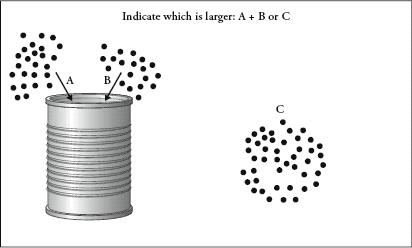
Approximate addition and comparison.
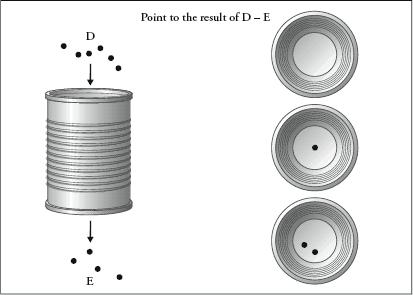
Exact subtraction.
The fact, however, that there were some Munduruku who had learned to count in Portuguese but still failed to grasp basic arithmetic was an indication of just how powerful their own mathematical system was and how well suited it was to their needs. It also showed how difficult the conceptual leap must be to having a proper understanding of exact numbers above five.
Could it be that humans need words for numbers above four in order to have an exact understanding of them? Professor Brian Butterworth, of University College London, believes that we don’t. He thinks that the brain contains a ready-built capacity to understand exact numbers, which he calls the ‘exact number module’. According to his interpretation, humans understand the exact number of items in small collections, and by adding to these collections one by one we can learn to understand how bigger numbers behave. He has been conducting research in the only place outside the Amazon where there are indigenous groups with almost no number words: the Australian Outback.
The Warlpiri aboriginal community live near Alice Springs and have words only for one, two and many, and the Anindilyakwa of Groote Eylande in the Gulf of Carpentaria have words only for one, two, three (which sometimes means four) and many. In one experiment with children of both groups, a block of wood was tapped with a stick up to seven times and counters were placed on a mat. Sometimes the number of taps matched the number of counters, sometimes not. The children were perfectly able to say when the numbers matched and when they didn’t. Butterworth argued that to get the answer right the children were producing a mental representation of exact number that was abstract enough to represent both auditory and visual enumeration. These children had no words for the numbers four, five, six and seven, yet were perfectly able to hold those amounts in their heads. Words were useful to understand exactness, Butterworth concluded, but not necessary.
Another important focus of Butterworth’s work – and of Stanislas Dehaene’s – is a condition called dyscalculia, or number blindness, in which one’s number sense is defective. It occurs in an estimated 3–6 percent of the population. Dyscalculics do not ‘get’ numbers the way most people do. For example, which of these two figures is biggest?
65 24
Easy, it’s 65. Almost all of us will get the correct answer in less than half a second. If you have dyscalculia, however, it can take up to three seconds. The nature of the condition varies from person to person, but those diagnosed with it often have problems in correlating the symbol for a number, say 5, with the number of objects the symbol represents. They also find it hard to count. Dyscalculia does not mean you cannot count, but suffereEasd to lack basic intuitions about number and instead rely on alternative strategies to cope with numbers in everyday life, for instance by using their fingers more. Severe dyscalculics can barely read the time.
If you were smart in all your subjects at school but failed ever to pass an exam in maths, you may well be dyscalculic. (Although if you always failed at maths, you are probably not reading this book.) The condition is thought to be a principal cause of low numeracy. Understanding dyscalculia has a social urgency, since adults with low numeracy are much more likely to be unemployed or depressed than their peers. Yet dyscalculia is little understood. It can be thought of as the number version of dyslexia; the conditions are comparable in that they both affect roughly the same proportion of the population and they appear to have no bearing on overall intelligence. However, a lot more is known about dyslexia than about dyscalculia. It is estimated, in fact, that academic papers on dyslexia outnumber those on dyscalculia by about ten to one. Among the reasons why dyscalculia research is so far behind is that there are many other reasons why one might be bad at maths – the subject is often taught badly at school, and it is easy to fall behind if you miss lessons when crucial concepts are introduced. There is also less of a social taboo around being rubbish with numbers than there is around being rubbish at reading.
Brian Butterworth frequently writes references for people he has tested for dyscalculia, explaining to prospective employers that the failure to achieve school maths qualifications is not due to laziness or lack of intelligence. Dyscalculics can be high achievers in all other areas beyond numbers. It is even possible, says Butterworth, to be dyscalculic and very good at maths. There are several branches of mathematics, such as logic and geometry, that prioritize deductive reasoning or spatial awareness rather than dexterity with numbers or equations. Usually, however, dyscalculics are not at all good at maths.
Much of the research into dyscalculia is behavioural, such as the screening of tens of thousands of schoolchildren by giving them tests on a computer in which they must say which of two numbers is the biggest. Some is neurological, in which magnetic resonance scans of dyscalculic and non-dyscalculic brains are studied to see how their circuitry differs. In cognitive science, advances in understanding a mental faculty often come from studying cases where the faculty is faulty. Gradually, a clearer picture is emerging of what dyscalculia is – and of how the number sense works in the brain.
Neuroscience, in fact, is providing some of the most exciting new discoveries in the field of numerical cognition. It is now possible to see what happens to individual neurons in a monkey’s brain when that monkey thinks of a precise number of dots.
Andreas Nieder at the University of Tübingen in southern Germany trained rhesus macaques to think of a number. He did this by showing them one set of dots on a computer, then, after a one-second interval, showing another set of dots. The monkeys were taught that if the second set was equal to the first set, then pressing a lever would earn them a reward of a sip of apple juice. If the second set was not equal to the first, then there was no apple juice. After about a year, the monkeys learned to press the lever only when the number of dots on the first and second screens was equal. Nieder and his colleagues reasoned that during the one-second interval between screens the monkeys were thinking about the number of dots they had just seen.
Nieder decided he wanted to see what was happening in the monkeys’ brains hey were holding the number in their heads. So, he inserted an electrode two microns in diameter through a hole in their skulls and into the neural tissue. Don’t worry, no monkeys were hurt. At that size, an electrode is tiny enough to slide through the brain without causing damage or pain. (The insertion of electrodes into human brains for research contravenes ethical guidelines, although it is allowed for therapeutic reasons such as the treatment of epilepsy.) Nieder positioned the electrode so that it faced a section of the monkeys’ pre-frontal cortex, and then began the experiment.
The electrode was so sensitive that it could pick up electrical discharge in individual neurons. When the monkeys thought of numbers, Nieder saw that certain neurons became very active. A whole patch of their brains was lighting up.
On closer analysis, he made a fascinating discovery. The number-sensitive neurons reacted with varying charges depending on the number that the monkey was thinking of at the time. And each neuron had a ‘preferred’ number – a number that made it most active. There was, for example, a population of several thousand neurons that preferred the number one. These neurons shone brightly when a monkey thought of one, less brightly when he thought of two, even less brightly when he thought of three, and so on. There was another set of neurons that preferred the number two. These neurons shone brightest when a monkey thought of two, less brightly when he thought of one or three, dimmer still when the monkey thought of four. Another group of neurons preferred the number three, and another the number four. Nieder conducted experiments up to the number 30, and for each number found neurons that preferred that number.
The results offered an explanation for why our intuitions favour an approximate understanding of numbers. When a monkey is thinking ‘four’, the neurons that prefer four are the most active, of course. But the neurons that prefer three and the neurons that prefer five are also active, though less so, because its brain is also thinking of the numbers surrounding four. ‘It is a noisy sense of number,’ explained Nieder. ‘The monkeys can only represent cardinalities in an approximate way.’
It is almost certain that the same thing happens in human brains. Which raises an interesting question. If our brains can represent numbers only approximately, then how were we able to ‘invent’ numbers in the first place? ‘The “exact number sense” is a [uniquely] human property that probably stems from our ability to represent number very precisely with symbols,’ concluded Nieder. Which reinforces the point that numbers are a cultural artefact, a man-made construct rather than something that we acquire innately.