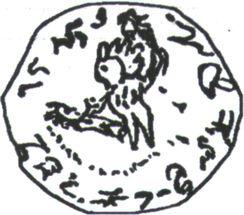
3. The Smithsonian’s 200,000 Year Old Coin
Another strange find
was reported in 1871 by William E. Dubois of the Smithsonian
Institution. One of these was a small copper coin covered with
strange markings and an unidentifiable figure. The coin was
retrieved by a man drilling a well from a depth of 125 feet,
through 3 feet of soil, “10 feet of yellow clay; 44 feet of blue
clay; 4 feet of clay, sand, and gravel; 19 feet of purple clay; 10
feet of brown hard pan; 8.5 feet of green clay; 2 feet of vegetable
mould; 2.5 feet of yellow clay; 2 feet of yellow hard pan; and 20.5
feet of mixed clay.”673 The Illinois State
Geological Survey’s estimates for the age of deposits at the 114
foot level was that they were formed at the “Yarmouthian
Interglacial ‘sometime between 200,000 and 400,000 years
ago.’”674 This is intriguing,
because it corresponds with the same approximate time frame given
in the Sumerian Kings List of the arrival on Earth of the Anunnaki,
and the time that they allegedly reigned on Earth prior to the
Flood: 241,200 years.
But there were other
interesting things about the coin than its age. Dubois noted that
the coin was polygonal, its inscriptions were in no recognizable
language, and most importantly, since it was of uniform thickness,
Dubois concluded that it must have “passed through a
rolling-mill...”675 This flies squarely
in the face of standard models in any number of ways, from the
existence of such technology, to the fact that Homo sapiens sapiens is not believed to have lived
“much earlier than 100,000 years ago,” to the fact that metal coins
were thought to be used only after the eighth century BC in Asia
Minor.676
400,000-200,000 Year Old Coin from Illinois:
the Writing is not from any known ancient
language 677