
3. Pyramidal and Other Rectilinear Formations
While giant hexagons
and “airports” might be accounted for by some unknown and exotic
geological process, four-sided pyramids possessing symmetry along
perpendicular axes is a whole other matter.
A
Martian Four-Sided Pyramid

The Cydonia region,
thanks to the efforts of Richard C Hoagland, Errol Torrun, Vincent
DePietro, Mark Carlotto and so many others, is well known to be
dotted with a number of pyramidal formations, including the large
and well-known five-sided D & M Pyramid. But the presence of
such structures in other areas of the Martian surface strongly
suggests that one is in the presence of a common cultural matrix.
The Sphinx-like Face, the Cydonia Pyramids and other formations,
and now another pyramid not in Cydonia,
decreases considerably the likelihood that the Cydonia formations
are accidents of nature. Geological processes might explain large
hexagons and large “airports”, but they will not adequately explain
such formations, which are not known to occur in nature. This fact,
along with the presence of such structures on the Earth, and the
odd presence of rectilinear and other regular surface features on
the Moon suggestive of artificiality, imply that we might be in the
presence of a common culture.
Another odd feature
found on Mars is the presence of depressions in its surface that, superficially,
resemble craters, but which, on closer examination, reveal
themselves to have a degraded rectangular structure underlying
them. Again, the question inevitably arises of how would natural
processes such as meteor impacts account for such
features?
Double Rectangular “Craters” on Mars

An even more stunning
example of a rectangular “crater” is the following.
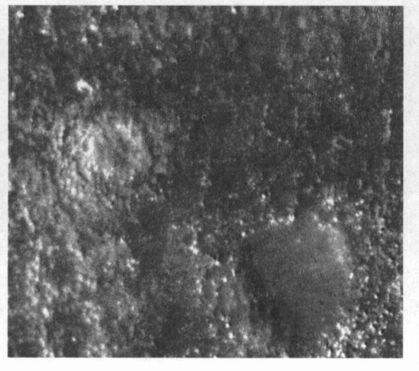
Again, what natural
process would account for this?
Another picture,
released from Malin Space Systems, appears to be nothing but a
typical region of Mars, with some non-descript geological
features.
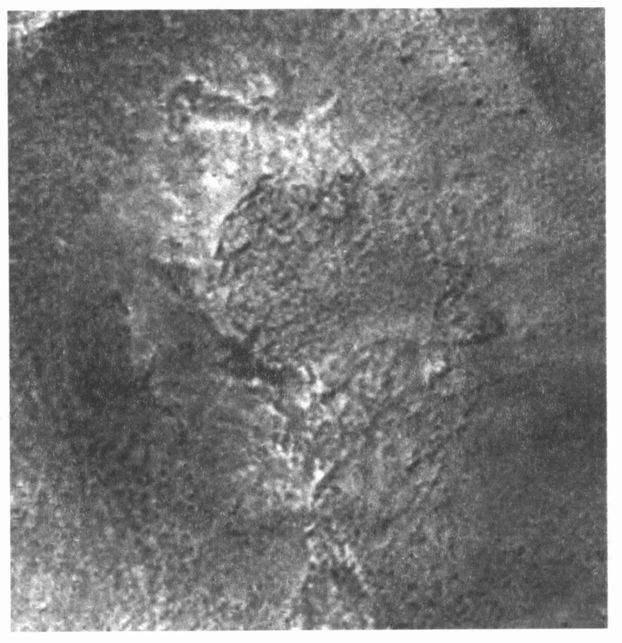
But closer inspection
will reveal a wealth of details about this “non-descript” formation
that are quite anomalous. Note first that the bulge is almost
perfectly circular. And note the zigzag rectilinear feature to the
left on the top of the bulge. On the right side of the bulge note
again the straight lines that form a “design” almost reminiscent of
a seventeenth and eighteenth century Vauban-style
fortress.
The “Bulge” with Zigzag lines and “Vauban” Style
“Fortress
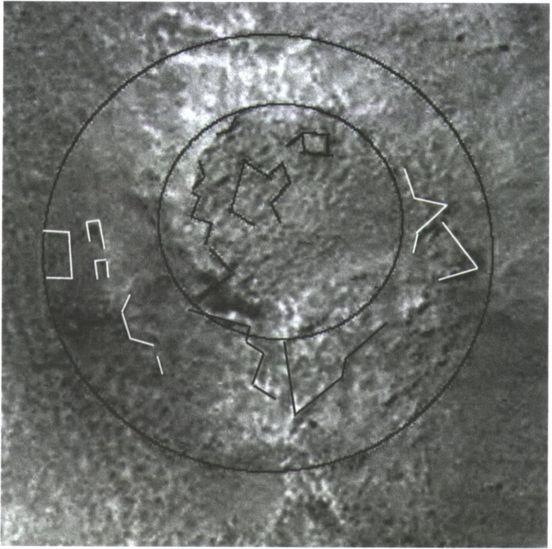
This extremely
interesting feature with all its anomalous characteristics might be
accounted for by geological processes, to be sure, but if so, then
it would appear that a number of discrete and very different
processes would be at work, and in a most unusual combination. In
short, natural causes might account for some of these features, but for all of them to be
present in one location, with such straight-lined regularity, would
seem to stretch plausibility. The only other explanation is that
these features are the creations of intelligence, and that
one is looking at degradations of structure
that have occurred over time.