
D. Evidence of Planetary Sized Discharges in the Solar System
In addition to all
the foregoing considerations, there is evidence that various bodies
in the solar system have suffered huge electrostatic discharges,
scarring their surfaces. Such massive discharges may have been
large enough to just barely be seen from Earth by man. One class of
evidence that should be considered are so-called “rilles” which in
mainstream planetary geological theory are the result of brief
releases of running water, or, in some cases, lava. While such
channels can indeed be created by such means, there are rilles that
show evidence of creation by the mechanism of gigantic lightning
strikes. One such rille is the Hyginus Rille on Earth’s nearest
neighbor, the Moon.
Hyginus Rille on the Moon

Notice the circular
“pits” in this rille. Such pits, according to physicist Wallace
Thronhill, are a typical characteristic of channels created by
massive electrostatic discharges.113
One of the moons of
Jupiter, Europa, shows even more dramatic evidence of massive
discharges, displaying a typical feature of the “corkscrew” effect
of plasma filaments.
Corkscrew Dircharge Pattern on Jupiter’s Moon,
Europa

Wallace Thornhill’s
characterization of this type of evidence may be summarized as
follows, noting the comparison of craters on planets and moons with
those created by electrical discharge in the laboratory:
Both tend to be perfectly circular because an electrical arc always strikes perpendicular to a surface. Walls are nearly vertical and floors are nearly flat as the circular motion of the arc machines out the crater. Impact and explosion craters, by contrast, tend to have a bowl shape: Instead of being lifted from the surface, excavated material undergoes shock displacement, shattering and flowing in a manner similar to that of a fluid for the duration of the shock.Another common feature of electrically generated craters, Thornhill explains, is terracing along the sides, sometimes corkscrewing down to the floor, following the rotary motion of the arc. The Moon and Mars both provide many examples of terraced and corkscrew craters.114
These considerations
indicate that at one time the solar system was far more
electrically active than it is now.
But perhaps the most
important - and from the standpoint of an actual war having been the cause of such scarring - a
significant piece of evidence for this planetary-wide scarring by
massive electrical discharges lies on Earth’s closest neighbor,
Mars, in the gigantic Valles Marineris, a huge canyon some four
thousand kilometers long, up to seven hundred kilometers across “in
some places, and up to six hundred kilometers deep.” Nor is this
the only mystery to this highly anomalous planetary feature.
“Approximately two million cubic kilometers of the Martian surface
was removed with no comparable debris field apparent.”115
Valles Marineris on Mars: Scarred Evidence of a Massive
Electric Discharge
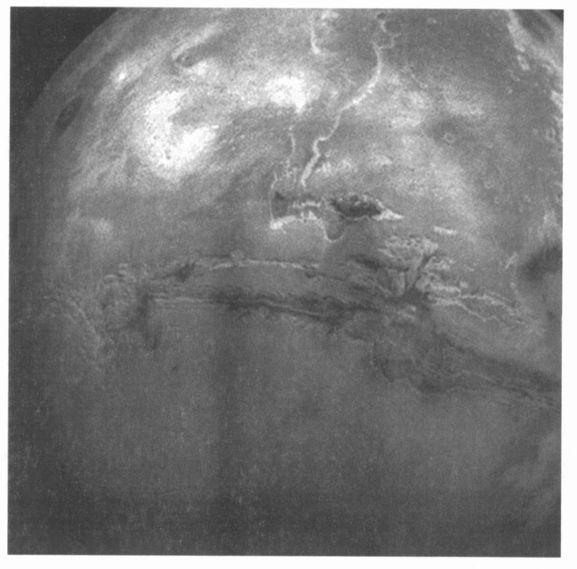
This is not, however,
the only thing unusual about the Valles Marineris.
Wallace Thornhill was
first contacted by comparative mythologist David Talbott, who,
investigating an ancient theme of classical mythology and knowing
of the Valles Marineris, decided to get in touch with the
physicist. What Talbott had noticed was the “Scarface Motif’ of
some ancient myths. This motif, common to many cultures, is one of
a “warrior-god, who, at a time of upheaval, receives a gaping wound
or scar on his forehead, face, or thigh.” But it would be a mistake
to see it as a merely “personal” wound inflicted on some
mythological hero. It is, rather, the wound associated with the
“celestial archetype of warriors - the
god whom human warriors celebrated as their inspiration on the
battlefield. In early astronomies, this warrior archetype is
identified with a specific planet - Mars.”116
Talbott immediately
asked a significant question, raising the “Problem of Peratt” yet
again, and in yet a different form: was it just possible
that
The “wounding” of Mars refers to an actual event? “I remember looking at one of the first Mariner photographs of Mars,” Talbott recalls. “It displayed a stupendous chasm cutting across the face of the planet. Even from a considerable distance, the chasm looked like a scar.... At that moment I ralized that of all the planets and moons in our solar system, Mars alone bore the likeness of the warrior-god’s wound.”117
Behind the myth, in
other words, lay a very real event: science and mythology were
converging at the very place mythology — if taken seriously from a
paleophysical perspective — said it would: Mars.
The wound of the
warrior-God, Ares, the Greek’s Mars, was real.
But this immediately
provokes two questions, the first of which was asked by Talbott
himself:
1. “Could something as massive as Valles Marineris have been carved by interplanetary lightning?”118
2. Did someone - humans or otherwise - actually observe the event from Earth or elsewhere, and record the event?
While the first
question indicates that one feature of Talbott and Thornhill’s
hypothesis is that these discharges are evidences of gigantic,
solar system wide interplanetary “arcing” from a time when the
solar system was very young and electrically dynamic, it is
important not to lose sight of the question itself: could such a
geological feature, massive as it is, be carved by electrical
discharge? “Could Valles Marineris have been caused by a
thunderbolt?” Talbott asked Thornhill.119
Thornhill replied, “It couldn’t have been anything else.”“...Valles Marineris was created within minutes by a giant electric arc sweeping across the surface of Mars,” Thornhill claims. “The rock and soil were lifted into space. Some of it fell back around the planet to create the great, strewn fields of boulders seen by both Viking Landers and Pathfinder.”120
The “mighty chasm” of
Valles Marineris thus “represents the confluence of two worldviews:
the dramatic, historical worldview of mythology and the objective,
physical worldview of science.”121
If that is so,
however, it raises the second question in no uncertain terms. How
is it that ancient mythology, art, and petroglyphic symbols can
preserve the legend of planetary scarring, can accurately record
the very shape of complex plasma filaments, of stacked toruses,
intertwining currents, and of plasma pinching effects?
There are only three
real possibilities:
1. The ancients possessed a plasma cosmology and physics themselves, and from laboratory experiments, were well familiar with the patterns exhibited by Peratt’s petroglyphs. They chose, for some strange reason, to disguise their knowledge by creating myths and legends in archaic petroglyphs and mythological symbols. But this implies a technology at least as advanced as our own in order to create plasma effects of the type observed to begin with.
2. Someone else possessed all these things, and actually transmitted this knowledge to ancient man, who subsequently embellished the basic conceptions with mythological hyperbole.
3. Ancient man actually observed and more or less accurately recorded what he saw in myth, artistic symbol, and in the petroglyphs.
Regardless of which
version one opts for, one is left with another disquieting aspect
of “The Problem of Peratt,” and that is, that whatever catastrophes
as ancient mankind appeared to witness and record in his art and
mythological archetypes, the catastrophes witnessed appear to fall outside the chronological parameters both
of Van Flandern’s Exploded Planet Hypothesis and Hannes Alfvén’s electrically
dynamic solar system, for in both cases the events or conditions
described in those hypotheses happened some millions of years
ago. Yet the artistic symbols, the myths, and Peratt’s
petroglyphs themselves are all only thousands of years old.
Any way one slices
it, various sciences are involved in the contradiction, in the
problematic inherent in the “Problem of
Peratt,” for on the one hand, if humans observed these events, then
either the described events are much more recent than the two
physics theories that can account for them will allow, or mankind
is of far greater antiquity than contemporary paleontology,
anthropology, and historical theory will allow.122 In the latter case,
an additional problem arises, for it would imply that mankind
preserved his artistic and mythological archetypes with amazing
consistency and accuracy over several million years.
It is this accuracy
of the artistic record - of the petroglyphs and ancient art work
depicting the “divine weapons” by capturing the subtleties of
plasma discharges - that is itself problematic for the
catastrophist view, espoused most brilliantly by scholar Alan
Alford as we shall see in the next chapter, that would then in turn
maintain that all mythological references to the Wars of the Gods
are but metaphors for an exploded planet cult. If that were so, why
did the ancients, who were certainly capable of depicting planets as circular orbs, not
depict them as such? Why give them arms and legs and faces and
beards, and thunderbolts that are amazingly accurate depictions of
electrical plasma phenomena? And why give the gods not only the
technology for such massive displays of power, but ascribe to them
personalities and motivations to use it?
Why indeed, unless
they are describing real events in a
real war.