
5. The Two Sphinxes of Ra, and the Two Eyes of Horus
As noted above, Ra is
associated with the Sphinx. However, as Rux states, there are
problems with that association:
Ra was specifically mentioned in Egyptian stelae as erecting a Sphinx in his own image in a “protected place,” i.e., a place of pyramids. Until the discoveries of the Viking probe, we had nothing but Giza to equate that to. But the Cairo Sphinx does not look like Ra, who was depicted as a hawk - the Cydonia Sphinx on Mars does. The very name of this Sphinx is given as Ra-Harakhte: “Falcon of the Horizon.” More to the point, Ra was said to wear a diadem on his forehead...
(This is sounding
familiar!)
...from which he could fire a bolt to kill his enemies - the Cydonia Sphinx appears to have exactly such an item sculpted on its forehead.526
But why refer to the
Cydonia Face as a Sphinx at all?
Alternative
researchers George J. Hass and William R. Saunders, in their
remarkable and provocative book The Cydonia
Codex: Reflections from Mars, summarize the history of
Richard Hoagland’s, and his associate, Dr. Mark Carlotto’s
identification of the Cydonia face as a Sphinx in the following
manner:
In 1984, Hoagland proclaimed the “Face on Mars” to be the embodiment of a Martian Sphinx, where the face was half humanoid and half feline. The profound implication of Hoagland’s claims was that an identical fusion of two specific combinations of humanoid and feline features exists on massive structures on two different worlds: Earth and Mars. Using computer enhancements of NASA’s Viking Frame 70A13 by Dr. Mark Carlotto, Hoagland produced a mirror split of the “Face.” He was astonished with the results and quickly adopted the title of Martian Sphinx in reference to the “Face.”527
We can perform this
experiment ourselves.
First, the Viking
frame 70A13:

Then, Carlotto’s
computer enhancement:

Carlotto’s Enhanced Image of Viking Frame 70A
13.
If one now pauses and
recalls Rux’s comments, it would appear that there are three, and not just two, types of forms being
morphed into this fascinating figure, for clearly, while the left
and right sides each have their own peculiar humanoid and feline
characteristics, as we shall see in a moment, their overall combination could be loosely construed as
ornithological, or bird-like. The author can only add that his own
personal reaction, when he first saw this image, was one of fright
and fear. In short, my reaction to this face is that it conveys a
malevolent intention, an intention that will, I believe, become
more apparent with the later images.
In any case, Hoagland
correctly identified the humanoid and feline aspects of this
Martian Sphinx.

And Hoagland’s
humanoid aspect is no less apparent:

The above image, in
my opinion, is not the countenance or visage of “love, harmony, and
peace”; it is most decidedly not Disneyworld “jonquils and
daisies.”
But then came the
images from the Mars Orbital Camera, in 1998, and it appeared as if
the whole Martian Face-Sphinx controversy would die down, for as
nationally syndicated radio talk-show host Art Bell quipped, the
image looked like a cat’s litter box, and the name stuck. The image
became “The Catbox Image:”
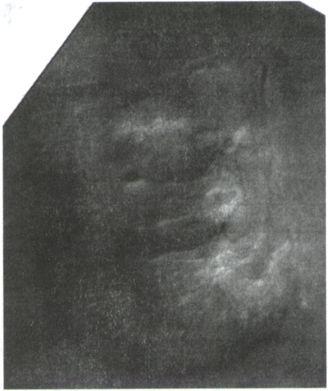
But careful scrutiny
of the image will show face-like features. The question then became
whether this image preserved the peculiar double morphology of a
Sphinx. If so, then it was, once again, an artificial structure,
albeit one in great decay. Haas and Saunders set out to do just
that.
This time, much to
the chagrin of “it’s just a mesa” proponents, the flipping of the
image, after computer rectification to provide an overhead view
that could be flipped, was nothing less
than astounding, as Haas and Saunders point out.
1998 Mars MOC Image, Flipped for Feline
Component
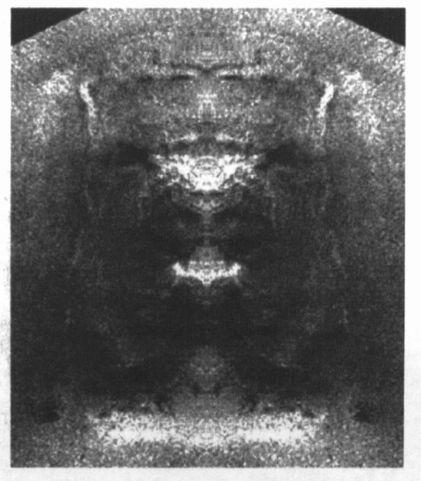
If anything, the
improved optics of the 1998 Mars Orbital Camera only enhanced, rather than overturned, Hoagland’s
original Sphinx hypothesis, providing a confirmation of it. The
resemblance of the image to a head-on image of an African male lion
is all too apparent and palpable.
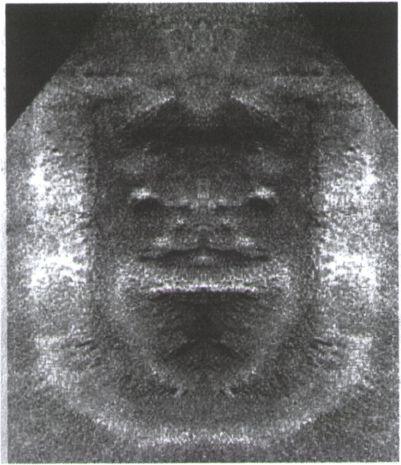
But what of the
humanoid component?
Here the results were
even more astounding, for not only was the humanoid component
confirmed, but Rux’s additional comment that the “headdress” of the
Face appeared to show a diadem or
jewel of some sort, as associated with
Ra’s “eye”, appeared to be confirmed in no uncertain terms, a fact
made all the more remarkable in that Rux wrote his comments in
1996, fully two years before the image was even captured by the
satellite’s camera!
1998 Mars MOC Picture, Humanoid Aspect with Clearly
Visible Diadem
Ra then, is
associated with two Sphinxes, one on
Earth, and the other, paradoxically, on Mars.
But there is still
more.
Rux again points the
way to yet more Mars-Earth connections by stating that
On the painted papyrus of Queen Nejmet in the Egyptian Department of the British Museum is a red planet to the right, surmounted by Harpokrates, the young Horus - it is called “The Red Eye of Horus.” Horus is sometimes referred to as having “two red eyes” or “two blue eyes”, or as having one red eye with the other blue. Ra’s “right eye” and “left eye” being used to refer to the Sun and Moon respectively, and “Thoth’s eye” used to refer to the Moon, we know that “eyes” are sometimes used by the ancient Egyptians to refer to planets. Horus lost one of his eyes in battle with Set during the civil wars, having it restored to him by the magic of Thoth....it is not unreasonable to assume ...that Horus’ blue eye would of course be the blue planet, Earth. As reasonably, his red eye would be Mars.528
In other words, Earth
and Mars describe two parts of an interplanetary relationship — a
civilization.
But Rux then notes a
disturbing aspect to this use of “eyes” to mean planets: “An ‘eye’
also can represent a weapon and/or a ship, as has been
demonstrated.”529 Moreover, if viewed
as a ship, and if one “enters the vehicle which is ‘the eye of
Horus,’ it powers up, and one goes from the blue to the red — more
specifically, in the typical dual meaning of ancient sacred puns,
from his ‘blue eye’ to his ‘red eye,’ or from Earth to Mars.”530 Indeed, if this
“ship” were based on any sort of field propulsion, its ionization
of the atmosphere would first start on the blue end of the
electromagnetic spectrum and as the “ship” swiftly receded from its
point of origin, its radiation would undergo the classic Doppler
phase shift, from blue to red.
Such a trip is
related to the Egyptian concept of the Tuat or Duat, which,
since it contains neither water nor air, and is “an unfathomable
abyss... dark with the blackest darkness” wherein a man can wander,
and in which there is no life, is space itself.531 At this point,
notes Rux, a journey through the Tuat
“not only involves one Sphinx - it involves two.”532
A double sphinx (Aker)533 can be seen depicted in the Pyramid Texts and the Book of the Dead, being either two sphinxes back to back with a solar disk between them, or else a single body with one head gazing eternally east (as ours does at Cairo), and the other gazing eternally west...it is referred to as the “Great God who opens the Gates of Earth.”534
The Pa-Ra-Emheb
Stele, moreover, refers precisely to “Ra’s building of the Sphinx
in his image amid a ‘protected place in the Sacred Desert’ with a
‘hidden name,’ the place of the ‘King of the Gods’ in the ‘secret
underworld’.” Additionally, this stele also mentions “the extension
of cords and a crossing of the sky to the subterranean world where
secret things are made.“535 And as if that were
not enough, Rux states that Wallis Budge himself wrote in 1934
that
Mars... was called Hor-Tesher, the “Red Horus,” He was said “to journey backwards in traveling,” and he was also known as “Harakhti,” “Horus of the Two Horizons.” The God of this planet was Ra; he had the head of a hawk with a star above it.” The Cydonia Sphinx of Mars is to all appearances exactly that: the head of a hawk with a star above it, the star (diadem) containing a stylized human face.536
Consequently we have
the following relationships:
• The association of Mars with Ra;
• Ra’s association with two sphinxes;
• The existence of the Sphinx at Giza, which may be associated with Ra through the use of red paints on its beard;
• The apparent existence of a sphinx or chimerical Face on Mars, depicting both humanoid and feline aspects in its two halves, and an ornithological or bird-like quality when viewed as a whole, which is associated with Ra’s depiction as the “Falcon of the Horizon;
• The use of the term “eye” to refer not only to planets, as with the red and blue eyes of Horus referring to Mars and Earth respectively, but also to refer to weapons, as with the Eye of Ra, which is used by Sekhmet to destroy all life on earth in a fiery conflagration;
• The association of Ra’s “eye” with his diadem, which parallels the lapis exilis or “stone of power” of Lucifer in the Christian tradition,537 and the evident presence of just such a diadem in the “humanoid” version of the 1998 Mars Orbital Camera’s imaging of the Martian Sphinx;
• The apparent association of Ra, as a sun-god, not only with light, but apparently with crystals, as with the stone or “eye” of his diadem;
• The association of mankind, of Adam, with the ”red earth“, i.e., the Red Planet of Mars; and, from chapter two,
• The association of Mars with the “scarred warrior” of some ancient mythological motifs, a scarring quite visibly demonstrated in the massive scar of the Valles Marineris.And last, but surely not least,
• The clear association of Mars with warfare.
These associations
allow us to hypothesize both who was involved in this paleoancient
war, and where it was fought, for these associations indicate that
the warfare referred to in ancient Sumerian and Egyptian texts was
interplanetary - cosmic — in nature, and involved at the minimum,
both Mars and Earth, and their “gods.” And we have now yet another
variation on our now familiar formula:
Mountains ≈ Celestial Bodies ≈ Pyramids ≈ Eyes ≈ Weapons.
Perhaps, in the light
of this formula, it is not surprising that the Martian Sphinx
should likewise be near a “protected compound” of pyramids, the
most massive of which is the celebrated five-sided D & M
Pyramid! We would, however, be remiss if we did not take note of
the other players...