
1. Gardner’s “Grand Assembly of the Annunaki”
The Grand Assembly of the Annunaki 556
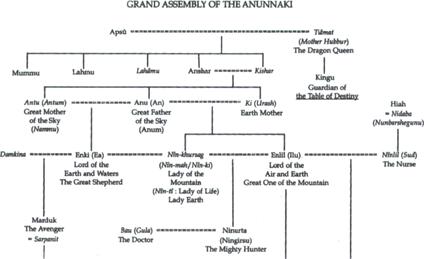
There are a number of
crucial points to be observed about this chart. First and foremost
is that it preserves the mythological character of Tiamat, Apsu,
and An. Tiamat, it will be recalled from previous chapters, is not
only a galactic symbol as De Santillana and Von Dechind averred,
but also a planetary symbol, as well as a symbol for the primeval
waters of chaos. Absu is the “Abyss” or primordial deep itself, and
sometimes functions as a symbol of the Sun. Anu and Ki are two of
their “children”, and clearly this distinguishes them from Tiamat,
because the genealogical chart supports the notion that as a
planetary symbol, Tiamat does not refer to the Earth, but to
“Elsewhere,” to the first exploded planet, and perhaps to an even
more galactic context.
Secondly, observe the
“marriage relationships” between brothers and sisters, and, as will
be seen in a moment, between half-brothers and half-sisters. This
is one of the stable features both of Mesopotamian and Egyptian
dynastic practice.
Thirdly, observe that
these “consanguineous” relationships assume particular importance
with the two great Anunnaki gods Enlil and Enki, both brothers who
share their sister Nin-khursag, or Ninhursag, as their wife. In
this context, the placement of Marduk becomes paramount, for as a
son of Enki, he is on the opposite side of the family - one “great
big happy pantheon” all! - from his distant “great-grandmother”
Tiamat - whom he would eventually destroy - and from the Enlil side
of the pantheon. Note too that Marduk is cousin to
Ninurta.
Finally, note that
many of the gods are “titled,” as being lords or “gods” of a
particular realm, or, alternatively, a specific functional
“department” of the “pantheonic government.” Thus, one might
likewise be looking at a genealogical chart of the relations not
only of individuals but of dynasties.
Thus, when Marduk recovers the Tablets of Destinies from
Tiamat, their possession passes from one side of the “family” or
pantheon, to the other. If this sounds a little farfetched,
one need only recall that World War One, from a certain point of
view, may be understood as a family “feud” of gargantuan
proportions between the Von Hohenzollerns in Germany, the Romanovs
in Russia, the Von Sachse-Coburgs (Windsors) in England, and the
Von Hapsburgs in Austria, all of which families were intricately
and inextricably interrelated through decades of intermarriages.
Kaiser Wilhelm was thus a cousin to Tsar Nicholas and to King George, a nephew of Queen Victoria, and
a distant relation of Kaiser Franz Josef of Austria, King Leopold
of Belgium, and King Vittorio Emannuel of Italy! World War One,
viewed in this somewhat simplistic and very over-generalized light,
was a “civil war” of sorts, between the interrelated Houses of
Europe. The same holds true of the Sumerian and Babylonian
traditions of the cosmic war; it is in every respect a family war, a civil war and revolt in the
pantheon.