
B. The “Fear” of Mars: the Moonlet Phobos and its Monolith
In this context of
the Azag as a “thing”, and a context for some parts of the Lugal-E
taking place on Mars, the peculiar features of Mars’ little moonlet
Phobos should be considered. Phobos,634 a name which in the
Greek means “fear,” is an unusual object in its own
right.
Mars’Moonlet, Phobos

Note carefully the
large crater, barely visible in the above picture, which more or
less faces toward the right of the Moonlet, looking toward the
surface of Mars. A close-up of this feature follows:
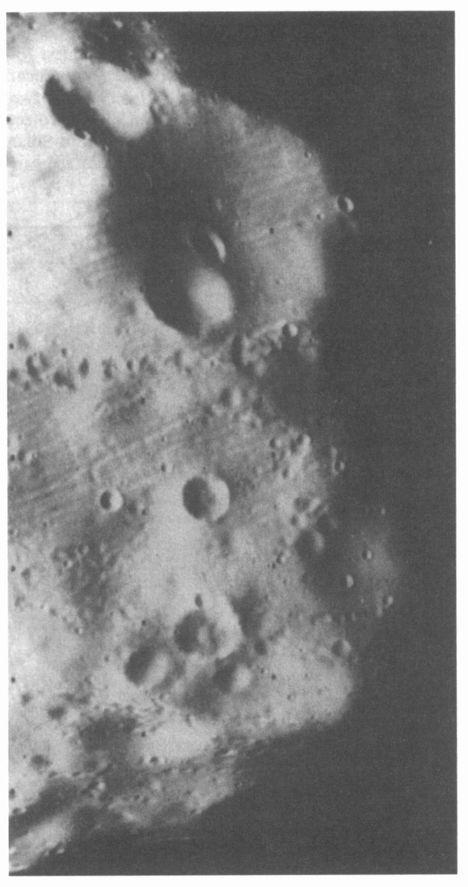
Close-up of the Large Crater Feature on
Phobos
Careful scrutiny of
this picture will reveal that the large crater is hexagonally
shaped!
Phobos’Peculiar Hexagon Crater
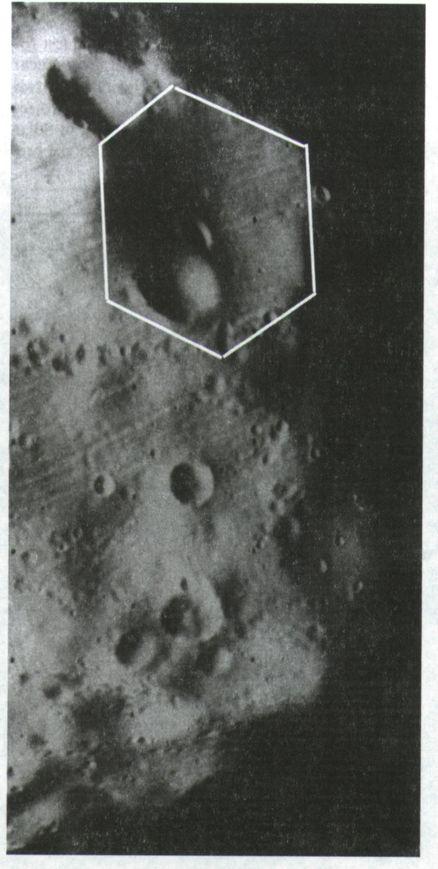
This feature, plus
the strange grooves running on the surface of the little moon just
beneath the hexagonal crater, suggest, once again, that there is
more afoot on Mars and its satellites than just natural geological
processes. As we shall see in the next chapter, the strangeness of
this feature is magnified by the fact that there is almost an exact
analogue of this feature on yet another moonlet, far far away from
Phobos.
The strangeness of
this little moonlet does not end there. The following picture of a
small “tower”, its square shape and shadow clearly visible, is also
from Phobos.
Small “Cylindrical Tower” on Phobos
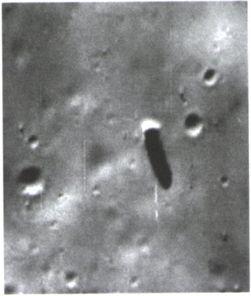
Additionally, Phobos
also has its own gravitational anomalies that strongly suggest that
it, too, might be a “hollow” moonlet. Indeed, the Soviets were the
first to suggest, as they did with Earth’s far larger Moon, that
Mars’ little satellite might indeed be an artificial object in its
entirety.
And well they might,
for Russian attempts to explore the Red Planet and Phobos have met
with some very disastrous results, the most extreme example of
which was the apparent deliberate destruction of their Mars probe
Phobos II on the 25th of March, 1989.
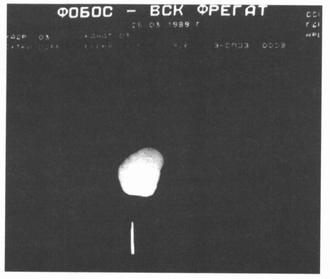
Just before transmissions from the probe suddenly ended, it sent
back the following picture of the shadow of an object on the
surface of Mars itself, an object that was in the vicinity of the
moonlet Phobos. The Russian probe also photographed a now famous
picture of a long, thin, cylindrical object beneath the Martian
moon shortly before all further communication was permanently
lost.
Shadow of Cylindrical Object Cast on the Surface of Mars,
Photographed by the Russian Phobos ll Probe, 25 March,
1989
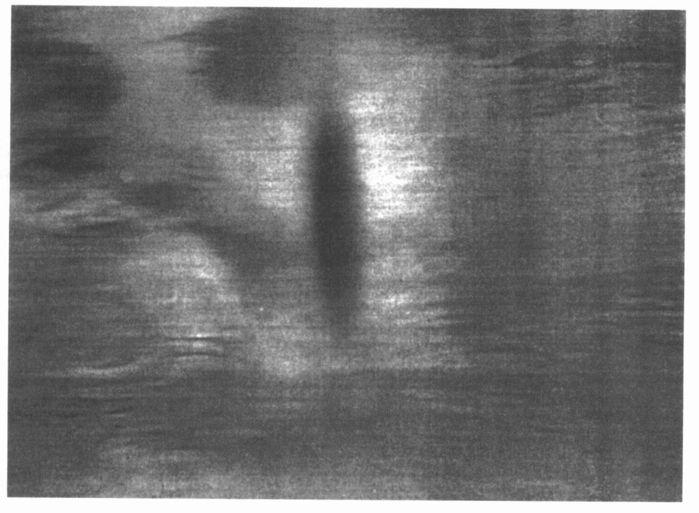
Photograph of Long Cylindrical Object Beneath the Martian
Moon Phobos Taken Before Transmissions Ceased, 25 March
1989
Needless to say, the
Soviet Union at first placed these photographs under the highest
security classification, then, for some reason, decided to share
these two pictures with the United States. This fact led some
Russian scientists to conclude that Phobos itself was an artificial
moon, and that their probe has been deliberately attacked and
neutralized by the cylindrical object that it photographed just
prior to the probe’s loss.