
4. The Celestial, or Galactic War and Deluge, and Mars-Nergal: The “Great Leaping One”
One of the overlooked
areas of De Santillana’s and Von Dechind’s work is the galactic and
astronomical-astrological context in which they understand the
ancient mythological references to the Deluge, to war, and other
apocalyptic imagery. An entry into their discussion is afforded by
their remarks on the gigantic war between the Pandavas and the
Kauravas in the Hindu epic, the Mahabharata: “The epic states unmistakably that
this tremendous war was fought during the
interval between the Dvapara and the Kali Yuga.”202 A significant clue
is thus afforded from yet another mythological source as to when it
dates its major “war of the gods in heaven.”
To see why, a brief
summary of Hindu thought on its “world ages” or “yugas” is in
order. In its most basic form, there are four great “yugas” or
ages. They begin in a “Golden Age” and each yuga thereafter is an
age that is declined from the previous one. Each age is thousands
of normal years in length, though each age is of a different
length. In order then, these yugas, with their lengths in years,
are:
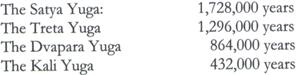
The final yuga, named
after the notoriously bloodthirsty deity Kali, is an age of
darkness, chaos, evil deeds, and war. Observe also that each yuga
is exactly half the length of the yuga previous to it, until the
cycle returns.
Note also that in
Hindu teaching, the world currently is in a Kali yuga, which began
— depending on the authority one consults — approximately 3000 BC.
But if the Mahabharata refers to events
of the previous transition from the
Dvapara to the Kali yugas, running through the full cycle, then one
is looking at a war that occurred between 3,898,000 and 4,320,000
years ago. While many would object to taking the epic this
literally here, it is nonetheless highly intriguing that the great
war recounted at such length and fought with such eerily
modern-sounding and awesomely destructive weapons in the
Mahabharata occurs in very roughly the
same time frame as Van Flandern’s second exploded planet event, which occurred ca.
3,200,000 years ago. In other words, we are once again looking at
the possibility of a real war, involving real planets blown up in a
deliberate act of that conflict.
Let us now turn our
attention to a seemingly unlikely source for additional perspective
of this ancient war and the “cosmological original sin,” and the
astronomical meaning it entails: the myths of the ancient Germanic
peoples of Scandinavia. De Santillana and Von Dechind observe that,
like the Hindus, and indeed, like the Babylonians and the Greeks,
the ancient Teutons also had a Golden Age, who’s passing was marked
by a war between the ruling “good” god and his ministers and a new
race of giants who sought to overturn the old harmonious
order.
Not having “multiplied” yet, this first generation of the world established the Golden Age under the rule of Him of many names — Enki,203 Yima,204 Freyr205 and many more. “But these sons whom he begot himself, great Heaven (megas Ouranos) used to call Titans (Strainers) in reproach, for he said that they strained and did presumptuously a fearful deed, and that vengeance for it would come afterwards,” as Hesiod has it (Theogony 207-10).206
But what was it that
these Titans - or giants or Nephilim or
Annunaki or whatever one wishes to call them - had done? De
Santillana’s and Von Dechind’s understanding of the galactic
context of ancient myths shows exactly what was involved:
...It was bound to happen ...when future generations would construct “forbidden ways to the sky,” or build a tower which happened to be too high. The one secure measure, the “golden rope” of the solar year, is stretched beyond repair. The equinoctial sun had been gradually pushed out of its Golden Age “sign,” it had started on the way to new conditions, new configurations. This is the frightful event, the unexpiable crime that was ascribed to the Children of Heaven. They had nudged the sun out of place, and now it was on the move, the universe was out of kilter and nothing, nothing — days, months or years, the rising or setting of stars — was going to fall into its rightful place any more... and now the time machine had been set rolling forever, bringing forth at every new age “a new heaven and a new earth,” in the words of Scripture. As Hesiod says, the world had entered now the second age, that of the giants, who were to wage a decisive battle with the restraining forces before their downfall.207
While De Santillana
and Von Dechind would agree with Alford that the “war” motif is
purely metaphorical, they would not have, as Alford does, reduce
this imagery to a flat univocal and monotonous reference to an
exploded planet and falling meteorites. In fact, to do so would
miss the point entirely, for what the ancient myths are trying to
say is not only that a planet exploded, but that the war was truly
cosmic in nature, and affected all the celestial bodies of local
space, including “earth.” In the Norse version, interestingly
enough, this “end of the world” is brought about by sounding the
apocalyptic trumpet, the Gjallarhorn, which has a “sound which
reaches all the worlds.”208 Universal sound,
capable of wreaking havoc throughout the “universe”, i.e., all the
worlds in the galaxy.
Indeed, as De
Santillana and Von Dechind observe, the Graeco-Roman cultural
complex if full of references to a celestial catastrophe of such
magnitude that even the “immoveable joints of the universe” were
shaken and the “very axle” running “through the middle of the
revolving heavens” was “bent.”209 At the minimum,
this last reference is nothing less than a statement that the angle
of the earth’s axis of rotation relative to the ecliptic was
altered in some drastic fashion.
But what if the
reference to a war is taken literally and not metaphorically? Only
if one takes it this way do some
interesting things now emerge. At this point, we shall now begin a
process of periodically summarizing the emerging case, adding, as
we go, new details. For now, the details we have assembled are
these:
1. Van Flandern’s Revised Exploded Planet Hypothesis indicated two events, one at 65,000,000 years ago, roughly coincident with the extinction of the dinosaurs, and another “lesser” event at 3,200,000 years ago, roughly coincident with the appearance of the first humans according to the standard mainstream theory;
2. This second event roughly corresponds with the timing given for the Great War in the Mahabharata;
3. Both events must have altered the geometry of local space and the astronomical arrangement of the heavens;
4. One or both events were observed and recorded, making it likely the second event was recorded, and referred to as the result of a war,
5. A case can be made, based on the plasma cosmology of Hannes Alfven and the petroglyphs observations of Anthony Peratt, that ancient humans observed large plasma discharges in the heavens, though these petroglyphs cannot be dated to the time frame of Van Flandern’s second exploded planet event nor to the Mababbarata’s Great War;
6. Further basis for believing that such discharges were observed is afforded by the peculiar resemblance of ancient depictions of the lightning bolts of the gods, such as Ninurta (with whom we shall much to do in part two), or ancient Greek depictions of the thunderbolts of Zeus, to the models of plasma instabilities observed by Peratt in the laboratory.210 The fact that these resemblances are so exactly described in ancient art and drawing, and, as we shall see in part two, described in texts are being weapons of war, strengthen the case that we are both looking at observed events and events of a real war. If so, the it follows that the “broken and shattered geometry” of local stellar and galactic space described in ancient myths is a result, as they themselves attest, of a war. In other words, the motif of war in the myths is not a metaphor for recurrent catastrophism, but the real cause of catastrophes, just as the myths state.
7. One or both planets may have been large water-bearing planets, and if of higher gravity than earth, and if home to intelligent humanoid life, then they may have been home to a race of “giant” like creatures;
8. Thus the explosion of such a water bearing planet would give rise not only to the asteroid belt, but, as the shock wave from that event spread through local space, would inundate first Mars, and then the Earth, with debris and water. Thus, the tremendous hemispherical “gouging” by sudden flood waters often commented upon by Martian planetary geologists is explained. One should therefore expect to be able to find references of a celestial Deluge.211 Of course, there is no lack of references from various mythological traditions referring to waters in or above the heavens. Perhaps it is time to take them less metaphorically!
9. Furthermore, if the exploded planet did have life, and if this life was of a high degree of sophistication and technological ability, its civilization might have been interplanetary in nature. The nearest planets capable of sustaining such life would naturally have been Earth, and Mars. As such, one might be expected to find mythological associations of Mars with war, which is in fact the case. In fact, it is highly significant as we shall see that the Vedic tradition refers to Mars as “the Great Leaping One.”
10. This war brought an end to an age and was fought between the “gods” and a race of giants, a theme common to mythological traditions from Sumer, Babylon, and Greece to Scandinavia and the Celts.
11. There does exist artifact and textual evidence of giant remains from all over the globe, which loosely corroborate the existence of anomalously large intelligent humanoid beings referred to in ancient texts.
12. Some traditions such as the Sumerian and the Biblical, ascribe the origin of this giant race to a mingling of the “gods” with “men.” The Enuma Elish makes it clear that Tiamat fought the war in part by creating chimerical creatures.
The image of the
“divine lightning” or the thunderbolt of the gods will become quite
crucial later on in this chapter.