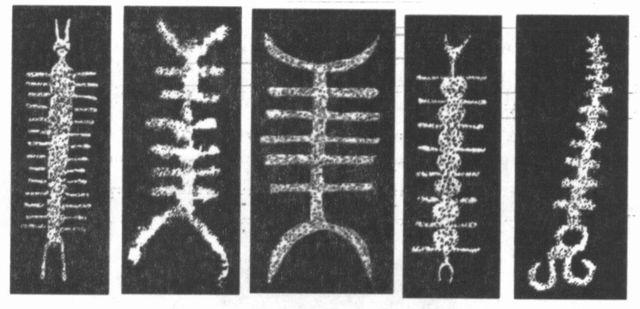
B. Petroglyphs and Anthony Peratt: Plasma Paleophysics
Peratt’s work is
quite the crucial matter for any investigation of paleophysics
along the lines of Alfvén’s plasma cosmology, for not only is
Peratt a respected physicist, but more importantly, his
paleophysical investigations and comparisons of ancient American
Indian petroglyphs with laboratory plasma discharges has been
published in a series of papers in peer-reviewed journals.97 Two of these papers
- “Evidence for an Intense Aurora Recorded in Antiquity,” and “The
Origin of Petroglyphs” - were published while Peratt was associated
with the Los Alamos National Laboratory, raising the question of
whether or not his work and that of his fellow scientists at Los
Alamos might involve such paleophysical investigations.98 And a glance at his
other research interests would tend to support that view, for these
“include numerical and experimental contributions to high-energy
density plasmas and intense particle beams, inertial confinement
fusion, explosively-driven pulsed power generators, lasers,
intense-power-microwave sources, particles, high-energy density
phenomena, new concepts in space propulsion and high-performance
computing,” as well as his interest in plasma cosmology and
cosmogony.99 Peratt is
consequently no light-weight New Age prognosticator. On the
contrary, his interests and associations would seem to suggest in
the strongest possible fashion that someone, somewhere in the
corridors of power in government black projects is seriously
interested in pursuing the avenues of paleophysics research that
his investigations outline.
Plasma Physicist and Cosmologist Anthony
Peratt
But what exactly has
Peratt uncovered? Peratt himself puts the case with all the
understated succinctness of a scientific abstract: “Based on the
compilation and analysis of the order of 50,000 digitally recorded
petroglyphs, we have identified several dozen general categories of
instabilities of a highly non-linear plasma column generally
associated with multi-mega ampere Z-pinches. This suggests that
prehistoric man recorded the occurrence of an intense and
long-lasting aurora.” 100 By means of a
“direct comparison of the temporal evolution of experimental
instabilities with petroglyphs” Peratt demonstrates that “nearly
all archaic carvings match the phenomena that might be produced in
an intense and long-lasting aurora.” 101In other words, the
seemingly meaningless stick figures of many petroglyphs are not
meaningless at all. They are the accurate recorded observations by
humans of immense electrical and plasma phenomena on a celestial
and planetary scale.
As if this were not
enough, Peratt is even more explicit in his lengthy article,
“Characteristics for the occurrence of a High Current, Z-Pinch
Aurora as Recorded in Antiquity,” which appeared in the Dec 6, 2003
issue of the IEEE Transactions on Plasma
Science. There Peratt states quite unequivocally that “it is
found that a great many archaic petroglyphs can be classified
according to plasma stability and instability data. As the same
morphological types are found worldwide, the comparisons suggest
the occurrence of an intense aurora, as might be produced if the
solar wind had increased between one and two orders of magnitude,
millennia ago.”102
For our purposes,
this implies three significant things:
(1) There is concrete worldwide evidence of a massive aurora phenomenon on a planetary scale from human prehistory, implying the existence of a physics able to produce such a phenomenon;
(2) human beings existed contemporaneously with this phenomenon, or other intelligent observers existed who passed on their knowledge to subsequent humanity; and,
(3) humans more or less accurately recorded it in the form of certain petroglyphs.
The last point is the
most significant, for it is not yet an argument for the case that
they may have accurately understood it,
much less have produced
it.
Having made this last
all-important observation, however, it is highly suggestive and
paradoxical that Peratt himself begins the main text of his article
in the following fashion:
On July 9, 1962, the United States detonated a 1.4-megaton thermonuclear device in the atmosphere 400 km above Johnston island. The event produced a plasma whose initial spherical shape striated within a few minutes as the plasma electrons and ions streamed along the Earth’s magnetic field to produce an artificial aurora....Concomitant with the artificial aurora was a degradation of radio communications over wide areas of the Pacific, lightning discharges, destruction of electronics in monitoring satellites, and an electromagnetic pulse that affected some power circuitry as far away as Hawaii. 103
In other words, it is
only with the rise of modern physics and its associated
technologies that such large scale plasma and aurora phenomena can
really be understood at all, since only these technologies allow it
to be artificially produced and studied in the
laboratory. That the “laboratory” in this case was the
entire earth’s magnetic field and a 1.4 megaton hydrogen bomb
detonated atmospherically should give one pause as to just what the
implications may really be for an ancient human observation of similar large-scale
auroral effects.
In any case, having
begun his article in this thought-provoking fashion, Peratt passes
immediately to a scientific consideration of the characteristics of
auroral plasma columns and displays. These plasma instabilities
come in two basic forms and may be observed over a wide range of
electromagnetic frequencies.104 The first type of
instability is a “column” of many varieties of toroidal or
vorticular structure. The second basic type is a “sheet.” Peratt
notes that the first type may have dimensions of “hundreds of
kilometers in diameter,” while sheets may be as wide as tens of
kilometers.105 The red, green and
blue auroras that occur naturally in the earth’s atmosphere are
easily explained as the natural result of atoms of nitrogen and
oxygen in the atmosphere “de-exciting” from their plasma
state.106
In producing the
various “mini-plasma” geometries in the laboratory, data was
obtained from the U.S. Department of Energy “pulsed-power
facilities at the Los Alamos National Laboratory and Sandia
national Laboratories.” Additionally “high-explosive generators”
from the United States and Russia also contributed to the data set.
Currents ranged from a few hundreds of kiloamperes to approximately
150 mega-amperes.107
Most notably, the
geometries themselves were “generated by applying high-voltage
pulses to gas-puffs to simulate an aurora-like plasma inflow... and
concentric plasma sheets formed by nested cylindrical foils to
produce high-velocity shock waves.”108 The beautiful and
evocative geometries that resulted were “a few centimeters in
diameter and 203 centimeters in length.”109
But what has this to
do with petroglyphs? And what has any of it to do with paleophysics
and the possible thesis of an ancient interplanetary
war?
Again, Peratt points
the way in his paper, for in spite of its scientific technicality,
its real focus is not on the plasma geometries themselves, but on
their uncanny resemblance to these ancient petroglyphs. Notably,
Peratt focuses his attention on petroglyphs thought to be dated
from 10,000 to 2000 BC.110 This is
significant, for it may provide yet another anchor point for any
eventual dating of the “war” scenario, and as we shall see, it
falls within the latest possible temporal window for the
cataclysmic events.111
In the presentation
of Peratt’s comparison of petroglyphs and the geometries of plasma
instabilities, I will rely on the excellent summary of his work
provided by comparative mythologist David Talbott, and Australian
physicist Wallace Thornhill, from whose masterful and provocative
book, Tunderbolts of the Gods, this
chapter takes its name. Talbott and Thornhill’s study is an apt
summary of
Peratt’s extensive
research, reprising its more salient points and greatly expanding
upon its cultural and historical implications.112
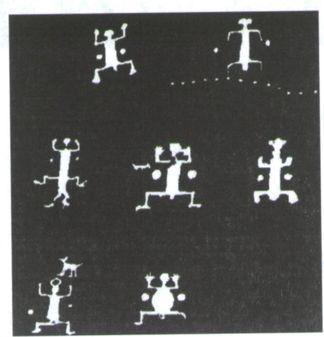
One of the most
common of the petroglyphs is the so-called “Squatter Man,” an
apparently humanoid stick figure with two dots to either side of
its “torso.” Found worldwide, the most common forms are early
American Indian versions.
Native American Indian “Squatter Man”
Petroglyphs
Such nomenclature,
assigned to these pictographs by anthropologists who could view
such cultures as nothing other than “primitive,” may have missed
the point entirely, according to Peratt, for they may be indicative
of a columnar plasma instability, indeed, bear an uncanny
resemblance to it.
Peratt’s Comparison of a Three-Dimensional Plasma
Instability on the Left, with its Two Dimensional Analogue on the
Right (photos found on p. 22 of Talbott and Thornhill’s Thunderbolts of the Gods)
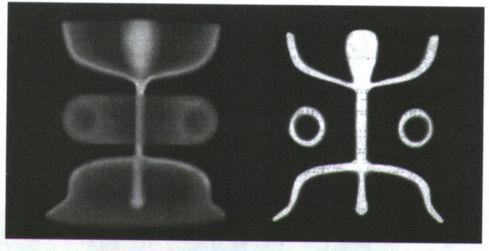
As the above
comparison indicates, the “Squatter Man” petroglyph may be nothing
more than the recorded two dimensional observation of a vast
auroral display, with the two dots to either side of the torso
representing the various toroidal forms such instabilities may
take.
Yet another such
comparison is the “stacked torus” columnar instability seemingly
indicated by yet another petroglyph.
Pictograph from Kayenta, Arizona.

As the above
interpretation of Talbott and Thornhill indicates, this petroglyph,
from an American Indian site at Kayenta, Arizona, not only gives
another verifiable connection to plasma physics but also
demonstrates that “primitive” man may not have been as primitive as
we have been led to believe, but was an accurate recorder of phenomena and events he
witnessed. This highlights a very significant question, for if
these ancient human observers were accurate recorders and observers
of such phenomena in their myths and art works, why would one
argue, as catastrophism does, that they accurately record such
awesome celestial displays, and yet dismiss them as mere
metaphor-makers or inaccurate recorders, when those same cultures
often indicate that such displays are the result of the wars of the
gods, fought with weapons of lightning and stones? We will return
again and again to this point throughout this work.
Three Dimensional Model of the Kayenta, Arizona
Petroglyph: Stacked Plasma Toroids

Other Petroglyphs of Stacked Toruses