
CHAPTER 3
The Power of the Platform: Visual Storytelling on Social Networks
In today’s world of information consumption, we’re surrounded by media, and it’s never been more important to grab your audience’s attention with high-quality content. The brain processes visual content 60,000 times faster than text1 so it is no wonder that marketers are increasingly turning to strong visual content to engage their audiences—and keep their attention.
Social media have made it easy for brands to connect with customers not just through text but with photos, videos, infographics, and other images. This chapter will show just what a vital role visual marketing is playing in brands’ social media strategies and its impact on engagement and sales. Visual media are increasingly being used instead of text by marketers keen to connect with customers—and to have their messages amplified with shares, likes, and comments.
Too many companies opt for a blanket coverage approach to social media. They share the same posts in the same way to all channels, and then they question why their followers aren’t engaging with their content. There isn’t a one-size-fits-all solution to social media: each network has its own character and audience. To get the most out of your social media channels, you need to create strong content—and then use it to start a conversation that is appropriate to that network.
In this chapter we’re going to take a look at how to get the most out of some of the most popular networks for sharing visual content: how to use that content to engage your audience, how to build it in to your campaigns, and how to make your brand stand out above the chatter.
Social media are increasingly offering solutions to the demise of traditional marketing and the fragmentation of our attention across so many channels. We’re going to look at how some of the most successful brands have used the visual strengths of social media to grab their audience’s attention—and to keep it.
The dark horse of the social media race is surely the image-community site Pinterest. On the surface, Pinterest is a whimsical pinboarding site where members share their favorite images and photos, grouped around themes. Users can follow pinboards or whole profiles and repin images to their own boards, adding comments and likes.
Pinterest’s meteoric rise in only a few years shows that the site is more than just a pretty community for people interested in fashion and lifestyle. Marketers are all over Pinterest’s lead-generation aspects, because online hits on products from the site have proved a marketing sensation. According to a study by Shareaholic, the site now drives more referral traffic than Google+, YouTube, and LinkedIn combined.23
STATS
Although it is most known for photographs, you can also pin images such as infographics, cartoons, artwork, or short, visual quotes. You can add videos, too, which many companies use to give short tutorials or how-to style guidance.
Pinterest’s slick, clean look is dominated by images and videos. When you go to a user’s profile, you see his or her themed boards, all beautifully arranged. Each board may contain many pins, and these can be commented on and liked, but the text is definitely secondary to the images.
“Pinterest Is Worth $2 Billion Because Its 25 Million Users Are Rich, Female, and Like to Spend.” This headline from Business Insider24 sums up what the savvy marketer knows already: one of the most sought-after consumer groups, women, particularly householders, are spending an increasing amount of time on Pinterest, and they are using it as a venue for their online shopping. Brands who don’t have a presence on the site are losing out, both in terms of sales and in terms of potential new customer demographics.
Although it’s known for being the site of choice for the lifestyle and fashion industries, Pinterest can help all industries find new audiences and connect with their fans through images. The U.S. Army, for instance, has a hugely popular page with boards that feature Army values, families, veterans, history—and, of course, Army style!
It’s all about translation: finding ways to appeal to Pinterest users, even if you don’t think your brand is a natural fit for the site. Digital news magazine Mashable’s site has one of the largest followings on Pinterest with almost 1.5 million fans, despite the fact that the brand doesn’t fall into any of the more usual fashion or style categories (http://www.pinterest.com/mashable). It does, however, feature pinboards for “The Modern Kitchen,” “Nerdy Desserts,” and “Fashion Meets Digital.” There is a little bit of something for everyone with boards like “Gorgeous Instagram Photos,” “Pets Gone Digital,” “3D Printing Creations,” “Women in Tech,” and “Web Humor.” The digital news magazine has done a great job hitting on exactly the right format to appeal to the Pinterest ethos: finding a visual way to represent its brand in a fun, humorous, and stylish manner. Marketers just have to think outside the box a little to find innovative ways to reach the Pinterest audience, but by getting the formula right, they can reach large, new, untapped audiences.
Pinterest’s format makes it very easy to share images, and it provides excellent lead generation, especially for visual industries. Because Pinterest users can add a widget to their desktop that allows them to easily repin images from any website onto their own Pinterest boards, companies who haven’t even got a profile on Pinterest have discovered new traffic coming in from the site from fans repinning images from the company website. Images taken from a site will still link back to the original source, so as long as they come from your website, you can still see a boost in your traffic coming from Pinterest.
It is better to add your own Pinterest button on your website so you don’t lose out from users’ finding your photos from other sources, such as Internet searches. Make it easy for fans to repin your images directly, especially if you have an image-rich site.
Those who don’t think of their websites in terms of optimizing them for Pinterest are missing the chance to share their products with a brand-loyal audience with disposable income. The brand agency Digitas says that automotive brands in particular are missing the boat: “Unlike the fashion/retail brands, top automotive brands average 3 repins on every pin, while the community receives 10 repins per pin. One reason the automotive industry might be seeing lower engagement on Pinterest than other industries is because most current automotive sites are structured to use Flash, which makes it difficult for users to pin content.”25
Even for nonvisual industries, Pinterest users (generally young, female, educated, and affluent) are often a key demographic that marketers want to reach, and the site provides an excellent opportunity to interact with them in a completely different way than traditional advertising allows.
The site’s community and sharing features give you the chance to have your message distributed by your followers (or their followers, or their followers …) to a potentially large audience of activated, social, brand-loyal users. These are exactly the types of people who make for the best brand advocates: they share, like, and comment on images from their network, and they are highly motivated to find out more about your products by clicking on the images to find the source.
If we have a look at Pinterest’s core demographic—women (80%), especially moms, with disposable income—we can see the hard-to-reach groups that marketers are often failing to engage with their traditional advertising (91% of women in one survey said that advertisers don’t understand them).26 As women account for 85% of all consumer purchases including everything from autos to healthcare, it is essential for marketers to find new ways of targeting them.27 Pinterest offers a creative solution to this problem for marketers who are willing to think about innovative ways of representing their brand through images and who want to engage with fans and new audiences online.
Creativity is at the center of Pinterest’s design. Choosing themes for your boards can open your company up to a whole world of ideas for visually interpreting its brand. We have compiled the following collection of board name and theme ideas that hopefully will get you excited and help you get started.
Some of the ideas for a company’s Pinterest board names and themes include these:
Inspiration and Ideas
 Holiday ideas
 Seasonal boards
 Spring, summer, fall, or winter style
 In your home
 Customer photos
 Party ideas
 Tech ideas
 Things we love
 Color-themed boards: white, red, and blue
 Upcoming
 Exercise and activity
 Health
 Back to school
 Thank you!
 Social media
 Home and kitchen
 Fashion
 Humor
Humor
 Brand-themed weddings
 Toys and games
 Quotes
 Environment and eco-friendly themes
 Charities or good causes
 Retro boards: images from the past
Information About Your Company and Its products
Webinars
Videos
Deals and offers
Shop
Store locations; about our stores
 How-to videos and photos
Our ads
In the news
Upcoming events
Conferences
Product demonstrations
Getting started
Help and advice
Troubleshooting
Style ideas: how our product fits into a lifestyle
Budget ideas: low-cost ideas for presents or styles
Information About Your Brand
Heritage
Behind the scenes
Our team
Our sponsored event
Have your say (customer-uploaded ideas)
Our offices
Our favorite foods
The office party
When we were young (baby photos of
staff)
Our customers
Our clients
Our mission
Our company’s charity
Our community
Our town
Fan Love
Pinterest can boost traffic to websites from a whole range of businesses and for companies of all sizes. Louisville resident Kim Gordon and her 15-year-old daughter Chloe created the PopCosmo site in 2011 as a trend-spotting site for teens showing off the latest fashion, beauty, makeup, and lifestyle tips. Immediately they saw the value in Pinterest as a way to generate interest in their site (http://www.pinterest.com/popcosmo). Chloe runs the social media platforms for PopCosmo, and her content focuses on providing visual inspiration and useful DIY tutorials—both types of media Pinterest users love. Her images for the PopCosmo site and social media pages focus on helping teens stay trendy in fun, creative ways. According to Kim, Pinterest accounts for half of the referral traffic to PopCosmo and 20% of the site’s overall traffic.
“When a pin goes viral,” says Kim, “it can alter our web stats for months.”
And Kim and Chloe’s visual storytelling savvy doesn’t just extend to their own Pinboard—they encourage their readers to spread the word about their site through images.
One article on their site, a tutorial on creating French manicures, has been pinned over 380,000 times, and that’s not even including likes or repins.
You don’t necessarily need a big marketing budget to be successful on Pinterest, but you need to put some effort into thinking about how your brand relates to Pinterest users, and you need to be willing to engage with fans.
Melanie Duncan is a female entrepreneur whose business is booming thanks to Pinterest. It’s hard to believe that earlier this year she didn’t even know the site existed!
Melanie owns Luxury Monograms—a website specializing in monogrammed décor and gifts. Her product range includes throw pillows, tableware, towels, shower curtains, and apparel featuring bold monograms in a variety of styles. At some point she noticed a huge spike in traffic to her site: “When I logged in to my analytics account, I was shocked to see that Pinterest had become my site’s number one traffic referral source, above Google and Facebook. But what was even more exciting was that the traffic was converting. I was getting thousands of dollars in sales and thousands of new visitors to my site each month just from others pinning my products on Pinterest. Once I realized the opportunity, I created an account for my business, and I began to develop marketing strategies for using it.”
Melanie’s boards are a mix of product pictures and general décor and apparel inspiration (http://www.pinterest.com/luxurymonograms): “For example, I sell entertaining items like placemats and napkins. I know my customers are inspired by beautiful tablescapes, so I mix my offerings with large subject matter boards like tablescapes since those generate the most followers. I find that giving customers ideas for how the products can be used and styled is very powerful.”
Melanie has a board called “Blissful Bedding” where her monogrammed pillow shams are interspersed with dozens of images of beautiful beds and bedrooms. She filled the “Bridal Shower and Wedding Gift Ideas” board with products that complement her own items, and she even pins press clippings about Luxury Monograms to add a level of authenticity.
So how does Pinterest fit into Melanie’s overall marketing strategy? “For me, the real advantage of Pinterest comes from adding the Pin It! button below product images and blog posts—this encourages others to generate exposure for me. I have noticed that reminding people and making it easy for them to pin my products is the most effective use of Pinterest for my business.”
Melanie has also hosted a number of successful contests through Pinterest. Contests further encourage fans to repin her products, gaining even wider exposure for Luxury Monograms.
“My followers are women who love to decorate and entertain. I develop effective information on my Pinterest account that inspires and educates on product usage and ideas. Inspiration is a very effective marketing tool.”
Melanie, who now hosts webinars teaching other entrepreneurs how to use Pinterest, says the platform has shown her the real power of social sharing, and it has allowed her to find a new passion: “Each morning I wake up to an inbox full of stores wanting to carry my line, magazine editors wanting to feature me, and tons and tons of sales. The only thing I love more than seeing my business do well is being able to help other entrepreneurs do the same.”
Pinterest contests are growing in popularity as a fun way for brands to inspire fans and promote products. HP hosts an ongoing Pinterest contest to promote its HP SpectreXT laptop. Each week the company announces a different theme on its website for fans to create a Pinterest board around. The board needs to include just one pin of the HP SpectreXT laptop, and entrants submit the Internet address for their board through the dedicated HP web page. Each week’s winner is decided by public vote from the submissions, which are rewarded with prizes, including an HP SpectreXT laptop and $500 Amazon gift cards. HP has cleverly assimilated the contest into its own website, helping to drive traffic between the two and simultaneously collecting contact details from entrants. As the contest is ongoing, HP ensures that consumer engagement remains high and doesn’t drop off after a single competition. By asking entrants to pin one image of the laptop, the company is promoting the product more widely, as there is a steady stream of new images of the product being added by a number of fans over time.28
Pinterest contests don’t just have to be consumer focused—B2B companies can run successful contests too. Emailvision, a company that creates “software as a service” (SaaS) marketing solutions to deliver and automate e-mail marketing, ran a Pinterest campaign that targeted e-mail marketers and was designed to promote Emailvision’s services and celebrate e-mail marketers at the same time. The “Pin Your Inbox” contest asked e-mail marketers to pin their favorite e-mail campaign to enter, and the prize was an e-mail creative designed by the Emailvision studio. The contest was smart—it focused on Emailvision’s target customers, and so it raised awareness of the company’s business, but because it encouraged e-mail marketers to send in beautiful campaigns, it was incredibly positive and generated a good vibe. Plus, the prize was one that the entrants would be happy to win.29
Intel is another example of a B2B brand that didn’t shy away from Pinterest. With boards like “Tech Infographics,” “Technology and Art,” and “Geek Chic,” Intel definitely owns its inner geek and shows its passion for technology (http://www.pinterest.com/intel). One of our favorites is the board called “Fan Love.” Well, okay, full disclosure: Ekaterina was the one who created that board as part of Intel’s Pinterest strategy in 2012. But what is fantastic about boards like this one is that it gives voice to Intel’s fans. A combination of images from Intel fans from around the world and images created through the crowdsourced contest, the board truly shows what Intel means to those who love the company and share passion for technology. A word of caution though: make sure you have the right to use the image before you post it on Pinterest. Intel has gotten the artist’s permission for every image posted on Intel’s “Fan Love” board.
Pinterest is all about creativity. Its users are creative, and successful brands are innovative with ideas for boards and pins. The best brands on Pinterest are the ones that keep content fresh and topical, that are dedicated to representing their brand in the best way they can to Pinterest’s users, and that think about what they can provide that appeals to the interests and tastes of pinners. Pinterest is fun, slick, imaginative, artistic, and social. If your brand can be all these things, then you could find new audiences for your brand.

YouTube
Since its inception in 2005, YouTube has revolutionized the way we interact with video content. Advertising success can now be measured in viral YouTube hits, and video content has become seamlessly integrated with brand marketing in a way that was unimaginable before YouTube’s online dominance.
One of the most important considerations for marketers is that YouTube is owned by Google, so make the most of search engine optimization (SEO) by choosing the right key words, titles, and video descriptions. By doing so, you’ll enlist the world’s largest search engine to help your content—and your brand—be discovered. Because of the power of Google behind YouTube, YouTube is the world’s second largest search engine after Google.30
A recent YouTube redesign (called “One Channel”) for brand channels means that you can have an intelligent banner image that will resize to look the same across all platforms, with the ability to embed social media links within it. You can also create your own 30-second video trailer at the top of the page to build your subscriber base. You can make more decisions over how your video lists are displayed and order them by related channels, interest lists, and content playlists in order to make the most of your content.
According to YouTube, optimized One Channel pages have driven a 20% increase of page views since they were introduced.31
Video annotations have revolutionized the way that marketers use YouTube. You can incorporate hyperlinks into the video itself to create a “clickable” interactive video. This opens up all kinds of possibilities to brands—viewers can follow the cue to click and find out more about a particular product, or you can put together an interactive commercial, during which users decide which outcome they prefer. You can use YouTube’s metrics to find out the click-through of different options to learn about your customers’ choices.
Marketers can also impose restrictions on viewers such as age or location. Brand channels can be featured on any website, and they are not limited to YouTube only, so they can become part of your main website, which can be a great option for SEO and viewers’ discovery of your main company website.
YouTube can enhance a brand’s global position in a way that could take millions of dollars in a standard advertising budget, and it can help a brand connect with hard-to-reach groups, such as 16- to 25-year-olds. A successful television commercial that goes viral on YouTube, such as VW’s The Force (http://www.youtube.com/watch?v=R55e-uHQna0) or Evian’s Baby and Me (http://www.youtube.com/watch?v=pfxB5ut-KTs), could expect to get tens of millions of views worldwide.
Since YouTube’s launch, many brands have been quick to explore the marketing potential of video content from video blogging to educational videos, conference talks, and new advertisements. Successful brands mix in a variety of content on their brand channel to maximize customer engagement and show their audience different aspects of their business.
When you are setting up and managing your YouTube content, it’s worth keeping in mind your marketing strategy: just what are you trying to achieve with this material? If you are trying to drive traffic to your website, make sure you include prominent links on your video’s description as well as on your channel’s home page. You can add banners or text to a video to give a call to action or remind viewers of your mailing list or a promotion.
You can use YouTube like a kind of video catalog, which cuts out the steps between more traditional advertising and purchasing. There is a growing trend among millennials in particular to use video to make purchasing decisions. By embedding ads in the video content, you can encourage viewers to click straight through to your store and purchase through the video.
Video content specialist Adjust Your Set created a series of click-to-buy videos for lastminute.com’s YouTube channel, launched in the run-up to the holiday season. The “Gifts for Him” and “Gifts for Her” videos ran for 10 days, and they attracted 22,682 views; there were 2,609 buy clicks on the gifts, with an average click-through rate of 11.5%.
STATS
A lastminute.com spokesperson said, “Video content like this where the viewer can click and buy products or services from us while the video is playing has proven that it drives sales and engagement for the brand, and we’ll continue to invest in this in the coming year.”48
In 2012, a video promoting a razor blade business called Dollar Shave Club went viral—and to date it has had over 10 million views on YouTube (http://www.youtube.com/user/DollarShaveClub). The video features the company’s founder, Michael Dubin, walking through a warehouse giving essentially a stand-up comedy routine and telling men to buy his razors. The initial results were spectacular: the company’s server crashed within an hour of the video going live from all the referral traffic as 12,000 orders arrived in the first 48 hours. The video launched the company and turned it into an overnight success.49
YouTube offers you a chance to be responsive to your audience. The in-depth analytics let you see not only popularity, likes, and shares but also demographics. You can use this information to make decisions on future content. For example, if you discover that you are popular in one part of the world or with one age group, you may wish to use more material to appeal to these demographics. Alternatively, you could look at why you are less popular with other groups and focus on changing that.
YouTube offers a chance for a more informal look at your company beyond your traditional advertising. There are many ways of connecting with your customers and reaching new audiences, so don’t limit yourself to posting only your company’s TV commercials—try and think of all the ways to use video to show a 360-degree view of your company and products.
Your videos don’t have to be limited to what you produce as a brand. You can let customers tell their own stories for a rich tapestry of real-life ways in which your brand has made a difference in their lives. Target recently created a commercial from home videos of real students opening their college acceptance letters (http://www.youtube.com/watch?v=NyDXdHVw-yM). The use of real people telling real stories in a powerful, visual medium meant that the campaign resonated with people all over the country. The campaign enabled a megacompany—Target—to build a personal relationship with its customers through visual storytelling.
Video can take the form of a conversation between brands and their customers. When consumers create a video (either to highlight your product or criticize it), it is a perfect opportunity to engage in the conversation and either thank them or turn them around or highlight some of the best features of your product.
In either case, your quick response might attract more traffic and create more conversations than the original video itself, as well as offer you an opportunity for creating yet another advocate. But you have to be agile and open to being creative and innovative in the way you provide your response. Much more on that in Chapter 5.
One great example would be Tiger Woods’s video game. When a customer found a glitch in the game in which Tiger walks on water, he posted the video on YouTube describing the glitch and saying that no matter how good Tiger is, he can’t walk on water. Tiger responded by posting a video in which the golf ball lands on a lily pad in the middle of the lake … and Tiger walks out on water, swings, takes the shot, and lands it right in the hole. The message read: “It’s not a glitch. He’s just that good.” It’s worth a watch: http://www.youtube.com/watch?v=FZ1st1Vw2kY. The video has had over 6 million views. Absolutely brilliant marketing! Agile and innovative responses connect with the customers on an emotional level.
Just before Christmas 2012, Ekaterina had her own encounter with the “wow” experience when her casual tweet to REI, “What is the best gift suggestion you have this year?” was answered through a video. Not only was the video custom made for Ekaterina, it was made within 30 minutes. Even for the most innovative companies, that speed of response is to be envied.
Someone actually took time to create a custom response. Not only that, REI presented itself as a socially savvy brand. That piqued Ekaterina’s interest, and she decided to meet REI’s social media team and investigate further.
REI started its social programs about five years ago. The social team is composed of three people, all passionate about working with customers. It was a natural fit for the brand because the company is a member-owned co-op. “Our members are the source of our inspiration,” said Lulu Gephart, social media team member at REI. “We love to bring our members’ outdoor inspiration and expertise to life on our social platforms.”

And it shows. One holiday season, the team decided to spice it up and answer holiday questions on Twitter with video. The program was called #giftpicks. To accomplish that, they used Green Vests—the in-store employees who pride themselves on their passion and expertise in various product lines and who are always available to help. Ekaterina’s video response came from Charis, a Green Vest who works in the Bellingham, Washington, store.
The team shot about 90 custom videos during the period of several days. During that time the referral traffic to REI’s site doubled. That is what we call “making marketing personal.” Brands that embrace the personal touch and creative agile response through rich media and visual marketing are reaping the benefits.
One of the first company videos to go viral and make a real difference to that company’s sales was made by Tom Dickson, who owns Blendtec, a company that manufactures food blenders in the United States. Back in 2006, he started making a series of videos, called Will It Blend?, shot in the style of tongue-in-cheek infomercials that simply showed him using Blendtec food blenders to blend ordinary household objects, including iPhones, credit cards, and golf balls. The videos went viral very quickly, and fans started writing in with requests for items to be blended, to which Dickson often responded (http://www.youtube.com/user/Blendtec).
The original video, featuring a bag of marbles being reduced to dust by Blendtec’s hardy blender, has now been seen over 6 million times, while a video showing an iPad meeting its match has had nearly 16 million views. The channel has over half a million subscribers, with 130 videos now uploaded, and counting. Dickson likes to bring out themed versions for holidays such as Thanksgiving (blending a Thankgiving turkey dinner, naturally), and a World Cup version where he blends a vuvuzela (a plastic horn used in football matches in South Africa).
The popularity of the brand’s series is staggering, but the impact on sales has been similarly impressive. Since the first video went viral in 2006, Blendtec has seen sales jump by over 700%.50
So what is the secret to Blendtec’s success? There are several reasons why the Will It Blend? series made such an impression on viewers—and on sales. The format is brilliantly simple: everyone can relate to the corny infomercial style. And it’s got that edge of misbehaving to it—we know our moms would never, ever let us blend half a dozen lighters (for good reason as it turns out: Blendtec had to deploy a fire extinguisher when the lighters exploded).
Tom Dickson is also really good at listening to fans and responding to their suggestions for items to blend, which has secured his popularity with followers. Dickson has also taken onboard that first rule of Internet content marketing: keep content fresh. New videos are always being released, keeping the product firmly in the minds of the hundreds of thousands of YouTube subscribers. Then there are the themed versions, inspired by holidays and events like anticipated product releases (the iPhone videos are some of the most popular) that keep the videos topical and add humor. The Will It Blend? series has now gained a total of almost 300 million views, and it has become an Internet meme in its own right. Not bad for a small blender company from Orem, Utah.
YouTube is a marketer’s dream: it can connect with a global audience and show more dimensions to your brand than the more traditional made-for-TV commercials. The best brand YouTube channels use a variety of formats to engage with their followers, from the more traditional advertising videos to behind-the-scenes footage, meetings with team members, videos shot by fans, how-to or troubleshooting guides, or minidocumentaries about issues surrounding the products. As smartphone and tablet usage increases and becomes more a part of the everyday lives of people around the world, YouTube will become part of a forward-thinking brand’s strategy to connect with audiences in ways unimaginable only a few years ago.
One social networking platform has become significant in the lives of so many people that it has spawned a major Hollywood film, and its name has even become a verb. Have you Facebooked lately?
Since its creation nine years ago, Facebook has become a habit of life for many of its 1 billion users. It isn’t “just” a social network: it has revolutionized the way we connect online. Facebook has opened up a global world to us from the comfort of our own armchairs, bringing people and organizations together in a way that has quickly become second nature but was unthinkable only a few years ago.
Facebook allowed brands and organizations to set up their own public pages in 2007, and ever since forward-thinking marketers have been using them—and the many improvements introduced over the years—to connect with their customers in ever more inventive ways.
One of the greatest assets of a company Facebook page is that text, image, and video posts can all be seamlessly integrated in a user-friendly design that encourages comments, likes, and shares from followers. Promotions and campaigns can go viral very quickly, and feedback from fans can allow you to generate two-way conversations with followers.
Visual posts really stand out on a company page and generate more engagement than text posts alone. Facebook is even starting to replace brand websites as a fan’s go-to place to find out more about the company: a recent study shows that 50% of Facebook fans prefer brand pages to company websites.51
Facebook has helpful guides for companies who want to start their own Facebook page or who want to make an existing one more successful at meeting their goals. Their Facebook for Business page has step-by-step instructions for setting up your page and getting the most from it. The page has a dos-and-don’ts section for choosing your cover photo, and Facebook gives tips for posting, such as these:
• Posts between 100 and 250 characters get about 60% more likes, comments, and shares.
• Photo albums, pictures, and videos get 180%, 120%, and 100% more engagement, respectively.
Facebook also tells you how to set up Facebook Adverts and Sponsored Stories to reach your target demographic, as well as how to monitor which adverts are more successful with the Adverts Manager function. There are tips for engaging your audience with relevant content and how to set up Facebook Offers to promote deals to your fans. You can promote your posts to reach more people, while Page Insights shows you what elements are working best and who is connected to your page. There are plenty of examples of best practices, such as “Post at least one to two times per week so that you stay top-of-mind and relevant to the people who like your page.” Once your page is up and running, Facebook has plenty of advice on how to increase your influence and reach a wider audience, so be sure to check out their pages and read their helpful guides for businesses.
It is also worth taking note of how Facebook filters the content that appears in the News Feed. As mentioned earlier in the book, an algorithm called EdgeRank determines how much engagement your posts inspire and how interactive you are at responding, reading, and liking other people’s posts. The more engaged you are, and the more engagement your posts receive, the higher your EdgeRank score, and your posts will be placed in a more prominent position in the News Feeds of your fans.
Marketers are beginning to realize the power of Facebook to connect with fans and to spread the word on new products and promotions. They are using it not only to reach out to new customers but also to turn them into loyal followers of a brand.
But how can a social networking site inspire this sense of potential for companies? Exactly how do you make the leap from friends’ sharing photos of vacations, drunken nights out, and funny pets to empowering brands to drive sales through Facebook campaigns?
It is unusual now for a company not to have a Facebook page—there are presently more than 15 million brand pages on Facebook66—but there is a huge range in the way that companies are using the network. While some are happy to post the same content in a blanket way across their social media sites and link to their made-for-TV adverts, others are really getting behind the unique properties of Facebook to create communities and use it as a spearhead for marketing campaigns—with impressive results.
Facebook’s recent brand page redesign focuses more on visuals, with “headline” photos taking center stage and larger images appearing on the Timelines. This is all great news for marketers. Out of all the various social networking sites, Facebook is still one of the leaders for community building and interaction with fans—and visual media are a large part of its success.
A 2012 study by ROI Research found that when users engage with friends on social media sites, it’s the pictures they took that are enjoyed the most. Forty-four percent of respondents are more likely to engage with brands if they post pictures than if they post any other type of media.67 It is especially true on Facebook.
Designer paper and analog brand Moleskine has harnessed the power of visual media to create one of the world’s most active, prolific, and creative online communities. The company’s visual content strategy focuses on user-generated content: it creates large-scale projects that users participate in by posting their own images and videos. Moleskine sales have risen 26% since 2006 thanks to a combination of imaginative marketing strategies.68
A popular Moleskine Facebook campaign called What’s in Your Bag? had users upload pictures of the contents of their bags into a Facebook album. The project generated thousands of likes and comments as readers looked at the contents of other bags (which included Moleskine notebooks, naturally) and shared photos with their friends.
Fans also post photos of themselves recommending their favorite Moleskine designs and showing how they use their Moleskine products on the Facebook page, which has over 170,000 likes (https://www.facebook.com/moleskine). The company organizes events for enthusiasts around the globe, promoted through its Facebook page. Inspiring fans to create and spread images, customize the Moleskine notebooks, organize online competitions, and otherwise engage with the brand on a creative level has set Moleskine apart in its highly specialized market.
Successful companies often use traditional media and social networking to support each other, rather than choosing one or the other to focus on. In March 2011, the digital media company Neworld wrapped up a campaign for Irish organic dairy food producer Glenisk called the Tune Challenge, which used audio tracks submitted by fans on Facebook to find the soundtrack for their next TV commercial. The company says that “Glenisk experienced a sales uplift of 35% while the TV ad was on air. This is in comparison to when the ad was originally run in early 2010, at that time experiencing no significant uplift in sales. This integrated approach clearly delivered tangible results for the brand, much more so than just a television advert alone.”
Glenisk reported the following results:
• There was a sales uplift of 35% when the ad aired.
• The company got national airtime on Today FM, plus national and local PR coverage to a value in excess of €200,000.
• There were more than 25,000 YouTube online views for the TV ad.
• The number of Facebook fans doubled.
• New fans, who joined for the contest, were encouraged to become customers through free yogurt coupons.69
Facebook has recently updated its services to offer brands customized regional pages based on where fans are logging in from. Some content may be the same around the globe, but companies can use the facility to personalize the experience depending on where their fans live, which has helped many brands better connect with their audience. The Harlem Globetrotters basketball team increased traffic coming to its website from Facebook by 230% with a regionally targeted social media campaign, which enabled the team to automatically serve unique content, such as regional game schedules, to its Facebook fans around the world.70
When it comes to marketing through Facebook, it is important to think carefully about the visuals of your page. Marketing software company HubSpot wanted to promote its brand on Facebook as a thought leader in the business-to-business field in an effort to increase engagement with fans and customers and to generate more leads.
HubSpot chose to feature a vibrant city landscape as its cover photo, as well as its company logo. The company developed a tab called “Try HubSpot!” in its main page view, allowing people to use HubSpot for free for a 30-day trial or request a demo to see how HubSpot can work for their business. In addition, it ran Facebook ads and used a strong call to action in its ads to encourage people to like its page (https://www.facebook.com/hubspot).
The company tested ads by targeting different age segments, including 24 to 34, 35 to 44, and 45 to 44, along with likes and interests. Eye-catching images were used to grab people’s attention, such as the word “Attend!” along with information in the ad text about HubSpot’s marketing conferences.
To increase engagement, HubSpot posted updates every day about marketing conferences and e-commerce tips as well as links to demos and videos, and it asked questions such as “Is mobile marketing a part of your strategy?” frequently to spark conversation among fans.
HubSpot also offered links to live chats with marketing experts from within the company on specific topics, and it ran Sponsored Stories to get the word out about its brand.
This mix of techniques, including a strong emphasis on visuals, led to some impressive results:
• A sales increase of 71% from Facebook users over the course of the 3-month campaign
• An increase in ROI of 15% from Facebook over the course of the campaign
• An increase of 39% in traffic coming from Facebook over the course of the campaign
Dan Slagen, head of paid lead generation, HubSpot, said: “We’ve found that actively participating on Facebook has engendered a valuable, open line of dialogue between HubSpot and its interest base. We’re able to announce product updates, new e-books, and webinars, get feedback directly from customers, and gain inspiration for new ideas around inbound marketing all while generating new leads and customers.”71
Intel is another company that puts emphasis on social engagement. Facebook is at the center of that strategy. The company’s global page boasts over 22 million fans (https://www.facebook.com/Intel), with over 34 million fans in over 50 countries collectively.

Intel’s strategy with social communications is about making its audience smarter while entertaining them. A lot of Intel’s Facebook posts talk to the power of the “inner geek,” something Intel’s audience strongly relates to. An example of this strategy comes to life in the post seen on the right: “Avocados contain important mono-unsaturated fats that improve blood flow throughout the brain. Eating one is like going from a 56K modem to a high-speed ethernet!”
In a similar post, Intel educates fans on one of the company’s core product’s benefits—the light weight of an Ultrabook. Rather than showing the product specs or comparing it to something ordinary, Intel weaves an interesting fact about an obscure insect, a rhino beetle, into its marketing copy. This way, Intel is not only educating its fans about the product but it is also giving them interesting trivia in an entertaining visual. The post said: “The Rhinoceros Beetle can lift up to 100 times its own weight. That means it could carry 8 Ultrabooks on its back.” Intel thus took a straightforward fact and made it instantly engaging and shareable.


Facebook has allowed companies to use their brand pages to improve customer service, talk to fans, encourage feedback, share images, drive sales, expand their marketing horizons, and encourage user-generated content. Followers are able to relate to brands as never before and to feel like they are an active part of the product experience, rather than a passive consumer.
Twitter has broken out of its early stereotype in recent years as a microblogging site that appealed mainly to young people and techies, to become an innovative marketing tool for brands keen to connect with their audience and create a new kind of customer service experience. Of all the social media platforms, Twitter is currently the most popular with Fortune Global (FG) 100 companies.
Recent redesigns have helped to create a more usable and visual layout. The simplicity of the format allows videos and photos to be viewed from within Twitter. Individual Tweets can now be embedded directly into websites or blogs and even responded to, creating new ways of interacting with followers. Users have far more interactivity than before, but without the clutter; this is a “clean” experience. Twitter also has an array of new keyboard shortcuts, which will appeal to marketers who spend a lot of time using Twitter.
The network has grown rapidly in recent years to embrace large new demographics, including companies and business users. The high percentage of young people on Twitter is just one of the factors that appeals to marketers keen to engage with this previously hard to reach group.
STATS
Although primarily a microblogging site, Twitter has steadily been getting more visual. In 2011, Twitter added a new gallery feature that gave an image-based look to the network. This means that pictures now stay around much longer—100 photos can be displayed at any one time, so rather than disappearing down your feed, followers will be able to see all the images you’ve tweeted recently. It’s worth sharing plenty of visual content or your gallery will look a bit empty. As these pictures stay around for a while, think about what you are tweeting and how the overall picture will look to an observer: Do you have a good mix of images, or do you tend to concentrate on one type?
Twitter cards are a recent addition to the site, and they have added a whole new visual dimension to tweets that make them far more engaging. Twitter cards make it possible for you to attach media experiences to tweets that link to your content. They are little summaries of web pages, such as articles, blog posts, products, or companies. Tweets that link to participating websites can be expanded by users to show a whole range of media, including content previews, images, and videos. It’s worthwhile for marketers to be aware of the technology behind Twitter cards: if you add the code on your own site, you can determine what sort of content will be shown by a Twitter link. The potential for highlighting particular content could be very beneficial for visual campaigns.
There’s a new twist to the Twitter cards too: lead generation. With this simple but brilliantly interactive tool, users interested in a particular offer or promotion will be able to fill out a field on the card that links to their existing information, allowing them to quickly register interest. This eliminates tedious steps in persuading followers to come to your site to register their details, and it integrates the website and Twitter experience in a seamless and slick visual manner.
There have been some imaginative ways to use the visual side of Twitter to run some recent marketing campaigns. Volkswagen Brazil used the fast-paced buzz of the social media site to create a storm of excitement around the country’s largest—and sold-out—music festival, the Planeta Terra Festival in Sâo Paulo, which was sponsored by Volkswagen to promote its new cool car, the Fox. Volkswagen hid tickets around the city and pinpointed their location on a microsite using Google Maps. The catch was that the map was zoomed all the way out—and the only way to make it zoom in to show where the tickets were hidden was to tweet the hashtag #foxatplanetaterra. The more times the hashtag was tweeted, the more the map would zoom in. For four days, fans raced around the city to get to the ticket giveaway locations, and the campaign hashtag stayed the number one trending topic in Brazil the whole time. What a creative blend of all the strongest features of Twitter!88
Diet Coke wanted to promote women’s heart health as part of its relationship with health organization the Heart Truth. The company held a contest in which people were asked to tweet or Instagram photos that showed something heart shaped using the official hashtag #ShowYourHeart. Coca-Cola pledged to donate $1 to the Heart Truth for every photo shared through February 7, 2013, and five winners were invited to the Red Dress Collection Fashion Show held by the Heart Truth in New York City. Thousands of people entered, generating awareness for the cause and for Diet Coke’s association with the Heart Truth, and thousands of dollars were raised to help heart health. This inventive and altruistic campaign worked because it inspired people to think about the heart motif in a holistic sense: how the heart shape and heart health are part of their own lives. It created positive associations in people’s minds about the Coca-Cola brand and its work with good causes, and all through a simple visual message.89
RadioShack used the Promoted Trend function on Twitter to ask people to upload a picture of themselves stretching out their hand, along with the hashtag #ifihadsuperpowers and a tweet of what they would do with superpowers, for the chance to win a mystery prize. RadioShack then digitally added a superhero costume to the photo and tweeted the photo back to the users! Several of the photos were randomly selected to win prizes from the store or RadioShack gift certificates. Due to the success rate and impressive increase in fans and positive sentiment, RadioShack’s 2010 holiday campaign was selected from more than 200 entrants for the Forrester Groundswell Awards that year, winning top honors for its category “Business-to-Consumer North America: Energizing.”90

In 2013 Intel began using the hashtag #dothemath on Twitter, and it’s been the company’s most successful hashtag to date. Intel includes a staggering fact or comparison, the hashtag, and an image. This really works well because Intel’s followers like to have their minds blown by geeky statistics, and it draws them into the conversation. Intel has found that Tweets with numbers, statistics, and top-10 lists are generally recipes for success.
Another great example of interactive Twitter engagement is a Valentine’s Day dialogue between Intel and Lenovo. Intel sent some of their partners custom Valentine’s Day image tweets. Lenovo was one of the first ones to respond.
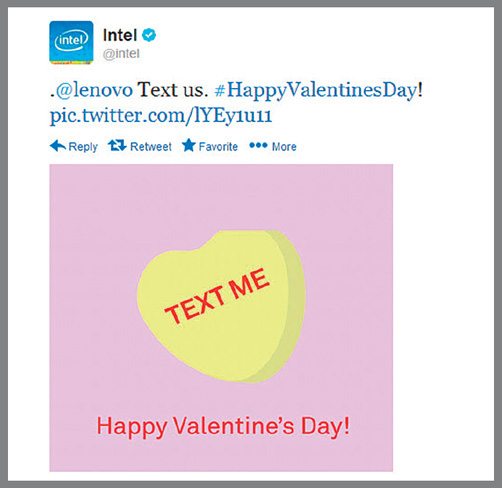
Intel said: “@lenovo Text us. #HappyValentinesDay!”
Lenovo jumped right in with this reply and a picture of the flowers made out of tech gadgets: “@intel We got you these. Don’t even need to put them in water.”
To which Intel responded with: “@lenovo Awww … we’re blushing! Thanks for the Valentine’s Day love.”
Banter like this shows the brand’s human side, its creativity, and its willingness to engage its partners and customers in the real-time dialogue.
Twitter has features that set it apart from other social media networks: it can generate buzz very quickly thanks to the trending element and the Promoted Trends and Tweets facilities, and individuals and organizations can have millions of fans so tweets can go viral almost instantly if they are picked up by influential figures. Using hashtags is a well-known method of getting your promotion out there to your fans and followers, but combining it with an image can encourage people to get creative and get the most out of this fast-moving network.
The photo sharing newcomer Instagram is changing the way we interact with images and with the brands that post them. Although it is primarily a mobile-based app, this hasn’t halted its spectacular growth since it launched in October 2010: it currently has 130 million monthly active users. Instagram photos (which are characteristically square, with artistic digital filters applied to them) can be viewed through Instagram or shared through sites such as Facebook (which owns it) or Twitter. Instagram relies on users’ posting hashtags with their images, which allows people to discover related images or search for something very specific. But the hashtags also work through other supporting sites like Twitter to make it a social network that stands alone or that integrates seamlessly into other platforms.
Now that Instagram has added the ability to record and share video directly from the platform to social media, the feature is already beating Vine91 in the battle to attract the biggest brands. The fact that Instagram is already heavily used by brands will help its new video feature be adopted quickly by companies looking for new ways to market products and connect with their followers. According to Mashable, videos shared by brands on Instagram have twice the level of engagement as Instagram photos and significantly higher engagement than videos on Vine.92
The features that make Instagram unique are these:
• There are 13 filters available to choose from to add mood and atmosphere to your video.
• You can add a static cover shot that serves as a thumbnail and/or title page.
• Recording time is 15 seconds versus Vine’s 6-second clips.
• Users can record multiple clips in succession.
• There is a stabilizer feature to smooth out shakiness and make the product more polished and professional.
• The usual Instagram tagging works the same as with photos.
The Instagram app gives a new, creative edge to snapping photos or videos from a phone. The whole process of taking a photo, choosing a filter or digital effects, and uploading it online is slick and fun: Instagram is an app for the click-and-share generation. Although there is no equivalent to the EdgeRank filter or promoted content, the most liked photos and videos do make it to the popular page, and now that Facebook has integrated it into its service, media liked on Instagram shows up on the Facebook Timeline, helping to share images more widely.
Since brands started to have real success using image sharing networks such as Pinterest, social visual marketing has become more and more central to a company’s strategy. Brands’ quick adoption of Instagram shows how attuned they have become to telling their stories through visual media—and with 100 million monthly users, they really can’t afford to miss the opportunities to reach new, young, vibrant audiences.
Like Pinterest, Instagram’s user base is dominated by women, and as we know, women are responsible for the majority of household spending. Smart brands are consequently prioritizing finding new ways to grow online communities that will reach this target market.
Because of Instagram’s instant, on-the-go appeal, companies are using it to humanize their brands, with plenty of behind-the-scenes and more informal content, as well as encouraging user-generated content, with great success.
The best-suited brands for Instagram are obviously the ones that lend themselves easily to images: luxury brands, retail, lifestyle, and fashion and design companies are natural fits for the platform. Your organization doesn’t have to fall neatly into one of these categories to build a following on Instagram though. Intel is using it to show the creative side of technology with some beautiful, artistic images that have captured their followers’ imaginations (http://instagram.com/intel).
American Express has similarly built on the opportunities that its product provides by posting lifestyle photos and the experiences that the product can enable, as well as shots of life at American Express HQ (http://instagram.com/americanexpress). The company has a vibrant community of over 27,000 followers, despite its being far from the typical Instagram brand user.103
Some of the most popular brands on Instagram are the ones who appeal to a younger demographic, such as Victoria’s Secret, Starbucks, Forever 21, and MTV. Marketers have been working for years to connect with this key millennial age bracket, and visual marketing on Instagram can be a core plank to a successful marketing strategy.
With more than 2.2 million followers, Nike is an example of a brand that got behind what Instagram is all about, and it is using it to its fullest (http://instagram.com/nike). You may think that there are only so many pictures of sneakers and apparel you could post, but Nike uses the platform to tell a lifestyle story filled with everyday and extraordinary athletic feats. From running to playing soccer, tennis, snowboarding, and more, Nike mixes in iconic images of professional athletes with inspirational photos, prompting its community members to share their stories of athleticism and pride in living an active lifestyle. Nike also celebrates its community by hosting fan-generated images on Instagram. To do this, Nike encourages fans to use hashtags such as #makeitcount or #justdoit for a chance to have their photos shared with the larger community. Nike also looks for opportunities to commemorate on Instagram its own milestones with its community. For example, when Nike hit 6 million uses of the hashtag #nike on Instagram, the company spent 24 hours sharing images from the community that prompted them to “push harder.” At the end of the 24-hour celebration, Nike ended by calling out the very first photo and fan who tagged #nike on Instagram, acknowledging that it takes both inspirational imagery and a passionate community to #makeitcount on the platform.
Instagram works well when it is mixed in with a brand’s wider conversation with its fans. Clothing company Free People uses customers as models by asking them to use Instagram to post photos of themselves wearing their favorite Free People fashion. Those photos are then added to the website so that customers can see how the products look in real life, in a variety of styles. People can add comments and likes, and the company can build up whole conversations around the looks that fans create. The company has over 800,000 followers on Instagram (http://instagram.com/freepeople).
The brands that are already using Instagram have been quick to test out the new video function. The 15-second recording facility will be a relief to companies who have struggled with Vine’s 6-second time limit, and it opens up greater possibilities for marketing ideas that need a little more space than Vine currently provides. Of course, having the mighty weight of Facebook’s billion users behind the sharing potential of Instagram will help to persuade brands new to Instagram to explore its new function.
The filtering capacity that has made its photos so instantly recognizable will be of great interest to brands wishing to use the video feature for creative marketing. Its users have already been delighted with how easy the photo filters are to use, so the potential for producing artistic video clips and then uploading them straight to followers will surely be hugely popular.
Brands have certainly been quick to upload their creative video offerings. Burberry has been a keen Instagram user, with an impressive following of almost 1 million people (http://instagram.com/burberry). The Burberry Instagram video debut took us into the world of its Prorsum Menswear Spring/Summer 2014 show in London. The video gives the viewers a sense of anticipation of the show, with a subtle soundtrack and vintage feel. It is well shot and beautifully edited—and it has been well received by fans, who have heaped praise on it like these comments: “This is BEAUTIFUL. I wish I were there. ” And “This video is inspiring!” Burberry is clearly an early master of the art of the 15-second Instagram video.
Lululemon’s Every Mat Has a Story to Tell video shows what is possible in 15 seconds with great editing. This wonderful sequence splices together a yoga routine shot in different locations to create a smooth progression with changing backgrounds, showing how the company’s exercise mats can be used anywhere. This video works as a slick but fun piece of marketing.
Charity:Water’s take on the format captures in 15 seconds the difference the charity is able to make in people’s lives. The video shows a woman called Sarpan Gamanga, who “often used to spend four hours every day walking to get water from a nearby stream.” The 15-second clip is used to show the length of time it now takes to fill a container and walk to her house since the charity was able to supply water facilities by her home. By shooting the video in real time, the charity cleverly made the point of how quickly (within 15 seconds) the villagers can now access their clean water supply.
Instagram’s unique features give brands the power to think creatively when it comes to marketing. Some of the most innovative campaigns of the last couple of years have included the use of Instagram—and they have redefined how we think of marketing.
On October 14, 2012, skydiver Felix Baumgartner successfully jumped 127,900 feet from space, and he became the first person to break the sound barrier without vehicular power on his descent. The stunt was sponsored by Red Bull, and the YouTube video has now been seen over 34 million times, surely the most extreme stunt ever performed—and the coolest product tie-in. Red Bull created a 360-degree social media campaign around the event, and its use of Instagram captured people’s imaginations with Red Bull’s step-by-step capture of the preparation leading up to the feat.
Red Bull posted 3,800 pictures in the run-up to the jump, giving fans an insider’s-eye view as it happened. Red Bull’s creative use of Instagram has earned it over 800,000 followers (http://instagram.com/redbull).104
The seamless link from Instagram to Facebook has been the inspiration behind some smart and imaginative recent campaigns that have benefited not only from the sheer size of Facebook but also the artistic, youthful edge of Instagram.
Ford’s new Fiesta model is sleek and modern, and it appeals to a younger audience—just like Instagram. Ford harnessed the power of the Instagram-Facebook relationship to create a Europe-wide campaign based on the Fiesta’s stylish features. Each week people were encouraged to submit photos tagged with #Fiestagram and the latest feature-inspired hashtag such as #entry or #music, and a wide interpretation of the word was encouraged. The best photos were shown on live digital billboards across Europe as well as in online galleries, and the very best even won prizes, including a brand-new Ford Fiesta as the top prize.
The campaign particularly focused on the car’s state-of-the-art features to raise awareness of the high-tech aspects of the car—something that would appeal to a new, younger, fashion-conscious audience—and to change perceptions of the traditional views of the Fiesta, which was already one of the most popular and recognized cars in Europe. Instagram’s users (young, stylish, tech aware) were the ideal target audience for Ford’s campaign, and the community building and sharing features of Instagram, coupled with the popularity of Facebook (the promotion was hosted on the official Ford Fiesta Facebook page), were perfect for the campaign.
More than 16,000 photos were submitted to the contest, and Ford’s Facebook community gained 120,000 new fans during the six-week campaign, with hundreds of thousands of visitors coming to the galleries to view the submissions. Each day, the “popular” page of Instagram featured photos from the contest, raising awareness of the new Fiesta across the Instagram community of Ford’s target demographic.105
Mashable points to Instagram’s strong network of superusers, called Instagramers, as being vital to the campaign’s success. When it came time to promote Fiestagrams, Ford knew that engaging this community would be key. So the company reached out to Gonzalez, founder of Instagramers, and he quickly spread awareness of the contest to a broad audience. “We have groups throughout Europe—England, Germany, Italy, Spain, France, and beyond,” said Gonzalez. “It’s easy to promote a contest when you have 20,000+ followers on your side.”106
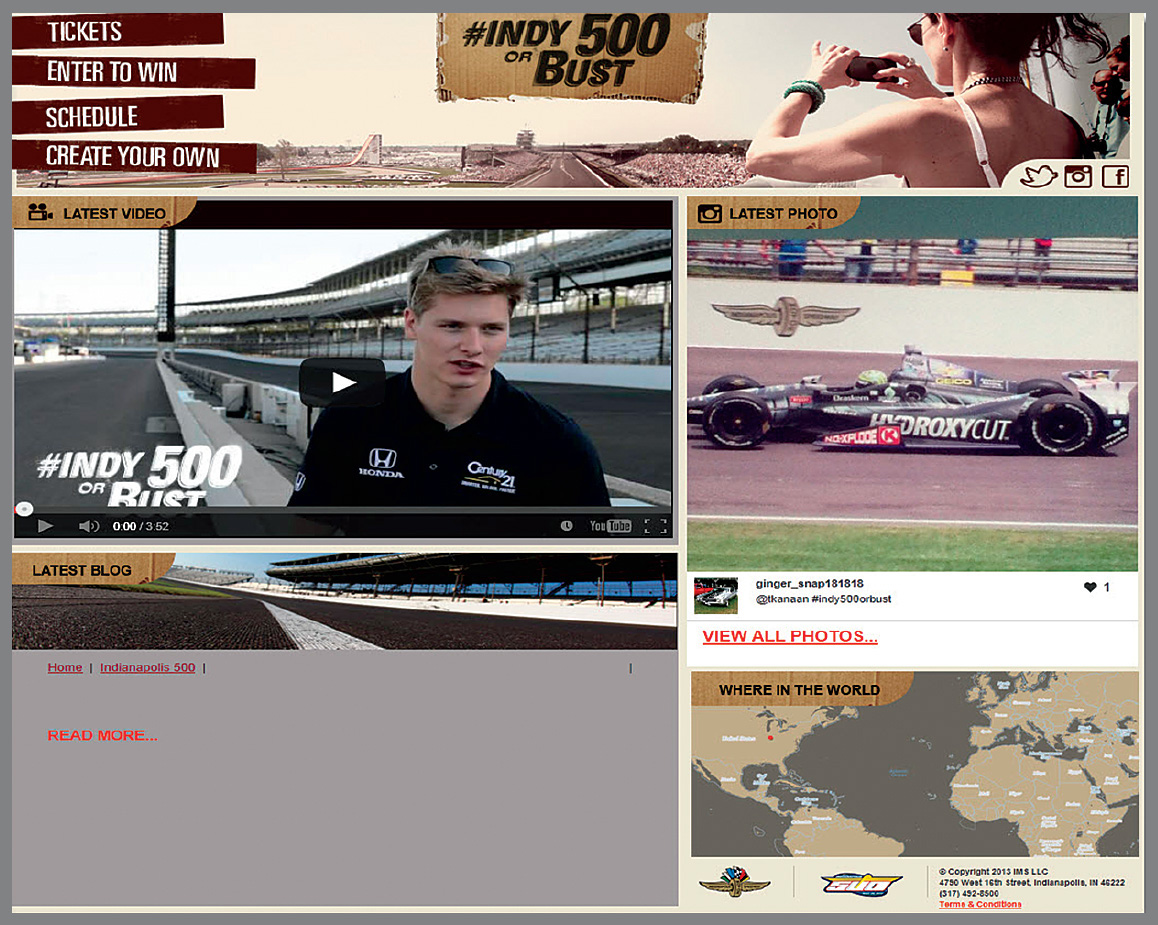
In order to engage fans leading up to race day, the Indy 500 partnered with Seen to build an experience that allowed fans to share their Indy 500 journies (http://www.indy500orbust.com). By uploading photos to Twitter or Instagram and using the hashtag #Indy500orBust, fans were entered for a chance to win the ultimate Indy 500 experience. Unlike most hashtag-driven campaigns, however, #Indy500orBust didn’t end there. For the first time ever, Instagram photos were incorporated throughout the Indy 500 marketing campaign, including an interactive map featuring geo-tagged photos (http://www.indy500orbust.com/map).
Fans shared 10,828 photos using the hashtag #Indy500orBust during the campaign’s run from January 2013 to Memorial Day 2013. This number grew by 8,000 throughout the duration of the official race weekend, with a total photo reach of 53,162,862. The Indy 500 also gained 4,400 new Instagram and Twitter fans during that time.

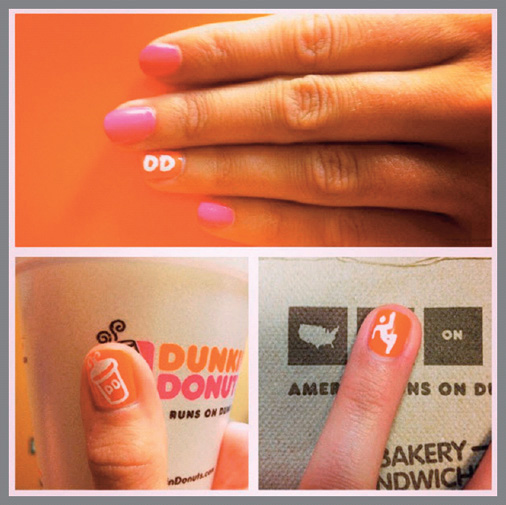
One thing marketers might not realize about Instagram is its ability to test and try out visual content. Dunkin’ Donuts has a passionate cross-functional social media team that is always coming up with fun and creative ideas for visuals. Inspired by their office, which is affectionately known as “The DD Mothership,” the team seeks out and tests everyday content moments on Instagram that are best captured in real time. Offering a behind-the-scenes look, photos of monthly sampling events where employees try new menu items and recipes being whipped up in the test kitchen are often shared as photos or videos on Instagram (http://instagram.com/dunkindonuts).

The team also looks for opportunities to weave in attributes of the brand’s office culture, such as a passion for pink and orange Dunkin’ Donuts nail art, or the internal “Tie Tuesday” movement, in which some employees proudly sport ties for fun. If a photo or video performs well on Instagram, the team may also consider it for use across other social media channels as a way to visually tell the story of Dunkin’ Donuts’ fun-loving and down-to-earth personality.
Instagram has a niche following—at the moment. Like Pinterest, as it grows, its appeal will surely broaden. Reaching out to a young audience of people with an interest in style, fashion, and technology is a core goal for many brands, and marketers can work with its slick, integrated features to create imaginative, innovative campaigns that stretch the boundaries of traditional advertising and appeal to new audiences around the globe. With opportunities like this, companies will want to make Instagram central to their visual marketing effort.
Tumblr
Tumblr is a blogging platform with a difference: it allows users to quickly reblog posts (text, images, video, quotes, links, or music) by other users with a click of a button. A Tumblr account is simple to set up, and it is visually appealing. And it plugs your business into a platform of millions of users searching for the best in visual inspiration. Importantly for marketers, Tumblr appeals to millennials and users with high levels of disposable incomes—both target demographics for brands. Tumblr was recently purchased by Yahoo! for $1.1 billion, showing that the platform doesn’t just have the confidence of its millions of users but of the business community as well.
The key to Tumblr is its simplicity. Tumblr isn’t about long blog posts and information-loaded content. Instead, it’s for quick visual inspiration and consumer lust. Photos, videos, charts, quotes, and Q&As fill Tumblr streams, with users’ reposting everything that catches their eye, wherever they are. It is fast paced, creative, irreverent, and entertaining—and it has street cred, often vital to brands hoping to attract younger customers.
One of the great features about Tumblr is that users can add comments only if they reblog your post, which cuts out a lot of comment moderating time for marketers, who would normally have to filter out trolling comments. This really helps the sense of community on the platform and gives it a positivity that can be lacking on other networks.
Tumblr has found favor with fashion companies and college students. Vanessa Gabriel’s shopping website aSociete.com is one company reaping the benefits. aSociete offers exclusive discounts on top fashion brands to college students, offering as much as 50 to 80% off retail. Vanessa partnered up with other Tumblr bloggers, and as they started writing about aSociete, the signups started to come in: “It started to happen organically where random people on Tumblr would post about aSociete and how much they love us. Over 5,000 people came in off one organic post. It is crazy how viral pictures can go on Tumblr if they’re trendy and fashionable at that moment.”107
Similar techniques work for other product-based companies. Sharon Gaffney cofounded MeebleMail, a company that transforms everyday e-mail into something special and unique with stylish personalized e-mail stationery. MeebleMail’s demographic is women interested in style and design—so naturally, she wanted a visual medium to showcase her company.
So far, Tumblr has proven a successful marketing tool for MeebleMail: “Our main goal was getting the word out about MeebleMail and the e-mail stationery we offer. Tumblr has helped us from a visual standpoint, but it has also driven traffic directly to our website.”120
“We are posting images of our e-mail stationery and other items from our design partners. We typically post images with very short captions,” Sharon says, explaining that most Tumblr users prefer images that speak for themselves.
Sharon also points out that there’s more to Tumblr than just posting images: “Like the other social media sites, Tumblr requires that you build relationships with other Tumblr users. You do this by tagging your posts so they show up in searches, following other Tumblr users, and reblogging relevant content. We use Tumblr as one of our social media tools in conjunction with Twitter and Facebook. I love Tumblr for the integration with Instagram and because it’s visual.”121
Even if your business isn’t image or product based, Tumblr enables you to share images that relate to your demographic. Lindsay Lopez, professional Pilates instructor and owner of FORM Pilates—a boutique Pilates studio in New York City—uses Tumblr to offer advice and inspiration. Lindsay understands that her readers are into keeping fit and looking great, so she posts recipes, inspirational pictures, and quotes.
“So far, it’s driven more people to my site, and I find that more people read it because it’s so simple and visual as opposed to being a page full of text.” Lindsay first stumbled across Tumblr after a fellow blogger suggested it as an alternative to a WordPress blog. Lindsay started early in 2013, and she is completely hooked: “What I love about Tumblr is that it is aesthetic. It’s very visual, and it is easy to make a post look fabulous.”122
As with any other social media platform, the keys to Tumblr success are post, promote, and participate in the community. Tumblr fills a niche by bringing together the best features of blogging and visual-based social media to create a unique platform.
The Tumblr crowd could be a perfect fit for many businesses. Vanessa Gabriel recommends companies try the platform and measure results to see if it works for them: “Tumblr is a great resource to promote your products and merchandise to thousands of people, increasing the sales and user base. I truly believe Tumblr is an untapped marketing gold mine that has yet to truly be capitalized by many companies. It’s been awesome for us!”123
While IBM does not produce products that are directly suited to the Tumblr crowd, the company has built a successful presence as a content curator. The company shares business and technology information (videos, graphs, photos, infographics, and short posts), and it has built up a community called A Smarter Planet around their expertise (http://smarter planet.tumblr.com).
The World Bank has shown that you can have great success on Tumblr despite not falling into any of the traditional Tumblr categories. The organization’s leadership team has been using social media for a few years as a way of sharing the World Bank’s mission and message, but they wanted to use Tumblr specifically to give an interesting angle on what the World Bank does. The team set up to run the account made use of the very extensive data bank that the organization has collected over the years to post charts, along with short explanations, to visualize the fight against world poverty. The blog is clean and simple, with clear data that cleverly makes the best of the organization’s role. The World Bank Data Vis Tumblr page (http://worldbank.tumblr.com) has received all kinds of positive attention online, and it has turned out to be a great success, according to social media strategist and site creator Liana Pistell. She made the wealth of data digestible and interesting, and the outreach to the Tumblr audience fit perfectly with the organization’s wider strategies.124
It’s essential to have a strong and simple theme to your Tumblr blog. Coca-Cola’s theme Where Happiness Lives Online (http://coca-cola.tumblr.com) captures the message of the brand perfectly with photos, cartoons, quotes, GIFs, and video snippets that support Coca-Cola’s message of happiness. The brand representative says: “Random bursts of Happiness and Positivity is the heart of Tumblr. That’s why Coke’s teen fans flock to it to share those expressions with each other, and that’s why the brand belongs here. Wherever Happiness is being shared, Coke is bound to be there.” The blog attracted over 12,000 visitors, 1,300 followers, and 300 notes and reblogs in the first six weeks since launching in December 2011, and it has fulfilled the purpose of a high level of teen engagement with a focus on positive content and community building.125
BBC America’s Tumblr feed for its show Doctor Who (http://doctorwho.tumblr.com) won the “Best Overall Brand on Tumblr” award at the industry’s Shorty awards in 2012. The blog “drives tune-in for Doctor Who, BBC America’s highest rated show ever, and it keeps fans active and engaged throughout the year.” The blog gained 82,000 followers in just 10 months. The show’s Tumblr uses with great success a mix of user-generated content, behind-the-scenes shots, program screen shots, GIFs, and images from real-world fan meet-ups in order to re-create the whole world around the show. It is a simple premise, but it gives richness to the fantasy universe the BBC has made, while taking it further. With an average of over 1,300 notes per entry, the Tumblr feed has captured what the platform is all about, and it is hugely popular with fans.127
Adidas has proved that Tumblr can fit into wider marketing campaigns with its successful Tumblr campaign in 2012. When Adidas bought its month-long campaign, it was one of the first brands to purchase advertising when Tumblr announced it would sell paid promotions on the site. The retailer created its soccer blog for the 2012 UEFA European Championship (http://adidasfootball.tumblr.com), being played across Poland and the Ukraine, and it planned to promote the site with paid placements in the Tumblr Radar slot on the user dashboard. The Adidas Tumblr features a YouTube video of football stars saying “Tumblr” in their native languages, as well as photos and animated GIFs. The site was a part of the wider marketing campaign around the tournament, and it aimed to build a large community of football fans. Adidas’s global brand marketing director, football, Tom Ramsden, described his vision for the Adidas football blog: “We will use Tumblr to share unique content with fans; combining material from our vast footballing archive with fresh, new content produced in real time by a lineup of exciting, up-and-coming producers.”128
The brand has continued to use Tumblr to support wider marketing and brand initiatives, such as the #mygirls campaign being aired in Russia, China, and Korea, which looks to explore the strong bonds between women in sport and to promote a healthy lifestyle for girls.
If your brand wants to connect with teens, college kids, and young professionals, Tumblr is a great platform to find a new audience. Take time to get to know the platform before you start to post, and think hard about simplifying your brand message to get the most out of the platform’s mix of visual content. Even if you don’t have a brand that lends itself to your own visual content, many organizations have built a strong following curating other people’s posts to build a community around their expertise.
Vine
Lately, the craze for Vine—the app that lets you post short, maximum 6-second video footage loops—has gotten brands thinking about how to use the tool to showcase products and expand their social media content. The app’s popularity has been exceptional: within three months of its January 2013 launch, Vine had grown to be the top free app on iTunes.129
Vine is similar to Twitter (the company that owns it) and Instagram in that users share video clips on the social network, but the clips can also be embedded in Twitter and Facebook posts. Initially launched on Apple, Vine is now also available on Android, so expect its use to leap from its current number of 13 million users as more fans get hooked.130
The app makes it simple to record your clips simply by tapping your smartphone screen—the app only records while the screen is being pressed, so you can either record one continuous shot, or you can record using stop-motion filming to give a speeded-up effect and condense a longer event into the 6-second limit. Vine also records sound, so you have to think about the audio element of your videos as well.
People can like, comment on, and share your footage with other image sharing networks, so clips can go viral across networks. You can also tag your clips in the same way you would with Instagram photos and Tumblr posts.
Vine offers marketers as many ways of telling your brand’s story as photos—and maybe more. What can you say in 6 seconds? The speed at which brands jumped onto the platform shows how many are seeing opportunities for short videos to go further than photos alone. For the online retailer, Vine can offer a 360-degree view of a product that photos alone can’t capture; for the creative marketer, a 6-second video could be a viral commercial; for the smart community building brand, the app is a way to reach out and connect with fans.
STATS
Within a short time of its launch, brands were already offering different examples of how short video clips could be used in the context of their brand. Lowe’s home improvement store created a series of how-to videos with the hashtag #lowesfixinsix showing simple home improvement tips, life hacks, and ways to perform various tasks using stop-motion animation.137
MailChimp is an online mailing list company famed for its quirky monkey character who acts as the site’s tutor and offers tips, tricks, and links to fun online distractions. With Vine, MailChimp has been able to take its trademark monkey character further by featuring him in videos that entertain as well as help raise awareness of the brand. The clips take MailChimp marketing to the next level while keeping the brand of humor and online memes (such as the company’s monkey mascot and office dog Maddie standing on things) that their fans love and recognize.138
You don’t have to limit yourself to product showcases. How about showcasing a service? SweetShot Photography is a boutique photography company that used Vine to promote headshot sessions. They shot a short behind-the-scenes video of how they stage a headshot session, finishing with a shot of an empty stool all set up for you to join them for your own shoot. The next day, @sweetshotphoto tweeted that it had generated new leads thanks to the Vine post.142
Vine can also be used to host contests or sweepstakes, allowing brands to crowdsource unique content from their fans. As the temperatures increased during spring 2013, Dunkin’ Donuts hosted the Running on #IceDD contest to celebrate the return of iced coffee season. The contest prompted fans to use Vine with the hashtag #IceDD to show how Dunkin’ Donuts iced coffee put a spring in their step for a chance to win a one-year supply of Dunkin’ iced coffee. Five runners up also had the chance to win gift cards to Dunkin’ Donuts. Throughout the promotion, Dunkin’ Donuts also created three of its own #IceDD videos to raise awareness and inspire its community on Vine to participate. The contest ran for one week, and it generated a range of energetic, creative submissions. It’s important to note that any video contest will offer a higher barrier to entry because it’s more work to participate in than, say, text or photo contests. However, pursuing this path has the potential to generate much stronger, shareable content that can leave a lasting impression with fans.

The creativity and integration with Twitter continues to propel Vine into new arenas. Dunkin’ Donuts also generated headlines for being the first brand to incorporate Vine into a professional broadcast: ESPN’s Monday Night Countdown. Throughout the 16-game season, Dunkin’ Donuts created four Vines, each 5 seconds long, to replace the static on-air billboard within the program.
With the goal of bringing an innovative and interactive social media experience into one of America’s favorite pastimes, Dunkin’ Donuts also introduced the #DunkinReplay into Monday Night Football. Each week, with a team from Dunkin’ Donuts and the Hill Holliday marketing agency on standby, the company produced a #DunkinReplay Vine, re-creating a marquee play from the first half of the Monday Night Football game using Dunkin’ menu items. The Vines were created during half-time and tweeted in the fourth quarter in order to maximize the second screen experience and to make the brand a natural part of the conversation around Monday Night Football. Each #DunkinReplay Vine delivered as many impressions as a comparable TV spot (at significantly less cost).
It’s fair to say that Vine’s integration into other, larger platforms such as Twitter and Facebook is going to help its steep upward trajectory as more and more users download the app and enjoy the creativeness that it inspires. For brands, Vine offers yet another way to catch the attention of audiences across platforms in a busy social media environment. If you think of the 6-second opportunity in the same way you would think of a 30-second TV commercial, there’s no reason why Vine can’t be part of your visual marketing strategy and have as big an impact as any other campaign media. Vine encourages innovative, imaginative responses to the 6-second constraints, so start thinking what you could do in that time to reach out to your fans.
SlideShare
It’s easy to overlook online presentation sharing website SlideShare as a platform for visual marketing, but it is an important business network: with 60 million monthly visitors and 130 million monthly page views, it is among the most visited 200 websites in the world.143 Users upload presentations, webinars, Word and PDF files, tag them, and share them on SlideShare or other social media sites such as LinkedIn, or they embed the files in their blogs and company websites. SlideShare has also been referred to as “the world’s largest professional content sharing community.”153
Like LinkedIn (the company that owns the site), it is mainly used by the business community, and the two networks complement each other. SlideShare presentations can be uploaded into a LinkedIn profile to add an extra dimension of knowledge and expertise to your company or individual image. While the basic platform is free, there is a paid-for professional platform that allows you to brand your channel and have ad-free pages, and it gives you access to analytics.
When it comes to community building and lead generation, especially in the B2B sphere, SlideShare can demonstrate expertise in your field, and it works very successfully as visual content marketing. SlideShare isn’t about quick fixes and viral memes, but about networking in a virtual space and having something in-depth but shareable to use to connect with colleagues and customers.
SlideShare isn’t just about sending information outward. The social functions in the site are giving companies the potential to connect with customers and clients in new ways, generating new business and enhancing their online image.
SlideShare also allows you to amplify your message. If a webinar or conference presentation reached only a few thousand in its original format, SlideShare can have a multiplier effect once the presentation is posted online. Think back to Ekaterina’s example of using a deck uploaded to SlideShare to promote her book Think Like Zuck. The presentation “12 Most Profound Quotes by Facebook’s CEO Mark Zuckerberg” was viewed by more than 97,000 people with no paid promotion behind it.
Being innovative in technology use to get their message across can help organizations of all sizes connect with new audiences. Sharing presentations can show users a company’s ethos far better than the more traditional LinkedIn, Twitter, and Facebook routes alone. In-depth presentations can make a company more three dimensional and add personality.
In May 2011 NASA launched its NASA Universe channel on SlideShare (http://www.slideshare.net/NASA), which integrated presentations, documents, and videos from their headquarters and field centers. In the announcement on the SlideShare blog, NASA Social Media Manager Stephanie Schierholz said: “NASA always is on the lookout for new ways we can engage people in their space exploration program. SlideShare provides us another great way to share our content in new ways and new places with the goal of inspiring and interesting people in the universe.”154
An increasing number of companies are using SlideShare to present financial, technical, or other in-depth information that can be difficult to represent on their websites using more traditional tools such as graphs and text. SlideShare enables them to connect with potential clients in a whole new way. Pfizer uses SlideShare to post its financial reports, allowing interested parties to access that information in a user-friendly format (http://www.slideshare.net/pfizer).
SlideShare can be used for a variety of goals, with community building, demonstrating expertise, and content marketing among the most popular. SlideShare is particularly effective as a lead-generation tool. When the employee recognition software company Achievers wanted to drive more leads from HR executives, it developed a strategy that took three months to plan. By sharing strong content on social media, the company used SlideShare to help position itself as a thought leader in its field. The company launched five presentations specifically designed for the site, and it used SlideShare’s ability to include a lead-generation form within the presentation. Achievers shared the presentations across its social networks and blogs, and within seven days of launch, it received so many qualified lead forms filled out by HR executives that the leads made up 77% of all incoming social media leads that week. The presentations got 42,000 views in the first seven days, and traffic from SlideShare to the Achievers website made up 30% of traffic from social media—beating out Facebook and LinkedIn referral traffic combined.155
With limited time for travel, SlideShare can be used to expand your global reach. Enterprise software company Salesforce.com had a goal of making its content more visible to a wider audience and create brand consistency of its wide variety of content.
Salesforce produces hundreds of presentation decks, tutorials, e-books, infographics, and white papers. “Previously, teams were setting up SlideShare accounts on their own,” says Jennifer Burnham, director of social strategy and content marketing at Salesforce. “With this decentralized process, we didn’t have a coordinated brand presence or a clear picture or pulse on what content the different teams were publishing.” The company created a custom brand network on SlideShare to bring all of its content together into one place and drive more traffic to the main channel (http://www.slideshare.net/salesforce).
Advanced tools like private sharing have enhanced Salesforce’s internal collaboration. Presentations, documents, and videos are uploaded and shared privately with teams for review. But the greatest benefit the company has seen with SlideShare, Jennifer says, is the “interaction and discoverability of content” with prospects, partners, and customers.
“With SlideShare, we’re able to expand the reach of our best content to people who may not necessarily be familiar with our brand and people who may not be visiting our website or attending an event,” says Jennifer. “In essence, by posting a deck to SlideShare, we are extending the reach and lifetime value of that content.”
SlideShare’s lead-generation features have helped Salesforce generate and assess the quality of hundreds of sales leads. The sales cloud team, for example, posted the Social Sales Revolution: 7 Steps to Get Ahead e-book on SlideShare and received 16,900 organic views and gathered more than 300 qualified sales leads. Salesforce CEO Marc Benioff’s “Welcome to the Social Enterprise” keynote deck received more than 122,000 views on SlideShare—far more than it would have if it had been presented only live or posted on the Salesforce.com website.156

The right SlideShare content can be of huge value added to your niche audience. Slides with lists, quotes, statistics—any aggregation of valuable data or advice around a particular topic—do very well on the channel. For example, BRANDERATI, the company that provides advocacy and influencer marketing platforms and services (disclosure: Ekaterina is a cofounder and CMO), put together a slide deck that showcased a collection of statistics around advocacy and influencer marketing in a visually appealing way called “The Age of Advocacy and Influence: 26 Stats Marketers Should Know.” The deck was organically viewed by over 5,000 people and provided numerous leads for the company (http://www.slideshare.net/Branderati).
If you are looking to use content marketing to expand your audience among business and industry professionals, then SlideShare offers a smart alternative to other networks. It gives you the built-in advantage of being able to share SlideShare content easily across platforms and promote it on other networks.
Google+
In November 2011, Google+ unveiled brand pages, enabling brands and businesses to use its social networking platform. Since Google is the world’s favorite Internet search engine, its foray into social media has been snapped up by business owners eager to improve their SEO and keep up to date with social media trends.
For businesses, Google+ offers many advantages of other social networks, as well as including several unique ones. It has LinkedIn’s business mentality: an open interface and networking strengths. It has the usability of Facebook and some of the news and interest aspects of Twitter. Its strengths lie in its openness, its community features, and its streaming facilities; it holds huge potential for brands keen to engage and connect with their audience and build new networks.
Many brands that have joined are still not showing true engagement; many just aren’t sure what Google+ offers that Facebook doesn’t. However, the recent increase in buzz surrounding the business opportunities is beginning to convince more technologically focused businesses in particular. It’s not just the numbers of new users. It’s who they are: tech-savvy, business-minded people who are looking to connect, share, and engage.
What hits you first about Google+ is the prominence of visuals in a profile page. The cover photos have recently been expanded to up to 2,120 by 1,192 pixels, so you can show off the visual side of your company to its best advantage. However, the cover photo dominates your profile to such an extent that you can be let down by a subpar photo. It’s worth putting as much effort into choosing or commissioning an image as you would with any marketing campaign.
Its look is clean and well organized, but a real advantage of Google+ is Circles: the ability from the outset to separate your connections by interest or industry. For brands, the Circles feature adds new potential for interacting in different ways with customers, employees, colleagues, the media, and other businesses. News and updates can be shared with only the relevant audience, meaning that brands can engage very differently with colleagues and customers.
One of the best community functions about Google+ is the Hangouts. You can have private video chats with a select group of people—or you can broadcast the chats publicly or record them for marketing purposes. Recorded Hangouts are automatically posted to YouTube, helping them reach an even wider audience.
Rather than straight-up numbers and stats, Google+ has opted for a feature called Ripples, which is a graphic that shows how a post has interacted with other users, literally like a ripple effect. This is useful for seeing how far your information has spread and the sorts of interactions it has inspired.
Google’s +1 feature is similar to Facebook’s like button. The +1 feature gives users a way of showing agreement or interest in content, and it allows them to share the content on their own stream if they wish.
Central to Google’s vision for Google+ is the integration of Google+ data into the regular Google search engine. Google is the largest search engine in the world, and information shared on Google+ is prioritized in searches, which has huge implications for your SEO. Having a presence on Google+ is also important for businesses who have a local presence because their profile is automatically integrated into Google Maps, so people searching locally for businesses will be able to see more about you—which can give you the edge over your competitors.
Brittney Bogues, CEO of All In PR, a digital PR firm geared toward pro athletes and nonprofits, finds Google+ essential for her business. For her, it’s the way the platform integrates with other Google tools that makes it so much more than just a social networking site. “It helps with managing our calendars, networking internally and externally, and keeping us updated with current events. This allows us to add real-time content to our clients’ digital accounts as well as our own.”
Yolanda Shoshana, the “Luscious Lifestyle Diva,” runs a lifestyle company for women. She’s a speaker, consultant, writer, and wedding officiant, and she uses her Google+ page primarily as a marketing tool. She says the platform has presented her with multiple business opportunities through networking with other professionals: “Through Google+, I have been recommended for writing gigs, and I’ve been invited on a few shows as an expert. I actually got a high paid column gig for six months because someone on Google+ had been following my work and recommended me.”
And, of course, there’s one key advantage to utilizing the social media platform of the world’s biggest search engine. Ashli Norton, cofounder of SimpleLeap Software, the company behind Workitywork—an app that helps teams give kudos and manage their workday in a fun and interactive way—has found that Google+ has been integral to raising her company’s profile online. “I’ve noticed links that I share in Google+ land in Google’s search results much quicker than sharing them on our Facebook company page or on Twitter.”
Quick indexing of links can be vital for businesses wanting to stay on the leading edge of their niche. It’s no surprise that Google will be looking to its own social network first for the most up-to-date information.
Yolanda says she’s had the most results using the Hangouts feature, which is a live video chat service unique to the platform. Google launched Hangouts On Air, which allows you to broadcast your Hangout video for anyone to watch. Yolanda is very excited to use this service: “With the addition of Hangouts On Air, I am going to revamp my online talk show to launch a lecture series and connect with my followers and fans.”
Ashli has found Google Circles to be the best tool for networking for her business: “I love sharing specific news and posing questions to the groups. Plus, when it’s time to make a contact—for instance, with someone who may be interested in something our business is doing—I go right to the circle I need and contact everyone who would be interested.”
In the beginning, Brittney found the vast array of features available overwhelming, and she suggests that businesses begin by taking a Google+ tour: “It helps you to grasp the superb functionality of it and how it helps your business stay organized. You want your staff to be educated on all the different dynamics of Google+ and take full advantage of what it has to offer.”
Just like any other social networking site, Google+ can help businesses get ahead if they’re clever about how they use it. Brittney, Yolanda, and Ashli all stress the importance of sharing information and connecting with your community. “Nobody wants to hear all about your business and your business only,” says Ashli. “Make sure for every business-related message, there are other interesting messages to follow. Keep it personal; keep it interesting.”165
Photographer Trey Ratcliff has nearly 5.5 million followers on Google+. He has used his visual talent to take advantage of Google+’s ability to put images center stage and build up an impressive audience. He often has 2,500 or more +1s, and hundreds of people will share his posts, all because of his skill with visual social strategy.
Ratcliff’s strategy can be used by marketers to build their own brand audiences:
• Try to tell a story through your images, and tag everyone involved or interested.
• Follow people whose posts and images you can share to inspire others. Ratcliff says, “I believe curating my own list of people to follow is very, very important. I need constant inspiration and ideas, so I circle up people who give me ideas, make me happy, and make me think.”
• Host Hangouts, and share them on YouTube.
• Share your YouTube videos on Google+ to get cross-pollination between the two sites.
• Tell stories by sharing visuals of behind-the-scenes activity at your company. Or tell stories of customers and how your product has improved their lives. Add great captions to make the images stand on their own.
• Regularly point back to your website to let customers find out more. Ratcliff says, “I think of Google+ and these tools as leaving scent trails to a bigger food source, if you accept the superorganism communication analogy.”166
Google+’s popularity with young, tech-aware people has made it the network of choice for brands eager to connect with this demographic.
Chocolate manufacturer and London 2012 Olympics sponsor Cadbury wanted to expand its audience among this very group, and the company decided to use some of the unique features of Google+ to build a community of the network’s users (https://plus.google.com/+CadburyUK). The company’s goals were to engage with the 18- to 25-year-old audience, stand out from other Olympic sponsors, and extend their reputation for creativity and innovation.
From the outset, Cadbury explored the potential of Google+ to the fullest. Cadbury shared exclusive and creative content that fans couldn’t get anywhere else. For example, special edition Google+ chocolate bars were made to feature on the page, and Cadbury even sculpted a chocolate version of its Google+ page. “We’ve really tried to do things that are unique to Google+,” says Jerry Daykin, social media community manager at Cadbury.
The company used Circles to target information at users with different interests—for example, sharing recipes, posting Olympic news, or collecting feedback from a Tasters’ Circle.
The Cadbury team broadcast frequent Hangouts, giving fans the chance to interact with Olympic athletes and chocolate experts. By promoting its Hangouts, Cadbury grew its Google+ follower base by 150,000 people: “Hangouts are a really great way to quite literally see people eye to eye,” Jay has observed. “At the end of the day, humans like communicating face-to-face, don’t they? With social media we’ve kind of been reduced to just writing to one another; it’s interesting to see people’s faces again.”
With the number of followers growing rapidly and a steady stream of exciting content, the Cadbury page was featured on the Hot on Google+ page, which further accelerated its followers.
The results were impressive:
• Increased the click-through rate across all of Cadbury’s AdWords campaigns by 17%
• Added a consistent 10,000 new Google+ followers per day
• Increased the traffic from Google URLs by 7.5%
• Helped reach over 3 million total followers167
Cadbury has shown how to make the most of its Google+ profile, linking it to their wider marketing for events or product launches but tailoring content specifically for their Google+ audience.
Google+ has the power of Google’s search engine behind it, so marketers would be wise to think about the SEO advantages of sharing information on their profiles if nothing else. But if you want to expand your audience among a young, tech-savvy crowd, then Google+ can be a great place to connect with them. The network is growing rapidly, so think about what its unique features can bring to your brand—and to your community—allowing you to take full advantage of your presence there.