
CHAPTER 2
Types, Tips, and Tactics of Visual Marketing
From images to videos, infographics, and presentations, the popularity and unprecedented usage of visuals have resulted in a social media era that rewards creativity. A picture may still be worth a thousand words, but memes, quotes, cartoons, and animated GIFs can breathe new life and context into a photo’s storytelling capabilities. Even videos, which continue to delight, entertain, and inform, are evolving with consumers’ attention spans, whether it’s 6 seconds on Vine or 15 seconds on Instagram. Infographics have risen as a valuable tool to communicate stats and the results of research studies. Presentations cater to the vast majority of visual learners and are proven to captivate attention when delving deeper into a given topic.
Types of Visual Content
What follows are some types of visual content that marketers might want to pay attention to.
Images
With the ability to captivate, inspire, motivate, delight, or humor, there are numerous reasons why more than 500 million photos are uploaded and shared every day on average—a number that is projected to double in the next year.2 The prevalence of smartphones, coupled with the ease of sharing via social media, has resulted in a culture in which photos are celebrated and in some cases, required. In pop culture, pictures have become so important to consumers that the Urban Dictionary now contains the saying “Pics or it didn’t happen,” meaning that if something really cool or crazy happens to you and it wasn’t captured in a photo, your friends may not believe it’s true.3
In line with consumer photography trends, savvy companies understand that there’s more than one way to add a storytelling element on their social media channels through imagery. From traditional images to user-generated content, collages, images with text overlays, memes, and more, there’s a lot of creative potential for companies to tap in to. In this section, we’ll share image types, photography tips, and examples to help you create well-composed photos that bring different stories and vignettes to life.
Types of Images Used for Visual Storytelling
• Photography
• Graphs and drawings
• User-generated images
• Collages
• Images with text overlays: captions, quotes, and stats
• Word photos
• Memes
• Postcards and e-cards
PHOTOGRAPHY
In many ways, photography is like a blank canvas. Any moment can turn into a photo opportunity, with the beauty in the eye of the photographer. The photos people take and share across social media platforms showcase how they see and experience their lives, what’s important to them, and what they believe is shareworthy with friends and family. For companies looking to amplify their visual storytelling efforts, photographs offer a good starting point.
The concept of well-composed photos is nothing new to companies—it’s something they’ve been sourcing for their websites, advertisements, retail locations, and for the news media for a long time. What’s new, though, is the concept of social media-friendly images that drive an immediate response. With professional images, techniques like retouching, food styling, set design, and lighting are commonplace. However, with social media, people are looking for images to be realistic and in line with company values and offerings. By retouching how a model looks in a dress or styling a sandwich to be larger than it really is, you run the risk of generating customer complaints and distrust in your products. Take TripAdvisor, for example, which allows members to post images of their hotel stays. With more than 14 million real images posted to the site, the value of seeing these images is so that consumers can see if the hotel truly matches the images shown on the hotel’s website.
GRAPHS AND DRAWINGS
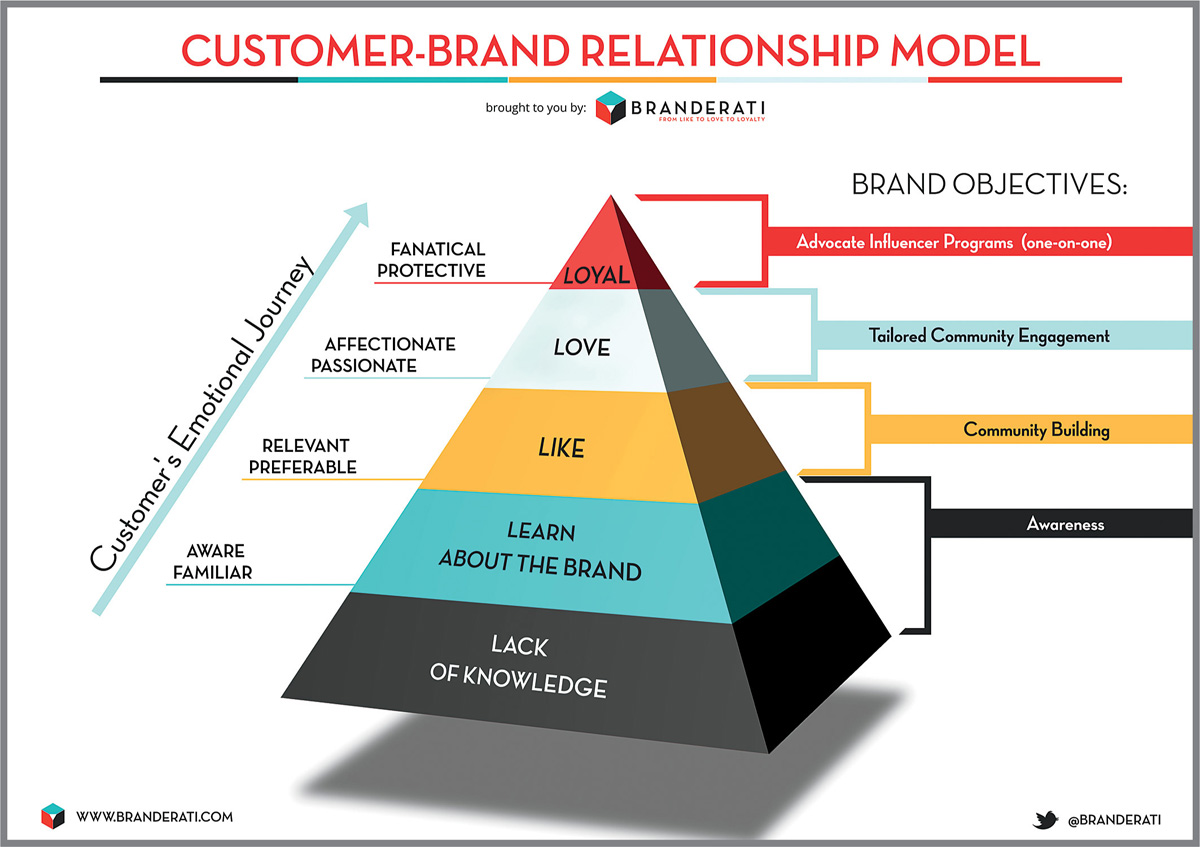
In some cases, when you market a highly technical product, graphs and visualizations may be a better way to go. Some people respond better to charts, graphs, numbers, and visual frameworks. Sometimes putting the concept you are trying to communicate into an easy-to-digest visual framework might make the message you are delivering not only easier to understand but also easier to share with others.
Case in point: when Ekaterina talks about the significance of the word of mouth and brand advocacy with her clients, she talks about the Five Ls of a customer’s emotional journey and the fact that the fastest and the most effective way to achieve brand affinity is not through the brand’s own messages but through building a strong network of advocates. She points out that the goal of your brand should be to take your prospective customers from “Lack of awareness” to “Learning about your brand” to “Like” and to take your current customers from “Like” to “Love” to “Loyalty.” But it isn’t until Ekaterina shows her clients the visual, the framework that explains the Five Ls and brand objectives associated with each one of the stages, that they start smiling and nodding their heads in agreement. It is more powerful when you accompany your message with a visual. Often, no matter how beautiful or impactful your story is, if you include a simple graphic, it’ll help your audience establish a deeper understanding and connection with your message.
USER-GENERATED IMAGES
Looking to supplement your image library while deepening your relationships with your consumers? Consider developing a program to collect and share user-generated images. By making consumers part of the visual storytelling process, companies are participating in collaborative storytelling while sourcing incredible imagery. Companies get to see firsthand what motivates and inspires their customers, while customers get the validation of seeing their images shared and liked by other fans of the company.
PHOTO COLLAGES
Why use just one image when three, four, or more might tell the story better? Collages are no longer just for scrapbook enthusiasts; they’re back in vogue. The concept and motivation are straightforward—you’re already snapping and sharing a ton of images, so why not parse them together to help tell a visual story? From highlighting different company or product attributes to weaving in different aspects of an event or curating an inspiration board, collages offer a lot of opportunity for creativity.
IMAGES WITH TEXT OVERLAYS: CAPTIONS, QUOTES, AND STATS
Looking to spice up a traditional image in a way that’s easy and cost effective? Want to make sure a photo’s caption isn’t lost in the social media shuffle? Consider adding a small amount of text. The use of snappy one-liners, quotes, and stats can add a new dimension to your visual storytelling possibilities.
POSTCARDS AND E-CARDS
Social media have not killed the postcard. It has simply reinvented it. Both postcards and e-cards offer a multitude of ways to pair a photo and text together. Whether used in a status update or a Pinterest board, or in a consumer engagement campaign, or in an activation around an event, the nostalgia, convenience, and shareability of an e-card offer companies a unique visual storytelling opportunity.
WORD PHOTOS
From traditional text to quotes and stats, there are many options for using words to enhance the visual story of an image. But what happens if the word is in fact the image? With the help of a few useful tools, like WordFoto, an app for iPhone and iPad Touch, or WordCam Pro for Android, your company’s name or tagline, plus key buzzwords, can be turned into an eye-catching visual image.
MEMES
Memes are concepts and ideas that spread from person to person, and they serve as signifiers of the spread of cultural information. In his 1976 book The Selfish Gene, Richard Dawkins created the term meme from the Greek word “mimeme,” which means “an imitated thing.”4 In the 1870s, English photographer Harry Frees started taking photographs of his cats and printing them on the covers of greeting cards, accompanied by humorous text.5 These cards are the first examples of LOLcats (the most popular and enduring Internet meme—where humorous captions are placed over pictures of cats).
“I can has cheezburger,” “Success Kid,” “Hipster Ariel,” “Bachelor Frog”—these sound like children’s superheroes, but they are in fact memes—jokes, phrases, concepts, images, videos, and cultural phenomena repeated and shared at an alarming rate. Thanks to the Internet and social media, visual memes can spread globally in a matter of hours. Often nonsensical, usually hilarious, 90% likely to contain an image of a cat, memes are the cultural glue holding the Internet together.
These days, memes appear everywhere, and they spread so fast it is often impossible to discover their source (although you could try www.knowyourmeme.com, which maintains a database on the origins of specific memes).
In the last several years brands have focused on the meme as a tool for awareness and social proof.
Home Depot created its own version of the popular cat meme when it launched “Richard the Cat, a.k.a. Pundit of People,” in spring 2013. Richard gives witty, sarcastic, and snobbish commentary on his human family’s DIY adventures. Users can create their own Richard memes, with the chance to win $200 worth of Home Depot vouchers.
Home Depot CMO Trish Mueller credits the origin of the feline meme to an internal meeting last year where she proposed the idea. “Everyone has elves, reindeer, Santa, but one of the biggest things followed in the social space is cats,” said Mueller in an interview with Ad Age. “When I shared this with our leadership team, our CEO got it immediately.”6 The focus of the Richard campaign is customer engagement by using the meme movement to tell the brand story in a simple and humorous way. With a popular Tumblr blog and a solid Twitter following, Richard is certainly achieving results for the brand.
Cartoons
The artistic, engaging, and humorous nature of cartoons makes this medium a powerful visual storytelling tool. Think back for a moment about your personal experience with cartoons. Many of us grew up with cartoons, from collecting comic books or flipping through the newspaper to uncover the “funnies” section. Cartoons are known for being funny, and viewers delight in uncovering the story and messages through their visual sequence. With so much brand recognition and nostalgia around cartoons, they’re inherently eye-catching.
Great messages and ideas for cartoons can come from anywhere, from common customer questions to key products or promotions, pop culture, memes, fun facts, and behind-the-scenes scoops about your company.
Kellogg’s Pop-Tarts frequently uses cartoons as part of its visual content mix to tell a fun and irreverent story around people’s cravings for Pop-Tarts. Often, the cartoons feature people using sneaky and creative ways to coax their Pop-Tart into a toaster. One such example occurred over the July Fourth holiday, where a cartoon depicted a person luring a Pop-Tart into a toaster made to look like a parade float. While inside the toaster, the Pop-Tart inquires about when to pop out, and the hungry person declares, “Yep, just one more minute …”
Companies looking to harness the power of cartoons should keep the best practices of the medium in mind. Bring in cartoons to spotlight what’s humorous about your brand, whether it’s laugh-out-loud funny or witty. It’s okay to poke a little fun at yourself or to mention events in pop culture that affect your industry and still remain on brand. If anything, doing this will humanize your company to your fans. Uncovering inspiration for what’s funny about your company or your industry shouldn’t be too hard. Simply visit your social media channels, speak with your customer service team, or host an internal brainstorm. Seed a few thought starters into the meeting, and watch the ideas fly!
When developing cartoons, keep in mind that they are an art form. So finding someone with a good drawing ability to bring your ideas to life is critical. The artwork doesn’t need to be perfect, but the viewers need to be able to clearly identify what they’re looking at.
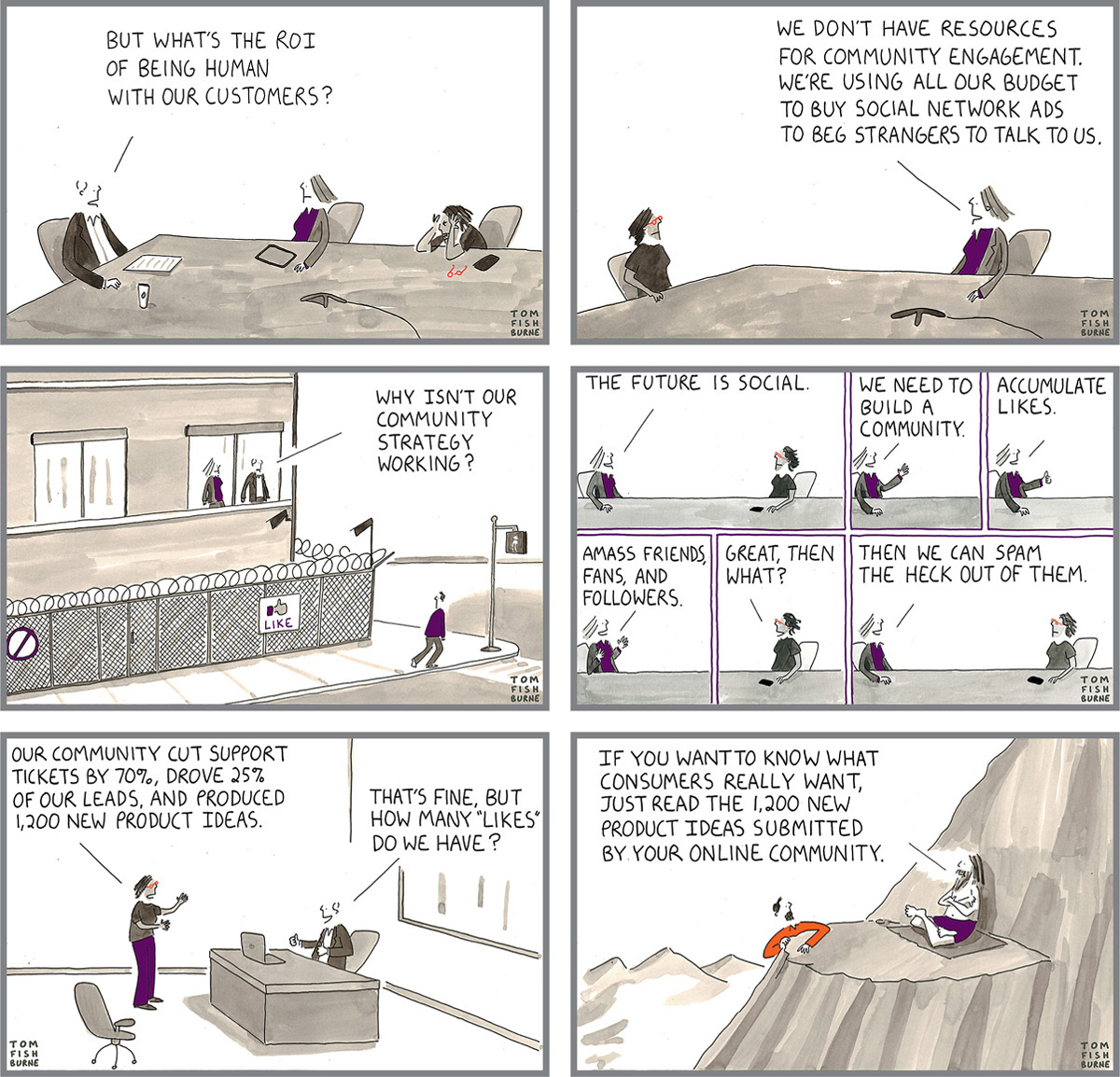
The CEO of Get Satisfaction, Wendy Lea, partnered with Tom Fishburne, the marketoonist, to create a series of cartoons to market her company. Get Satisfaction is a community application that allows companies of all sizes to connect with their customers online, and that connection is facilitated by the company’s software and managed and curated by clients’ community managers.
When Ekaterina asked Lea why she chose cartoons to market her brand, Lea said:
There are two reasons. We wanted to be creative, and we wanted that creativity to be memorable to a certain type of individual. In our case it was the community manager. Through cartoons we were trying to bring to the top of mind the challenges and the craziness community managers face in their daily jobs, as well as showcase both the demanding and the fun sides of their roles.
Get Satisfaction had created a lot of visual content, such as infographics, quite successfully in previous years, and the company wanted to stay within that visual lane to market its brand. But the company took the application of those visuals beyond ads. The company continues to use the 10-cartoon series from a content standpoint both online and offline. For example, the team designed cartoons into the posters and coasters to use and give away at their Customer Success Summit and around Customer Management Appreciation Day. The cartoons were a big hit and generated a lot of positive buzz for the company.
In the interview with the authors, Tom Fishburne said that there are several things that allow cartoons to stand out as a marketing vehicle. “One is the Trojan horse aspect of it: you can communicate an incredible amount of information in a very small space. Because it is couched in humor, and it is made very accessible, people like to see them. But then you can also carry in a message and an insight in the cartoon that conveys something deeper.” Cartoon is an efficient communication device that allows viewers to break through the clutter. “I think the fact that cartoons can often work as a series is highly valuable,” continues Fishburne. “It’s not just a one-off piece of media; it’s not like creating a YouTube video one time and hoping it goes viral. If there is some sort of cadence to a campaign in which you are releasing a new cartoon every so often, the audience starts to look out for them, and they want to find the next installment.”
People like to laugh. That will always be a win with using cartoons as vehicles to deliver brand messages. But there is also a way of illustrating a need of the audience. “If you are marketing something, you are solving some sort of problem for that customer base,” says Fishburne. “A cartoon does a good job of illustrating that self-need: how that audience feels that naturally sets up what you’re trying to market as a solution for that. I think it works really well that the audience identifies themselves in the cartoons when they are reading them. They kind of put themselves into it, and that makes it much more personal and direct.” Get Satisfaction’s campaign most certainly showcased all of those aspects.
The challenge, obviously, is to do it in a way that the cartoons are not seen as infomercials, but instead as valuable pieces of content that people genuinely want to see. And if you are successful, you will see amazing results. Fishburne says that some of his customers who use cartoons as regular content additions to their newsletters see an open rate of up to 45% on those e-mails versus the traditional open rate of 5 to 8%.
GIFs
While GIFs have been around since 1987, they’re experiencing a new surge in popularity due to an uncanny ability to put an exclamation point on a moment. GIFs, or pictures in the Graphics Interchange Format, allow users to store multiple images or still frames from a video in an image file, bringing the image to life with animation. Though a relatively simple format at first glance, what makes GIFs special is their ability to tell a bite-sized story in a few seconds.
GIFs also stand out for the unique niche they’ve created for themselves in pop culture. Think about the witty jokes common in memes or the actions present in slapstick humor like a cream pie to the face or a dog chasing its tail. GIFs capture comical and funny moments in several seconds in a way that bridges the best of both photo and video. The end result is so addictive that consumers will share and watch GIFs over and over again.
Though GIFs have become pop culture darlings, there’s plenty of creative potential for companies to tap in to. Over the Christmas holiday, Coca-Cola turned the “12 Days of Christmas,” into the “12 Days of GIFs” to craft a seasonal story on its Tumblr blog. Inspired by the popular reaction blog What Should We Call Me, HBO’s Girls created GIFs related to moments and themes from the show.
Although there’s incredible potential for creativity, GIFs are supported on only certain platforms like Tumblr, Google+, blogs, and websites. GIFs have yet to break through on other platforms like Facebook, Twitter, and Pinterest. Sites like BuzzFeed and Mashable regularly run roundup articles with GIFs as the creatives. As a result, it seems like it’s not a question of if but when GIFs will truly hit the mainstream social media.
Infographics
Infographics bring together the best of data and visuals to craft a story. Offering a visual representation of information, infographics help companies emphasize key points while packaging content in a highly shareable way. Infographics are understood and shared across social media platforms like Facebook, Twitter, Google+, and even Pinterest, where users create boards dedicated to the best infographics. When designed well, infographics can enhance thought leadership, educate a target audience, and optimize search engine rankings.
The beauty of infographics is that they can be designed around various data points on any topic. From how Google works to analyzing the growth of green technology or how to survive a zombie apocalypse, if there’s valid, trustworthy data, there’s potential for an infographic.
There have also been cases in which infographics haven’t been shaped around numerical data. Instead, they focus on sharing expert information—for example, how-to steps, tips, and qualities, such as what your favorite ice cream flavor says about you. They can also communicate a top-10 list in a visual format.
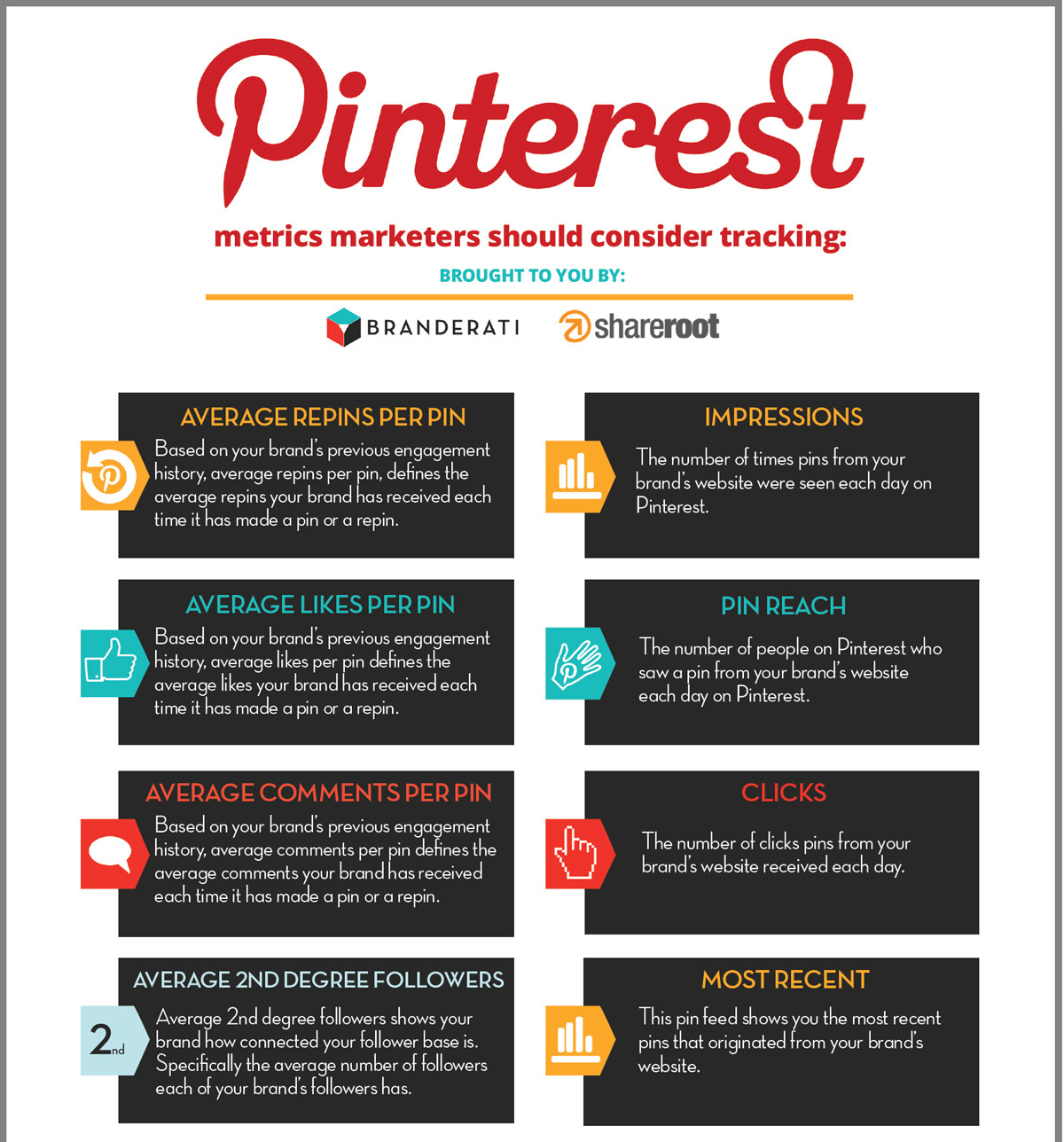
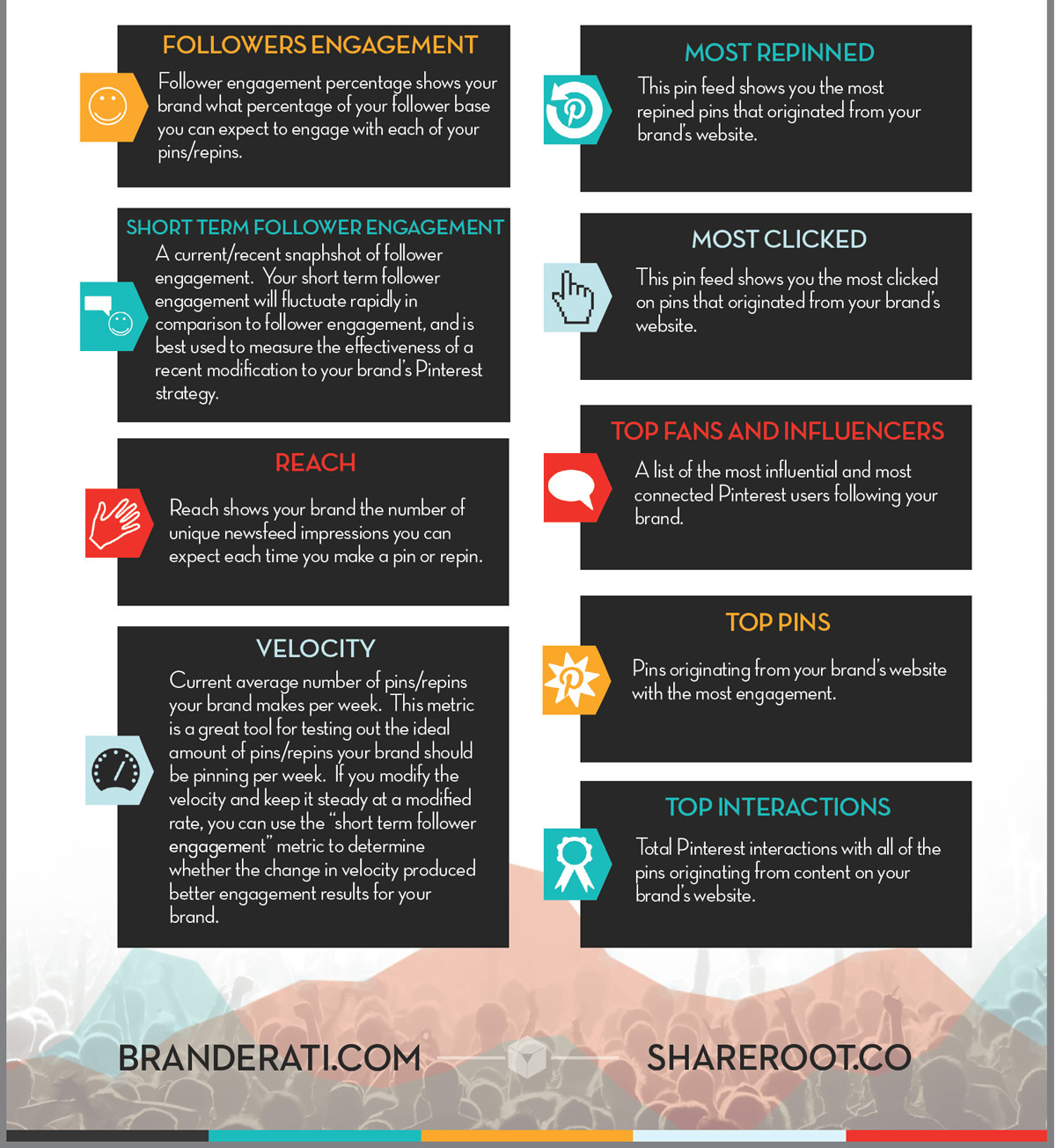
A great example of an infographic that is both visual and useful is one designed by BRANDERATI in partnership with ShareRoot. It offers a meaningful list of metrics that brand marketers should track on Pinterest, and it explains each metric.
For more examples, visit sites like visual.ly, a site where designers and companies alike share infographics they’ve created.
Videos
When it comes to visual storytelling, the power of video is undeniable. Videos offer a compelling way for companies to stand out—and for good reason. From funny to educational, inspiring, surprising, motivational, or heartwarming, videos are personal, draw attention, and resonate with viewers in a way other mediums cannot. As Frank Eliason, SVP of Citibank says, “We tend to trust humans, not some corporate logo; and video is the best way to do that on a scaled basis.”7
YouTube has been the grand dame of video since its inception in 2005—every minute in 2013, 100 hours of video footage was being uploaded, which was an increase of 100% from six years earlier.8 Featuring videos of varying lengths, YouTube has become so respected for its video content that it now ranks second as a search engine to Google.9 With sites like YouTube paving the way, the power of video continues to evolve in ways that make it easier, faster, and more cost effective for companies to produce and consumers to engage with. Apps like Vine, Instagram, Kik, and Viddy have evolved with consumer attention spans and preference for short-form video. These apps are available only on mobile devices, and they are meant to capture and share short-form video in real time. Sites like Pinterest and SlideShare now allow video in addition to pins and presentations. Platforms like Tongal have also popped up due to the demand from companies to crowdsource user-generated video content.
The popularity and variety of video platforms provides a prime opportunity to reach a large number of people and leave a lasting impression. In order to use video to connect with your customers on a deeper level, companies need to align their video goals with their audience needs. Companies also shouldn’t be afraid of showing a little personality. No matter how well a video is produced, if your target audience doesn’t find the information valuable, they won’t watch or share the content. There also needs to be a strategy behind the mix of video content produced, in terms of types and platforms used. This strategy can be determined by the desired message, video length, consumer interest, and the company’s ability to film and share in real time.
From Evian’s dancing babies to the Old Spice Guy, companies have successfully extended the life of already popular advertising campaigns. When music phenomena like “Gangnam Style” and the “Harlem Shake” went viral, some companies joined in on the fun by filming their own parody videos. Companies have also used video to forge partnerships with celebrities or movie phenomena, such as when Pringles joined forces with Star Wars to host a crowdsourced video contest with its fans to channel “The Force for Fun.”
Videos can also help companies to take fans behind the scenes during major events. For example, fashion retailer TopShop partnered with Google+ to live stream its AW13 fashion show from the models’ perspective. Tiny cameras were hidden in the models’ clothes so the viewers could watch and feel what it was like to strut down the runway at a major fashion show. TopShop also used Vine to share moments from the show and exclusive behind-the-scenes video content.
Companies have also used video to communicate an important platform or inspirational mission. In Dove’s Real Beauty Sketches, women are asked to describe their facial features for a forensic artist. A stranger who has recently met the same women is also asked to describe their features to the artist. In the end, the women see two very different photos, which dramatically shows the importance of how we look at ourselves. The story of encouraging confidence and feeling beautiful is powerful and incredibly shareable, with 56 million views on YouTube and counting.10
The continued volume of video content, combined with the surge in new ways to capture and stream in real time, paints a bright future. Companies that have struggled to find resources or define a video strategy should embrace the wave of creativity, platforms, and tools available. As the trend indicates, it will continue to get easier and more seamless to incorporate video into your visual storytelling program.
Presentations
Social and online media have reinvented how we look at presentations. Presentations are no longer just for conferences, speeches, and business meetings. Presentations have become an art form, with highly visual layouts, content, and snappy bits of text. With creative titles and a defined flow of information, the slide-by-slide navigation of a presentation offers a dynamic visual storytelling opportunity—all without the need for a speaker.
Presentations can be housed on company websites, blogs, or platforms like SlideShare that boast a massive following and facilitate easy sharing across popular social media platforms. Inspiration for presentations can come from anywhere, including executive speeches, blog entries, webinars, case studies, white papers, infographics, new product launches, how-tos, lists, company events, and more.
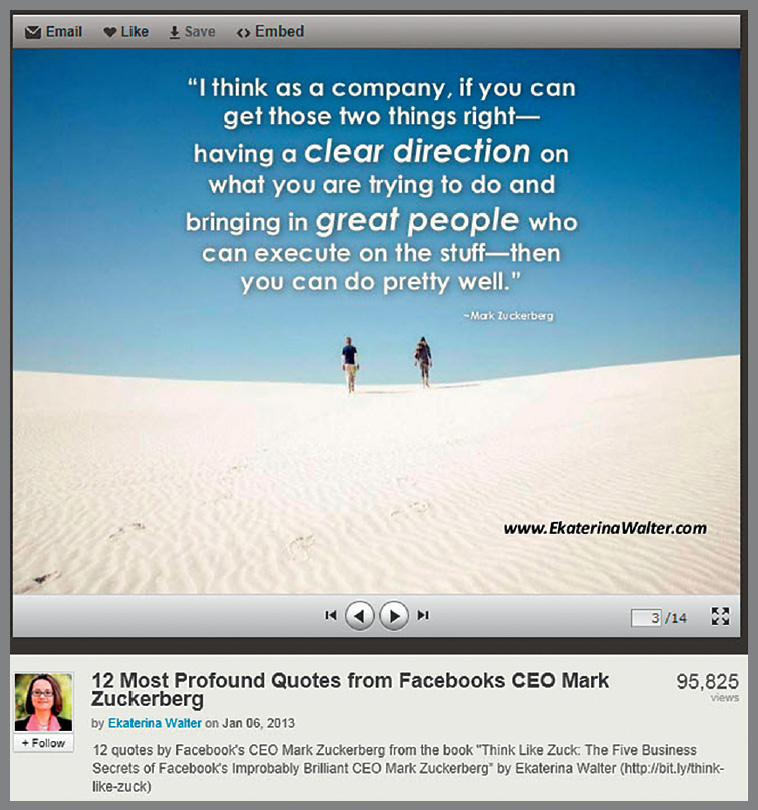
The key when dreaming up new presentation ideas is to think creatively and listen to your community. The vast majority of people are visual learners, so think of your presentations as an opportunity for networking, thought leadership, and consumer engagement. What can you capture in a highly visual format to motivate, inspire, or teach? Consider frequently asked questions coming into your social media or customer service team or perhaps an internal speech to motivate employees. Aggregation of niche statistics, quotes, facts, and so on can also make a valuable resource for your target audience. Humor can also be used in presentations, as seen by HubSpot’s “12 Terrible (but funny) Places to Work” or GoToMeeting’s “10 Reasons Geeks Make the Best Mates.”
When Ekaterina Walter, coauthor of this book, was marketing her first book Think Like Zuck: The Five Business Secrets of Facebook’s Improbably Brilliant CEO Mark Zuckerberg, she put together a visual collection of the 12 most interesting quotes by Mark Zuckerberg featured in her book. The presentation was viewed so many times that it was featured on SlideShare’s home page, and it has had over 97,000 organic views to date, with no promotional dollars behind it.
In order to set your presentations apart, spend time developing a design aesthetic and voice for your company. Determine what sides of your company’s personality you want to show, plus key stories that you can bring to life. Make sure to build storyboards for your presentations that make each slide a key supporting point in the overall story.
The best presentations favor a clean, easy-to-follow layout. You want your layout, text, and visuals all to work together, versus competing for attention. SlideShare presentations have an average of 19 slides and 19 images, which means that there’s about one photo per slide.11 Slides now contain an average of 24 words per slide, indicating a focus on high-impact stats, statements, quotes, and visuals.12 It’s also important that your end slide be branded to your company and encourage sharing, e-mail opt-in, following your channel, and so on.
As companies continue to embrace the power of visual content, the ability to package different stories, ideas, and campaigns into a presentation will remain a valuable tool in your arsenal.
Aggregators
With so much content on the web and social media sites, it’s easy to feel overwhelmed when trying to source the most shareworthy content. In response to the never-ending stream of content, aggregators have boomed in popularity to help both people and companies organize and share important information. Aggregators offer access to timely, relevant content, and they can be curated according to your company’s interests. Although many aggregators are link based, the rise of visual content has resulted in a wave of aggregators that cater to images, videos, and more.
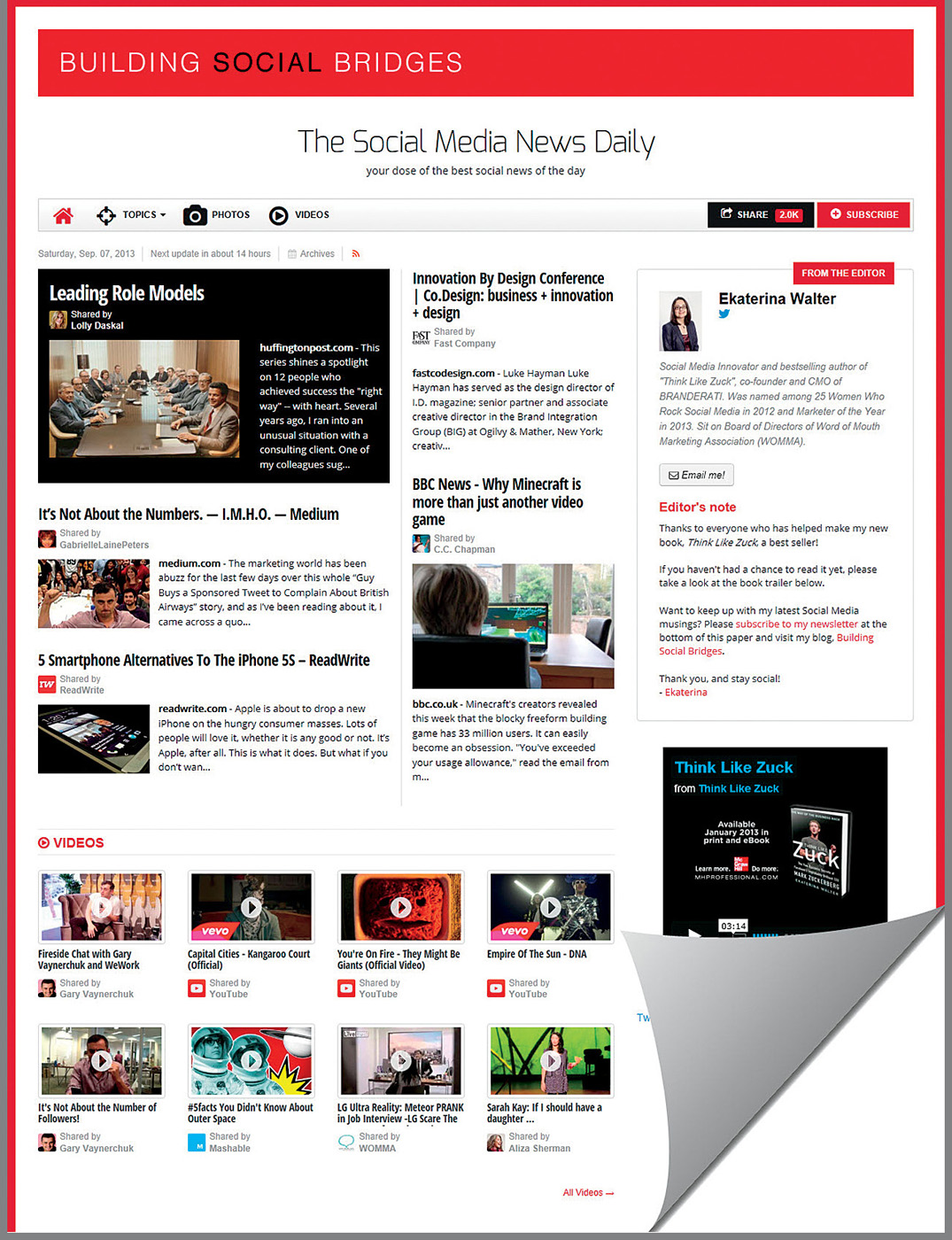
Paper.li is a free and useful tool for creating a visual online newspaper in minutes with content that has been crowdsourced from articles, photos, and videos across the Internet. Companies can pull in content from their Facebook, Twitter, and Google+ pages, plus popular newspapers. The end result delivers relevant content based on timely subjects of interest from your company and industry. Consider developing a custom Paper.li for a major event leveraging the event hashtag, so you can pull in all of the important tweets, photos, videos, and blog content into a great takeaway to share postevent. More custom Pro accounts are also available for a fee.
On the next page is Ekaterina’s Paper.li digital newspaper The Social Media News Daily that automatically goes out to all her Twitter followers on a daily basis and serves as a great subject of regular Twitter conversations and is a fantastic relationship building tool for the author.
RebelMouse is another free aggregation tool that connects all of your social media activity and live streams it in a highly visual way that’s similar to Pinterest on a personalized website. There are so many options for integration—if you can dream it up, you can probably find a way to get it on your RebelMouse site. Options listed include RSS feeds, custom hashtags, Twitter, Facebook, Google+, Instagram, LinkedIn, Tumblr, Pinterest, YouTube accounts, and more. It’s free, but your domain will be www.rebelmouse.com/username. For a fee, custom domains can be purchased.
In the enterprise space, aggregators aim to provide a seamless experience for sharing amazing user-generated content through branded content. The difference is that customized content can be sourced and integrated in real time across a number of online and offline platforms from websites to Facebook tabs, TV, mobile sites, digital screens, and more. Two of the major players include MassRelevance and Postano. Both offer the ability to create a slick, branded experience that pulls in visual content and conversations across all major social networks and Internet sources. The end goal is to let your fans tell the story of your brand through a continuous steam of shareable visuals.
Using MassRelevance, for example, Pepsi turned its home page into an interactive pop culture dashboard with a Live for Now theme driven by fan-generated images on social media.
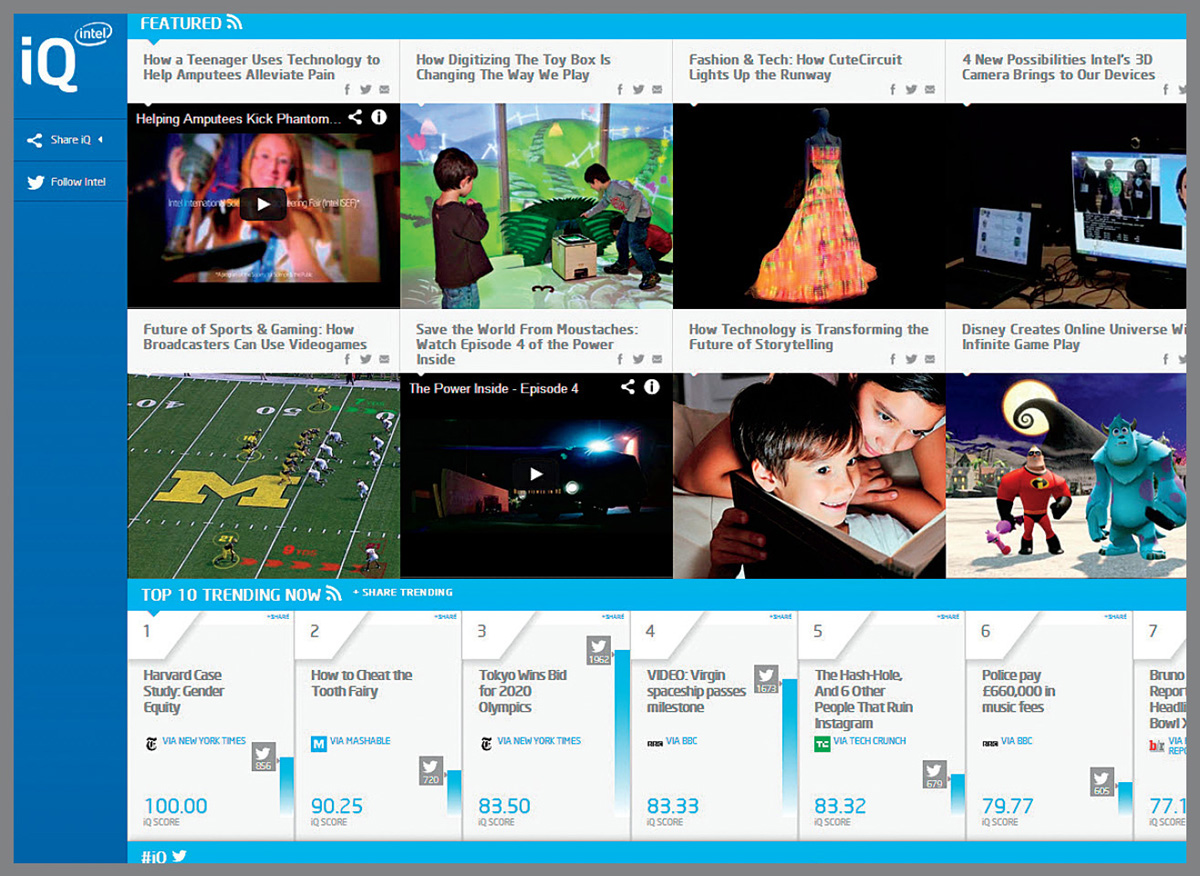
Intel went one step further and in 2012 launched a mobile-first, employee-curated digital magazine called iQ, the digital newsstand that aggregates the best stories from the Internet about technology. It looks like Flipboard, aggregates content like Reddit, and serves up news visually, like Newsmap.
As an ingredient brand, Intel touches almost every part of the technical modern world. Given that, the iQ editorial strategy is to narrate those touch points that may get overlooked or to tell stories on innovation everywhere from an Intel point of view.
Beyond this “brand as publisher” exercise, Intel iQ is quickly transforming itself to be part of a wider “brand as publishing network.” Through partnerships with publishers such as PSFK, BuzzFeed, Vice, and others, iQ’s original and cocreated content syndicates throughout publishing networks and touch points like Flipboard and Zite. Intel also uses this content in paid distribution services like Outbrain and Sharethrough.
iQ has become the hub for Intel’s social content and strategy. Once content lands on iQ, it is then available in a form that is optimized for Intel’s owned social properties, like Facebook, Twitter, and Tumblr. The company is increasingly integrating it with paid media, and it has plans to take it global in key markets in 2014.
With the rise of visual storytelling, expect to see the range of tools and service providers in the content aggregator space continue to grow. It’s always been a challenge to track and monitor a multitude of social media channels, e-mail newsletter subscriptions, and RSS feeds, warranting the demand for automating the delivery of relevant content in a visual package. The challenge for companies will be to focus on curation versus merging all of their outbound content in one place. The use of social media is ultimately about the power of your community, so the experience needs to feel personal versus automated. The more that companies can use aggregators to discover inspiring visual content that sparks a conversation and engagement, the better.
The Seven Elements of Visual Storytelling
Similar to how people grow relationships with each other, visual storytelling offers companies meaningful opportunities to deliver positive experiences that build brand awareness, trust, loyalty, and engaged communities.
In order to develop and implement a successful visual storytelling strategy, marketers must focus on the following elements:
 Design
 Personalization
 Usefulness
 Personality
 Storytelling
 Shareworthiness
 Real-time amplification
Embrace Visual Imagery
When it comes to the design element of visual marketing, it’s inspiring to see companies curating stunning imagery with the help of talented artists and photographers. One company that does this exceptionally well is Land Rover USA, with its Tumblr blog The Journey (http://tumblr.landroverusa.com). Featuring gorgeous photos, such as the “ferocious” photo of a beautiful animal, the tiger, all images in The Journey come together to tell an aspirational story of the Land Rover brand targeted at rugged and romantic adventurers.
Taken by photographer Jay Trinidad for Land Rover, these images underscore how capturing stunning, yet powerful visual imagery can tell a story and add to the overall branding of the vehicle, without the use of text. The image of a tiger in front of a vehicle, for example, is highly stylized, which speaks to the quality and luxury of the car, and the roaring statue of the animal showcases that this high-end vehicle has the heart and prowess of the tiger. While the Tumblr post does include text that says “FEROCIOUS. And fearless,” it is easily conveyed through the image.
Personalize, Don’t Spray
Another key theme of visual marketing is the personalization of content by platform. Gone are the days when it’s okay to spray the same piece of content across multiple platforms. Instead, social media leaders are embracing the special features and capabilities of each type of platform to foster different types of engagement and storytelling.
General Electric is a great example of a company that adopts unique strategies for visual marketing across different platforms. Whether it’s Facebook, Tumblr, Instagram, Pinterest, Vine, or YouTube, the content is different, but it is consistent across the themes of science, technology, and innovation. One of General Electric’s unique approaches to visual content can be found on Pinterest, which showcases incredibly creative boards (http://www.pinterest.com/generalelectric). With the goal of inspiring people to build, power, move, and cure the world, the board titles include “Badass Machines,” “#GEInspiredMe,” “Mind = Blown,” and more. There’s even a little geek humor found in a board called “Hey Girl,” which shares spoof pick-up lines from Thomas Edison.
Make Yourself Useful
By playing off of the strengths of each social media platform, companies are taking the first step in ensuring that their visual content is also useful. However, personalization alone does not necessarily make content useful. Social listening can help companies be more useful and relevant by uncovering key themes and trends around which to craft visual content. Social listening can also help companies to better understand what drives consumers and prompts action, whether it’s sharing, engaging, or purchasing.
Whole Foods is a good example of a company that goes above and beyond in being useful and relevant to its consumers. The company has more than 600 social media accounts, spanning both the national and store levels. Local stores are tasked with developing content related to what’s happening, or being offered, much of which is visual across sites like Facebook, Pinterest, and Instagram. At the national level, sites like Pinterest help Whole Foods be useful at scale (http://www.pinterest.com/wholefoods). Clearly, it’s not a leap to assume that a grocery store offering recipe content would offer value. However, Whole Foods Market has become a leader on Pinterest for its unique approach to cocreation.
During the Visual Voice panel at SXSW 2013, Whole Foods’ director of social media, Natanya Anderson, shared that for every pin, Whole Foods repins five things from other people, making sure that they’re able to appropriately source and credit the content. Whole Foods also participates in cocreation by bringing in different subject matter experts to help them pin worthwhile content. As a result, Pinterest has overtaken all of Whole Foods’ other social media channels for traffic generation to the recipes on WholeFoodsMarket.com. During the panel, Anderson went as far as to say that Pinterest’s 110,000 followers generate 15 times more value than Facebook and Twitter combined. For example, one of the most popular Pinterest recipes for spaghetti squash has been repinned 68,000 times, driving 44,000 views to the recipe on Whole Foods’ website.13
Be Human
In addition to being useful, visual marketing performs better when the content has a human element. Being human means feeling more like a friend than a corporate entity. A friend has a personality, values the relationship, shares experiences, and understands when to listen, when to be serious, and when to have fun. Being human means not leading with “buy this now.” Instead of going straight for the sell on social media sites, companies need to think through how people discuss and recommend a product or service to a friend. Evaluate and learn from the best practices of known influencers and superfans who are producing trustworthy visual content about your company. Chances are, you’ll find that the trust is generated in part because of their reputation but also because they discuss and share product attributes in a relatable, easy-to-understand way.
It’s also important to go beyond what people are saying about your company and understand what else they care about. Learn what issues, causes, and interests are important to them, plus what motivates them. For example, if your customer base is passionate about sports or entertainment, content can be crafted around a major event, season, and more. This is strategic because people aren’t going on social media sites to hear from companies. They are hopping onto Facebook to see their cousin’s vacation photos or to post photos from a birthday party. Being human also means fitting in, so your goal as a company is to craft visual content that’s a welcome interruption between the status updates, photos, and more that people come on social media platforms to view.
One way to show the more human side of your company is by putting your community’s user-generated content in the spotlight. In Lululemon’s #TheSweatLife campaign (http://thesweatlife.lululemon.com), the company prompted its fans to share on Twitter or Instagram how they get their sweat on for a chance to appear on the company’s website or social media channels. It used a service called Olapic, which offers software for collecting user-generated photos across Facebook, Twitter, and Instagram. Naturally, the photos all put Lululemon apparel in the spotlight, but it did so in a way that personified the brand and the people who live an active, healthy lifestyle. Lululemon could craft a ton of inspiring visual content to promote its brand, but seeing real people out living their lives while wearing the company’s apparel is more relatable. People could see how the clothing fits on real bodies and not just on models. They could also use the images to source styling ideas, fitness tips, and more. According to an interview with Nancy Richardson, Lululemon’s vice president of digital and brand strategy, the campaign launched in fall 2012 and, as of spring 2013, there had been more than 26,000 people who had used #thesweatlife hashtag on Instagram, plus over 2 million page views on Lululemon’s website.14
Tell a Story
All of the visual marketing examples thus far prove that a successful visual marketing strategy requires that the content’s storytelling element be just as important as the use of the visuals. Stories can come from a number of places, whether it’s company values, how people enjoy your products or services, key milestones, or simply by being timely and relevant. For example, in Oreo’s Daily Twist campaign, the company celebrated its one hundredth birthday by developing 100 compelling images inspired by real-time pop culture (http://www.pinterest.com/oreo/daily-twist). Holidays and timely occasions celebrated included National Talk Like a Pirate Day, Hispanic Heritage Month, the Mars Rover landing, and more. While each piece of content was different, the creative theme of showcasing a unique twist on pop culture happenings and holidays for an extended window of time added a storytelling element. The campaign ultimately garnered global praise and awards, and it redefined how many people looked at the Oreo brand.
Be Shareworthy in Everything You Do
Akin to lightning in a bottle, companies and brands of all sizes are looking for similar visual storytelling opportunities to hit those magical high notes with their consumers. According to Coca-Cola, one way to do this is by being shareworthy in everything you do. Wendy Clark, SVP of integrated marketing communications and capabilities for Coca-Cola, told Fortune, “For Coca-Cola, our Facebook fans are just over one fan or friend away from the entire Facebook community of 1 billion+. So if we do our job well of developing useful, compelling, interesting, and shareworthy content, our fans become our sales force for us.”15
Clark also encourages companies to think of their customers as storytellers: “Taking the principle of Initial and Ultimate audiences, we’re increasingly thinking about all of our constituents as storytellers, not just receivers of our content.”16 Clark cites that as much as 80% of conversation about the Coca-Cola brand comes from its customers, offering opportunities for cocreation, versus simply pushing out messages and hoping they will stick.
An example of how Coca-Cola is embracing its customers as storytellers can be found in its #BestSummerMoment campaign. Hosted on a microsite and the company’s social media channels including Facebook, Twitter, and Instagram, Coca-Cola encouraged its customers to share their unforgettable summer moments. Coca-Cola celebrated its fans by sharing some of the best photos across its microsite and social media channels, plus offering some lucky participants a special reward to open even more summer moments. During the #BestSummerMoment campaign, the company sourced incredible photos to use on its social media channels, including a collage of newlyweds enjoying Coca-Cola on their honeymoon and many more. Many of the photos submitted were highly shareable, and they told a unique and emotional story that was a positive reflection of the Coca-Cola brand.
STATS
Live in the Moment
There’s a massive amount of visual and video content for consumers to sort through. There’s also a lot of opportunity for real-time interaction and engagement. Think back to the Introduction to Ekaterina’s example with Benefit: the company quickly tweeted her an image of a compliment to put a smile on her face during the tough day. Developing a robust image and video library filled with content to share in real time offers companies a strong opportunity to add value in the moment. The challenges and opportunities, which will be discussed in depth in Chapter 4, are how to anticipate the types of content you’ll need.
In addition to daily consumer engagement, living in the moment also extends to current events. From the news of the day, to traditional and wacky holidays, or a meme that just went viral, there’s no shortage of topics to pull from. The key is to stay aligned with your company’s values and to play to your strengths. Oh, and you never, ever, want to look like you’re marketing to a tragic event. For example, as the eyes of the world turned to the Boston Marathon bombing tragedy during April 2013, Scott Monty, head of global social media for Ford Motor Company, tweeted, “If you manage social media for a brand, this would be a good time to suspend any additional posts for the day.” The companies who ceased their planned communications and posted heartfelt messages about Boston were rewarded, while those who appeared to be marketing to the disaster lost fans and suffered a blow to their reputation.
An example of being timely without being promotional happened in February 2013 when a massive blizzard hit Boston. With people stuck at home, two Boston-area sports teams, the New England Patriots and the Boston Red Sox, revised their content calendars to focus on what people would be buzzing about—the snowstorm. From the beloved Boston Red Sox mascot, Wally the Green Monster, waist deep in snow digging out Fenway Park, to the New England Patriots’ showing fan photos of snowmen dressed up in team gear, both teams were relevant and fun in real time without being promotional. The teams showed their fans that they too were digging out and having fun in the snow, and they were rewarded with engagement, positive comments, and fans’ sharing their content. The Boston Red Sox tweeted a picture of Wally shoveling the snow with the message: “Wally is still digging out. … Are you?”
In the next chapter we will dive deeper into each social network and provide tips and case studies for each. In Chapter 4 we will walk you through developing a visual storytelling road map and show you how to implement it.