
Chapter 16
Growing Herbs
In This Chapter
• Easy-to-grow culinary herbs
• Annual herbs to grow from seeds or seedlings
• Perennial favorites
• Exotic and esoteric herbs
• Growing herbs with medicinal powers
It didn’t take long for our ancestors to figure out that certain plants taste good or satisfy hunger, some plants improve the taste of food, others make folks feel sick, and still others make them feel better when they’re under the weather. Obviously this sequence of discovery didn’t happen overnight, but took only several thousand years. Eventually, someone developed the bright idea of growing all those feel-better and taste-better plants, and the concept of the herb garden was born.
Today, herb gardening is one of the most popular forms of gardening—and one of the easiest. Herbs will grow in poor soils, thrive with a minimum of care, and generally take up far less space than most vegetables. In this chapter, we explore growing a wide variety of herbs, from the culinary basics to exotic specialty types, as well as those known for their curative powers.
Easy and Essential Herbs
There are a few herbs no good cook can do without. Can you imagine a world without basil or parsley? And what’s a baked potato without a few snips of fresh chives? I can’t bear the thought of iced tea without a few sprigs of fresh mint to liven it up. These four essential herbs are among the easiest of all herbs to grow.
Partial to Parsley
Parsley (petroselinum crispum) is the number one essential herb. Cooks of every persuasion use both the curly variety and the flat-leaf Italian type to enhance just about any food you can imagine.
Food for Thought
Grow your herbs in a spot that’s convenientto the kitchen for easy arvesting.
This biannual plant is easy to start from seed especially if you soak the seeds overnight. In cooler zones, start the seeds inside about 7 weeks before the last predicted frost.
In warm areas, sow outside directly in the garden. When the seedlings are a couple inches tall, you can thin them to about 3 inches apart. If you’re pressed for time (or just lazy!), buy young plants.
With its 2-year life span, parsley can survive in cold conditions. I actually picked parsley in the snow in my zone 5 vegetable garden, although it can become a little bitter and tough in its second season.
Because parsley is so easy to grow from seeds or seedlings, most gardeners treat it as an annual.
Basil Is Best
Known officially as sweet basil or Ocimum basillicum, this easy-to-grow annual herb is essential in Italian cooking. Several varieties are available, including a very pretty purple type. But the medium-green classic variety is the one to grow for making pesto and spaghetti sauce and to serve with fresh tomatoes and mozzarella cheese. I begin to drool just thinking about it.
In cold climates, sow basil seeds thinly (about 8 or 10 seeds per inch) indoors in mid-spring. Plant seeds directly in the garden as soon as temperatures are reliably over 50 degrees Fahrenheit.
Set out seedlings when they have four leaves and after all danger of frost. As the plants grow, pinch back the tops to make them bushier. Also pinch back any flower buds as they form to encourage the basil to keep producing leaves. And always grow lots of it. You’ll need handfuls to make fresh pesto.
Much Ado About Mint
I’m including mint in this selection of easy and essential herbs mostly because mint is easier to grow than just about any plant I can think of. Mint is a perennial herb. In fact, we can include mint in the “invasive plant” category, meaning you can’t get rid of it even if you want to. But a little bit of mint is, as Martha would say, “a good thing.”
The two most common varieties of mint are spearmint and peppermint. You might also find apple, pineapple, and orange flavored mints. All are available as seedlings.

Garden Guru Says
To prevent mint from taking over the entire garden, place plants in plastic or terra-cotta pots and plant the pots. Leave a bit—about an inch or two—of pot rim above the surface of the soil. Every few years, dig it up and replace the pot with a larger one, adding more soil. Or unpot the mint, trim back the roots, and repot with fresh soil.
Another method for growing mint is from a root cutting. (Ask someone with mint growing in his or her yard for a handful of roots.) Just stick a bit of the root with some stem and leaves attached into a pot with some soil, water it, and stand back.
Crazy About Chives
Think of chives as itty, bitty onions, because that’s exactly what they are. Chives are especially easy to grow, unless you insist on starting them from seed. But why bother? Chive plants are easy to find. And once you have a mature clump or two growing in your herb garden, you can divide them to produce more (see Chapter 22). You’ll need to divide them every 3 or 4 years to keep the clumps healthy anyway.
When planting, place chives about 1 foot apart as soon as the soil can be worked. To harvest, snip the hollow stems at their base.
Chives produce pretty, papery, pink blooms, which are very decorative in the herb garden, in pots, or among other perennials. They’re also edible. This is one herb plant you can allow to bloom without sacrificing flavor.
One at a Time
As you’ve most likely figured out by now, some herbs are annual plants, or go through their entire life cycle from germination to flowering and seed production in a single year. The following annual herbs are among gardeners’ favorites.
Delightful Dill
One of the tallest herbs we’ll look at in this chapter, dill can reach 4 feet, though there are dwarf varieties. Feathery dill leaves are used to flavor pickles and fatty fish like salmon. The seeds are also used as a flavoring. I love cucumber and onion salad with sour cream and lots of dill.
Growing dill from seed is a bit of a pain in cold zones. The seeds can’t be planted outside until the last frost, but they need about 3 weeks to germinate, so you wind up waiting well into the summer season to harvest.
And because dill doesn’t transplant very well, starting the seeds indoors is iffy unless you start the seeds in peat pots, eggshells, or homemade paper starting cups. The seeds need light to germinate, so lay them directly on top of the soil. Be sure to do successive plantings every couple weeks until the weather gets too hot. Dill hates hot weather.
I prefer to buy dill as seedlings so I can start harvesting it early. I also like to use it as a decorative addition to pots of flowers on my terrace.
Garden Guru Says
Some herbs are known for their insect repellant qualities and can be helpful in the garden as well as in the house. Dill, chives, oregano, sage, borage, coriander, rosemary, hyssop, and mint are among the most effective. Plant the herbs among the most susceptible vegetables for a little natural assistance. For a comprehensive list of which plant repels what insect, visit www.rexresearch.com/agro/comp1.htm.
Cilantro (a.k.a. Chinese Parsley or Coriander)
Unless you’ve been living in a cave for the last 10 years, you probably already know about cilantro. It’s an essential ingredient for Mexican and Chinese cooking and another relatively easy-to-grow annual herb. I say relatively easy because it does have one little quirk—cilantro hates hot weather.
The seeds germinate in about 10 days, so there’s no need to start them indoors. Instead, plant them outdoors after the last frost and then start a new crop every couple weeks. The plants will grow quickly until the heat gets to them. Then they’ll either stop growing and look awful, bolt to flower, or die.
Not to worry. As soon as the weather cools a little in the early fall, start another crop. In places like Arizona, Florida, or South Texas where summer temperatures soar, consider cilantro a winter herb.
Food writers, by the way, almost always refer to the leaves of this plant as cilantro and the seeds as coriander.
Summer Savory
More gardeners should grow this great herb. It’s easy to start from seed indoors (about 2 months before the last frost), although it takes up to a month to sprout. The seeds need light to germinate, so place them on top of the soil. You can also grow this herb from cuttings. The easiest way to add summer savory to your herb garden is to buy small plants, although you aren’t likely to find them everywhere.
Plant seeds and plants in a good potting soil with some compost added because this is one herb that likes a richer soil than most.
Summer savory is very versatile in the kitchen. It tastes a little like thyme but a bit spicier. Use it to add flavor to meat, fish, poultry, beans, eggs, and potatoes.
Summer savory grows to almost 2 feet and might need to be supported (see Chapter 11).
Fabulous Fennel
The herb fennel is a totally different plant from the Florence fennel grown for its bulb, though both share that delightful anise flavor. In fact, fennel is sometimes referred to as anise.
The herb fennel grows easily from seed in ordinary or even sandy garden soil. Plant it after the last frost, and it germinates in about 2 weeks. To keep the leaves looking their best, pinch out flower buds regularly. A few weeks before the first frost of fall, you can allow the flowers to bloom and then collect the seeds to use for winter cooking, to flavor fish, chicken, and pasta dishes and to add an anise flavor to baked goods.
In warmer zones (although not where it’s really hot), fennel behaves like a perennial.
Chic as Chervil
No French chef could survive without a source of fresh chervil to use in salads and as a flavoring for meat, poultry, fish, vegetables, eggs, and vinegar. It’s also an essential ingredient for the herb blend herbes fines.
But it’s still not a household herb in the United States, even though it’s so easy to grow.
Start the seeds outdoors in spring as soon as the soil is workable. Like dill seeds, chervil seeds need light to germinate. New sprouts appear in about 2 weeks. If you find you like using chervil in your cooking, plan on making successive plantings so you have a steady supply.
Like cilantro and dill, chervil hates the heat, so avoid new plantings in very hot weather. Unlike most herbs, chervil tolerates shade. In fact, it prefers a shady location, and it doesn’t like to dry out.
Garden Guru Says
To help herb plants produce the tastiest and most aromatic leaves, use fertilizer sparingly. It’s better to underfertilize than to use too much. Follow mixing directions on the product label, but don’t use it as often as prescribed. Or mix the fertilizer at half-strength and use it according to the suggested schedule. If you’re making your own fertilizer, water it down to a weak solution.
Perennial Favorites
One of the most beautiful herb gardens I’ve ever seen is at Sissinghurst Castle in southern England. It’s a huge square intersected by flagstone paths and surrounded by a tall hedge. And it’s full of perennial herbs—including such culinary varieties as thyme, rosemary, and sage—that form a gorgeous tapestry of colors, shapes, and textures.
Perennial herbs are the aristocrats of the herb world. As important as parsley and basil are, somehow the perennials described in this section are a step above.
They’re also a boon for thrifty souls. Buy a few of these plants (or start them from seed), and you can enjoy the harvest for years.
Oh, Oregano!
You can’t make spaghetti sauce, pizza, or an Italian hoagie without this pungent perennial herb. Oregano (Origanum onites) is easy to grow from seed, germinating in just 8 to 10 days. But it needs a pretty long growing season before the leaves are ready to harvest. So in cold areas, start seeds indoors 6 to 8 weeks before the soil can be worked. In warmer zones, they can go directly in the garden. Plants are also easy to find.
Oregano is a low-growing herb, never reaching more than about 18 inches tall. It spreads rapidly but doesn’t become invasive like mint. Divide oregano plants every 3 or 4 years to keep them full. Frequent harvesting also encourages lots of new growth.
Oregano might need a little bit of protective mulch in very cold climates, unless there’s continuous snow cover.
Food for Thought
You can find several varieties of oregano available in seed catalogs and nurseries, including Spanish, Mexican, and Cuban. But when cooking Italian, use the Greek type (go figure!).
Sage Savvy
For years I neglected a large sage plant that just refused to die. Originally I planted it so its silvery color would complement the bright annuals in a large container. The savory, mint-flavored leaves were just a bonus for flavoring poultry and fish dishes. After 3 years in the pot, I pulled it out because it had become too large. It then sat in a corner of the garden, where I had dumped it without any sort of proper planting. After about a year of this abuse, it finally succumbed. I don’t recommend this kind of treatment. But it does prove just how tough sage is.
Sage, whose Latin name is Salvia officinalis, prefers dry conditions with a slightly alkaline soil, but don’t go out of your way to meet these needs. You can sow sage seeds outside as soon as the soil is workable or start them indoors about a month earlier. The seeds sprout in a week or 2. Young plants are readily available, too.
Sage produces spikes of pretty purplish-pink blooms that are very attractive to bees. Pinching out buds forces the plant to put more energy into its leaves. Or you can look for one of the bloomless varieties such as Dalmatian or Berggarten, although they might not be easy to find.
Time for Thyme
Sissinghurst Castle (which is sort of a mecca for gardeners), has another herbal wonder—a large walkway completely carpeted with thyme plants. The concept is that when you walk on the springy, low-growing lawn of thyme plants, the fabulous scent is released. It’s quite a romantic, although impractical, design.
Thyme (Thymus vulgaris) is an important herb for French cuisine. And although it’s usually used sparingly because of its strong flavor, no herb garden should be without at least one plant. Look for English or French thyme for the basic flavor.
Garden Guru Says
Specialty nurseries sell orange-, lemon-, caraway-, and even coconut-flavor thymes for the gardener who has everything.
Grow thyme from cuttings, or buy small plants. They like dry conditions and require a light soil. Pinch a few sprigs regularly to encourage healthy new growth, and be prepared to replace tired plants after 3 or 4 years.
King Tarragon
The French call tarragon the king of herbs, and we should be paying attention. It is used to flavor poultry, fish, and cheeses and is essential for creating béarnaise sauce.
Creative cooks also make flavored mayonnaise, butter, vinegar, oils, and mustard with tarragon, which is called Artemisia dracuinculus in Latin. But it’s important to use only French tarragon for these things. The very common Russian form of the herb is all but flavorless.
Tarragon is a bushy herb that grows to 2 or 3 feet in height and width. It doesn’t mind very poor soil and likes dry conditions. It’s hardy even in very cold climates as long as it has excellent drainage. Be prepared to divide or replace tarragon every few years.
Tender and Tasty
Among the most-often used culinary herbs are a few that are part of a class of plants known as tender perennials. This means that they live for several years as long as they’re protected from cold weather. Some are more tender than others.
Fragrant Rosemary
If tarragon is the king of herbs, rosemary is the queen. If they could choose only one herb to grow, more than a few cooks would select this exquisitely aromatic herb used to flavor poultry and meats, especially lamb and pork, and vegetables.
Don’t even attempt to grow rosemary from seed. It’s too hard. You can buy young plants at any good garden center. You can start new plants from cuttings, but it’s still easier to buy young plants. Rosemary isn’t too fussy about soil as long as it’s well drained. Be diligent about not overwatering, and give your rosemary plants plenty of room and good air circulation—they’re prone to mildew.
What’s really important to remember is that this plant won’t survive winters in anyplace cooler than zone 8. But if you live where it’s warm, you can have rosemary shrubs up to 6 feet tall.

Garden Guru Says
To grow rosemary in cool places, keep it in pots so you can bring it inside easily. Put the pot in your sunniest window, or even consider using a grow light during the short winter days. Water your rosemary sparingly, letting it dry out between waterings, and never let the pot sit in standing water. Use a mister to keep humidity levels high.
The Noble Bay
Another of the herb world’s aristocrats, bay leaf (a.k.a. sweet bay or bay laurel) has a long history, going back to ancient Rome and Greece. (Think of the laurel wreath around Caesar’s head.)
In warm areas (zones 8 to 10), bay grows as an evergreen tree that can reach 10 feet or so. Everywhere else, it’s grown as a potted plant. Bay grows slowly and can be kept to a manageable size with root pruning.
Don’t bother trying to start a bay plant on your own. Buy an established one and be prepared to baby it for a long time. This means a slightly acidic soil (a pH of 6.2 or so), full sun indoors, afternoon shade outdoors, careful attention to watering (don’t let it dry out but don’t let roots become water logged), and moderate amounts of fertilizer.
Bay leaf is used to flavor soups, stews, shellfish dishes, and a variety of sauces.
Sweet as Marjoram
A close relative of oregano, sweet marjoram has a slightly stronger flavor and is less hardy (except for another cousin, pot marjoram). It grows in nice, neat clumps to about a foot or two high and is evergreen in zones 8 to 10.
Marjoram can be grown indoors from seeds started about 6 weeks before the last hard frost or from cuttings. Plants are easy to find, too. This herb prefers a more alkaline soil in the pH range of 7 to 8.
For the best flavor, pinch back flower buds as they form. And to keep the plant nice and bushy, harvest small sprigs of leaves frequently.
Not Your Everyday Herb
Dedicated foodies as well as ambitious gardeners might enjoy experimenting with some other herbs that might not be as well known or as often grown as the traditional parsley, sage, rosemary, and thyme.
Thai One On with Lemongrass
If you like to cook Thai or Southeast Asian food, lemongrass is a must. A tropical perennial, lemongrass is grown as an annual everywhere except in the hottest climates. Start new plants by dividing existing ones, or look for young plants to buy.
Food for Thought
Cats like to chew on lemongrass leaves—which could be a plus or a minus, epending on your point of view.
Lemongrass plants tend to need a richer soil than most herbs, and they like slightly more moist conditions. You can bring these plants indoors before the weather gets cold and they’ll do pretty well. A grow light and regular misting helps.
High on Hyssop
Hyssop is a really old-fashioned herb, one that was grown by the ancient Hebrews and perhaps even earlier. Known mostly for its medicinal properties, the fresh leaves of the hyssop plant are also used to flavor salads and soups and to make tea.
Hyssop is a very hardy perennial that can stay evergreen even in severe cold climates. Where winter temperatures regularly drop below 0 degrees Fahrenheit, you might need to use a thick layer of mulch. It grows to about 3 feet high and about half as wide.
Start seeds indoors about 2 months or so before the last predicted frost. Hyssop can also be grown from cuttings or by dividing existing plants.
Expect to replace hyssop plants every 4 years or when they become very woody and rangy.
Borage Is Not Boring
Borage is an annual herb with cucumber-flavored leaves that are used in salads or to flavor meats and vegetables. The crunchy stems and the beautiful blue flowers are also edible.
Plant seeds or seedlings outdoors after the last predicted frost. New sprouts appear in a week or so. Do successive sowings every 2 or 3 weeks for a steady supply until it gets very hot.
Other Exotic or Esoteric Herbs
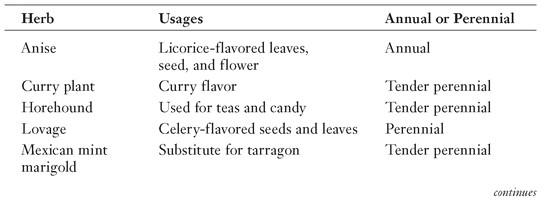
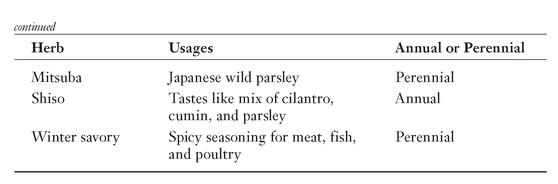
If the preceding sections weren’t enough to get you interested in growing your own herbs, the following table might be all you need to make the decision.
A Taste of Your Own Medicine
Before herbs were stirred into the cook pot to flavor foods, they were used to cure every kind of illness from headache to insomnia. Some medicinal uses were nothing more than quackery, but many continue to be reliable alternatives to what we now consider traditional medical practice.
A word of caution: some herbs can cause allergic reactions or can become toxic in combination with certain foods or substances. If you plan to use herbs as alternative remedies, you’ll want to do some more reading so that you’ll have as much information as possible.
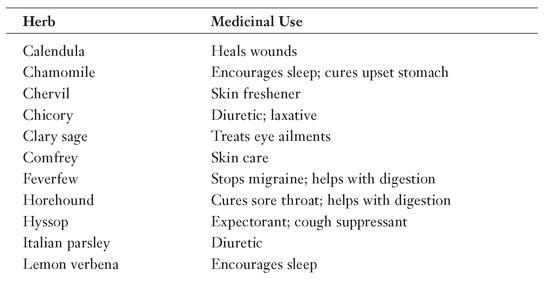
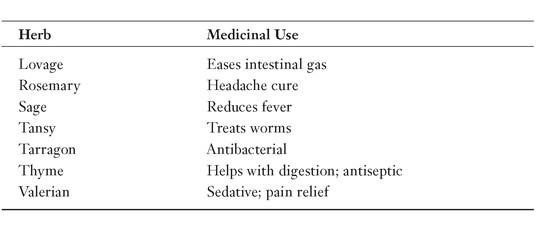
The following table contains just a few of the many herbs used for medicinal purposes.
Windowsill Herb Gardens
Fresh herbs are an essential ingredient of fine cooking year round, but I hate to pay grocery store prices for a bunch of rosemary, basil, or tarragon in the winter. And even more annoying, I have to buy a whole bunch even when I only need a few sprigs. The rest winds up rotting in the vegetable drawer of the fridge—an expensive mess.
Instead of overpaying and wasting, grow a few frequently used herbs on a sunny windowsill right in the kitchen. This is also an option for those would-be herb-growers who don’t have land outside to plant in.
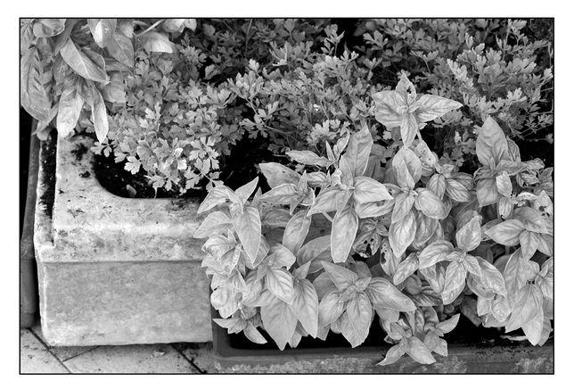
Herbs are among the easiest plants to grow in containers. You can have a full assortment of culinary herbs in one planter on the front step or on the windowsill.
You might have to replace indoor plants more often than the ones you have outside because they might not like the conditions in the house. But your chances of success will improve with plenty of sun and a relatively cool temperature.
The Least You Need to Know
• Herbs are annual, perennial, and biannual plants with culinary, medicinal, or aromatic qualities.
• Provide herb plants with well-drained soil and at least 6 hours of sunlight a day.
• Avoid overfertilizing herb plants to ensure the best flavor.
• Pay close attention to the cultural requirements of each herb you plan to grow so you can adequately meet their needs.
• Many herbs have medicinal properties.