
Chapter 3
Do It in Style
In This Chapter
• Planting gardens in urban or small spaces
• Growing suburban gardens
• Very large gardens
• Introducing your kids to gardening
• Landscaping with vegetables
You know you want to plant a garden of some sort, and you’ve come up with a list of the plants you’d like to grow. You have some idea of what type of garden it’s going to be and whether or not you’ll use organic methods. Now it’s time to get really serious. How is it going to work? Who’s going to do the work? Do you want to just make a few horticultural attempts without a big commitment? Or is this something you’re really drawn to in a big way?
In this chapter, you review all your options and learn how to create a garden with style.
Gardens in the City and Other Small Spaces
Not every gardener is blessed with an acre of ground. Millions of Americans live in apartments, condominiums, townhouses, and flats where the outdoor spaces might be strictly regulated or even nonexistent. Yet erstwhile gardeners who live in these dwellings still yearn to get their hands dirty just like anyone else. And for many, there’s no reason why they shouldn’t have an opportunity to grow at least a little bit of their own food.

Compost Pile
Lead from car and truck exhaust can poison produce grown in urban gardens, so when gardening in pots or other containers in the city, use fresh soil in the pots every year. Also, be sure to wash your harvest thoroughly before you eat it.
I’ve always marveled at the ingenuity of city gardeners. From my friends’ eleventh-floor apartment on New York’s Upper East Side, I can see a huge variety of plants growing in containers on windowsills and rooftops. In other parts of the city, fire escapes become mini jungles of flowers and produce during the summer months. At the retirement community where my mother lived, the residents use their balconies to re-create tiny versions of the gardens they left at their former homes.
Where you find a balcony, rooftop, fire escape, or windowsill, you can find room for a plant or two.
Life on the Ledge
Windowsill gardening is an indoor and an outdoor affair, but for the purposes of this chapter, let’s concentrate on the great outdoors because to produce produce, most plants require far more sun than is available to them indoors. (One exception is greenhouse gardening, which is another book entirely. Herbs are the other exception. They are relatively easy to grow on an indoor windowsill.)
By necessity, most windowsill gardens are home to small plants that are comfortable growing in window boxes. Herbs are the most likely candidates, especially the more compact and lower-growing types like parsley, basil, marjoram, coriander, and oregano. (See Chapter 16 for more information on herbs.) An ample window box can provide enough space to grow things like leaf lettuces, sweet and hot peppers, eggplant, bush beans and peas, and strawberries. Look for dwarf varieties of other plants, too. Avoid root vegetables and sprawling plants like melons, squash, and cucumbers.
Several types of window boxes are available to choose from, including those made of cedar or plastic. On very wide masonry sills, like the ones on apartment buildings, cast cement, or reconstituted stone planters are an option. You should select whichever size and material works best for your windowsill.
Garden Guru Says
Go deep! Vegetables require a minimum soil depth of 9 inches to thrive in a window box or other planter.
Whatever material window box you choose, be sure it has excellent drainage. Select containers that have enough drainage holes to allow water to pass through quickly, or add more holes. Cover the holes with pieces of broken terra-cotta pots or use a handful of Styrofoam peanuts in the bottom of the pot over the holes to keep soil from leaking out.
Be sure your window boxes are securely attached to either the windowsill or the wall to protect passersby (and your insurance carrier) from any disasters. On wide sills, rest the box on the sill and fasten it with screws or bolts through the bottom of the box. On shallow sills, attach brackets to the wall and screw or bolt them to the bottom of the container. And always be considerate when watering. No one wants to a take an unscheduled shower in window box drippings!
Fire Escape Gardens
I love fire escape gardens. They are one of the most hopeful, life-affirming things I know of. The people who grow plants in the gritty environment of the urban streetscape exhibit great creativity and optimism. It’s not easy to make things grow under these conditions, but they keep trying. Even the most ambitious fire escape garden will be limited in size. But with some careful planning, you can still grow some incredible edibles.
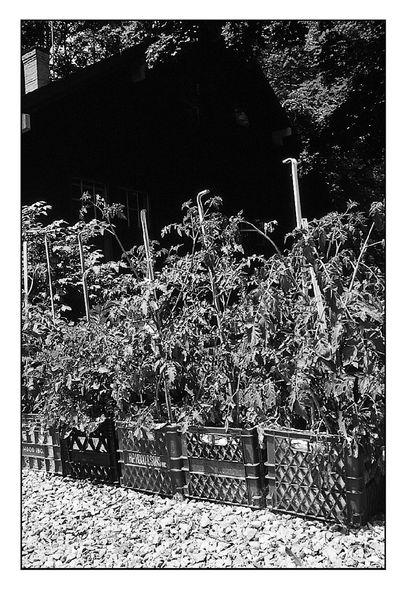
There’s something about a fire escape garden that calls for found-object containers, especially giant olive oil cans (the kind used in restaurants), 2-pound coffee cans, milk cartons, and plastic water jugs with the tops cut off. I once saw tomatoes growing in milk crates lined with black plastic garbage bags. How creative!
The biggest problem facing fire escape gardeners is sunlight, or lack thereof. If the space gets fewer than about 5 hours of full sunlight a day, you’ll have a really hard time growing plants. Consider growing ferns and flowers such as impatiens instead.
Plastic milk crates lined with garbage bags are an unusual but effective alternative to pots.
Balcony Bounty
For many folks, the only outdoor space they can call their own is a bit of balcony. This is where they park the hibachi, a lounge chair, and, if they have any horticultural leanings, a few plants in pots. There’s no reason why a balcony can’t become a mini farm for those so inclined.
Garden Guru Says
Whether you’re limited by space or not, sometimes smaller spaces are smarter choices, especially if you are an inexperienced gardener.
Balcony gardeners can usually grow their plants in a combination of planters, hanging baskets, and window boxes attached to the railings. With a little ingenuity, even the smallest space can accommodate a wide variety of edible plants.
Basics in a Barrel
It’s possible to grow a nice variety of edible plants in an old whiskey barrel or two. You’ve probably seen these barrels. They’re cut in half across the middle, making planters about 2½ feet across and about 2 feet deep. Whiskey barrels are not completely water tight, but you should still drill 2 or 3 holes in the bottom for good drainage.
Food for Thought
New whiskey barrels are available at many garden centers, but you could also recycle other containers. Soni Pitts, who gardens outside her apartment building in Asheville, North Carolina, purchased old plastic Rubbermaid bins at a Goodwill store, punched holes in the bottom for drainage, filled them with good soil, and successfully planted carrots and beets. Yard sales, Freecycle (www.freecycle.org), and Craigslist (www.craigslist.org) are also good sources for reusable containers like trash cans, washtubs, or even diaper pails.
What can you grow in a barrel? Here are a few good combinations:
• 1 tomato, 2 peppers, 1 eggplant, 1 basil, and 1 parsley.
• 3 basil, 1 oregano, 3 bean plants with a climbing support, leaf lettuces, and mini carrots or radishes.
• 3 herb plants (parsley, basil, and cilantro, for example).
• 1 hot pepper, 2 cilantro, 1 lemongrass, and 3 snow pea plants on a climbing support. When the peas are done, put in a tomato plant.
• 2 parsley, 2 basil, 1 dill, 1 cilantro, 1 thyme, 1 rosemary, 1 oregano, and 1 chive.
• 6 dwarf strawberry plants.
• 1 large variety tomato plant and 3 basil.
• 1 cherry or grape tomato plant, leaf lettuces, and 15 scallion sets.
These are just a few of the many combinations of vegetables and herbs that grow well in a large container like a whiskey barrel. After you’ve tried it, you’ll figure out what plants work best for you.
Garden Guru Says
To grow climbing peas or beans in a pot, they need something to climb. The easiest “something” is a support made of bamboo stakes. Insert three tall bamboo or fiberglass stakes equally spaced around the inside of the pot. Be sure the stakes are pushed all the way to the bottom of the pot. Secure the tops of the stakes with twine or a rubber band, forming a tepee. The plants will climb the stakes on their own.
Keep in mind that you can use several whiskey barrels or other containers without increasing your workload significantly. And there’s no reason why you can’t try some larger plants like pumpkin, cabbage, zucchini, or even cucumber. Just look for dwarf or bush varieties.
The key to success for large container gardening is adequate irrigation. Irrigation, fertilizer applications, and succession planting are all discussed later in the book.
Gardening in Suburban Spaces
The vast majority of Americans live in the suburbs, where properties range from small lots measured in feet to multiple-acre spreads. It’s in the backyards of these homes that most of us garden.
Suburban landscaping is probably the largest segment of the gardening industry, with vast quantities of consumer dollars spent on foundation plantings and lawn care. It’s reasonable to expect to pay up to 15 percent of the price of a new home on a landscaping package. And real estate agents can tell you that a badly landscaped house won’t command as high a price as its well-done counterpart.
But where does the vegetable garden fit into this picture? In most cases, it’s an afterthought. It doesn’t need to be. A successful backyard garden should be carefully planned so it’s integrated into the landscape. We talk about how to do this in Chapters 5, 6, and 7.
Doing It Big!
My first vegetable garden was an enormous affair, at least the size of a football field. My friend and I prepared it completely by hand and planted it with every vegetable we could think of.
That summer, we spent all our free time sowing, weeding, watering, and harvesting. I took a class on canning at the county extension office and filled hundreds of jars with tomatoes and pickles. My husband and I had enough frozen green peppers to last 5 years! And the zucchini bread—after a while friends stopped coming to the door if they saw me arrive with a little package wrapped in aluminum foil! I could never tackle a garden that large again, but it was worth all that effort for the incredible sense of accomplishment.
If you have the time, the space, and the cash for start-up expenses, doing it up big can be very rewarding. But if you’ve never gardened before, this is not the best route to follow.
Why do it big? Your reasons could vary depending on your circumstances. Maybe you want to grow your own organic food so you know everything that goes on and in it. Maybe you just love the taste of fresh vegetables or want to grow some produce for local restaurants or markets. Maybe you love canning and preserving foods and want to grow your own fresh fruit to preserve. Or maybe you just enjoy spending summer days outside in the sun and the dirt, making things grow.
Something for the Kiddies
My earliest experiences with gardening weren’t quite hands-on. Instead, what I remember is watching my father dig holes in the garden and move plants from here to there. I can also remember him growing tomatoes in a large plot at the far end of our big suburban backyard. I can’t recall many details except that he regularly pinched back some of the flowers on the tomatoes to force them to grow larger fruits. And I’m sure he explained the physiological reasons for doing that in great detail. I loved every minute of it, because it allowed us to be together.
One of the best reasons to involve your kids in gardening is that it does give you more precious time together. And if you make the experience fun rather than a chore, you might help your children develop a lifelong interest. In addition, many parents have found that children who might normally shun vegetables are more willing to at least give them a try if they’ve had a hand in growing, or at least picking, them.
It doesn’t take much to create a kid-friendly garden. Here are just some of the gardening themes you might use to interest kids:
• A spaghetti sauce or pizza garden with tomatoes, peppers, onions, basil, and oregano plants
• An alphabet or name garden, with a plant for each letter of the alphabet, or one for each letter in the child’s name (S = squash; A = arugula; M = mint)
• A giant tepee (made with 8- to 10-foot bamboo poles in a circle attached at the top with twine) with peas and beans planted at the base of the poles (They grow up the poles and cover them, making an enclosure.)
• Vegetable plants outside a playhouse or at the base of a climbing set
• A section of your vegetable garden just for the kids and planted with their favorite vegetables
• A series of pots and containers decorated and planted by your kids on the deck with favorites
• A collection of dwarf, miniature, and “baby” vegetables; or a “giant” garden featuring extra-large varieties of pumpkins, tomatoes, watermelons, and cabbages
Most children have relatively short attention spans, so it’s really important that their gardens are low maintenance. And don’t expect the kiddies to get too excited about preparing the soil or weeding. They’ll be most interested in planting seeds and seedlings and harvesting. Watering can be fun, especially if it’s done in a bathing suit and everyone gets wet!
Garden Guru Says
Several seed companies have special collections designed for children, with easy-to-grow, colorful, and fun plants. Check out Burpee Seeds (www.burpee.com), Kitchen Garden Seeds (www.kitchengardenseeds.com), and Renee’s Garden (www.reneesgarden.com). Kitchen Garden Seeds has one collection called the “Oddly Strange Vegetable Garden,” which might be especially appealing to children.
Children can learn so much from the experience of starting plants from seed. Try quick-to-germinate plants like radishes, carrots, peas, and beans to start from seed. For tomatoes, peppers, and eggplant, start out with young plants.
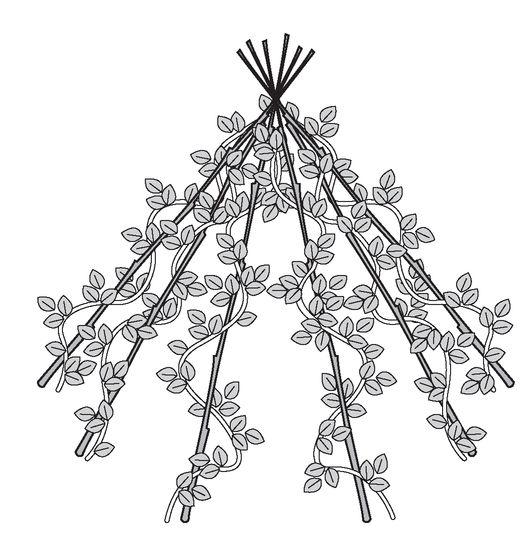
A tepee garden can be a magical place. Try planting dwarf sunflowers around the perimeter for color. (You can also harvest the seeds.) And with an inexpensive grass mat and old pillows inside, it makes a great hideout.
If you have the room, try some real kid-pleasing plants like corn, watermelon, and pumpkin. They need a lot of space but are very easy to grow. A heavy mulch (see Chapter 19) will keep weeding at a minimum. After all, there’s nothing like weeding to take the fun out of gardening for a kid.
Produce Among the Posies
While most folks think of vegetables, herbs, and fruits as simply plants to grow for food, many gardeners—including me—like to use these plants as ornamental additions to beds, borders, and planters.
A friend of mine who gardens in a tiny yard mixes vegetables with flowers throughout his garden. One time he trained a strong vining tomato up a trellis and across an arbor. The tomatoes hung below the vine, just waiting to be picked. It was beautiful, if unusual.
I first saw extensive use of edibles in ornamental gardens when I visited England. At one small row house just outside London, the owner grew rhubarb in giant raised planters and chives in pots on top of a wall. At Tintinhull House, one of the great
National Trust properties in the southwest, fennel was used as a decorative accent in a perennial border. I also saw artichokes used decoratively.
Recently, I was given a 6-pack of baby kale plants. Because the big planters on my terrace only had a few lonely geraniums in them, I stuck two kale plants in each one. By mid-July, the huge blue-green kale leaves had made a pretty, if eccentric, foil to the fuchsia-colored geraniums. And I was able to harvest the kale leaves all summer.
If you think a vegetable is pretty, then by all means add it to the flowerbeds. Or try some of these tucked among the blooms:
Arugula
Chives
Curly parsley
Hot peppers
Kale
Leaf lettuce
Okra
Purple basil
Purple beans
Sage
Strawberries
Swiss chard
The Least You Need to Know
• You can grow your own vegetable garden in any size space, whether it’s a container on a small terrace or the back 40.
• Get kids involved in gardening by letting them plant their favorite vegetables (especially if they’re quick-growing, to hold their interest).
• Vegetable plants can be used as ornamental plants in your flower beds and among your landscaping.