
Chapter 7
Design Dilemma
In This Chapter
• Popular garden styles
• Different or unusual garden styles
• Dealing with utilities and unsightlies
• Minimalist gardens
• Incorporating decorative elements
At this point, you probably have a pretty good idea of how big your garden will be, what kinds of things you’ll grow, where you’ll locate the garden, and how to put some of your ideas into action.
This chapter is a little different because it’s not about essential stuff. Instead, in the following pages, we’ll go over some of the aesthetics of your garden. Not the nuts and bolts things, but how the garden will look. Do you want a basic vegetable garden, or do you want to re-create a mini version of a royal French potager? Do you want to add a little sitting area, a small terrace, a fountain, a potting shed, or another decorative feature to enhance the look of your garden? Do you want to follow feng shui principles? Read on and then decide.
A Sense of Style
We all have our own sense of style. Usually we express our style in the way we dress and how we furnish our homes. Sleek modernists often wear basic black and favor smooth granite countertops and unadorned floors. Traditionalists, in tailored sportswear, frequently have homes with lots of chintz and tabletops cluttered with frames and decorative mementos.
Your sense of style can also be reflected in your garden. Do you like cute vegetable-shape plant markers and lots of ornaments? Or do you prefer to take an unadorned approach? Whatever appeals to you most is what you ought to do. Some garden styles are more, well, stylized. In this chapter, we’ll look at a few different approaches.
The Island Bed Garden
Think of your lawn as a body of water. Now create an island in that body of water. The island is the garden bed floating in the sea of lawn. Okay, I know that sounds kind of corny, but that’s the best way to describe an island bed.
The island bed garden should be free form, with gently curving lines. Right away, because of the form, you know it’s an informal space. And because it’s free form with a curved outline, a wooden fence isn’t going to work. If possible, leave an island bed unfenced.
A large island bed needs a path through it so you can tend all the plants. Make your path twist and turn gently from one end to the other.
And because the island bed is meant to be seen from all sides, plant taller things toward the center, then medium-size plants all the way around with the lower plants along the outer perimeter. Here are some suggestions for various-size plants:
Tall plants for center of island bed:
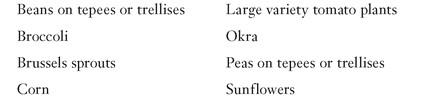
(Okay, sunflowers aren’t really a vegetable, but they do have edible seeds.)
Medium-height plants:
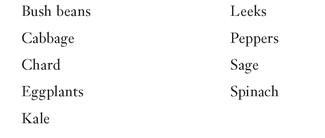
Lower plants for perimeter of island beds:
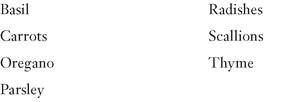
The Country Cottage Garden
The English cottage flower garden was all the rage a few years ago, and it’s not hard to understand why. This is a very appealing garden style.
The cottage vegetable garden is equally appealing. It’s easy on the eye, not too fussy, but not too bare. Each might have its own personality, but the best country cottage gardens have a few common elements, including a nice picket or split rail fence; an arbor over the gate; a little shed at one side; a bench; plenty of neat, straight paths in gravel, grass, or mulch; and a wide variety of well-tended plants.
Crisp edges aren’t a priority in a country cottage garden. In fact, plants should appear to tumble out along the path. One of the lessons I learned from English gardeners is to design axial paths (straight intersecting perpendicular paths) bordered by thickly planted beds with plants that overstep the bounds of the beds on to the paths. It produces a controlled chaos that’s enormously appealing.
The Feng Shui Garden
You’ve probably heard about the Chinese belief and practice called feng shui. The belief is that energy affects wealth, health, and relationships. In a house, feng shui dictates the placement of doors, windows, furniture, and other elements. The same principles can be applied to the garden.
Prof. Price’s Pointers
Feng shui literally means “wind-water,” and it refers to the flow of chi, or energy, in a space.
In a feng shui garden, the placement and shapes of beds are important. So is the use and location of certain materials and elements, including metal, wood, water, and color. You can even find feng shui experts to advise you on the best way to achieve proper feng shui in your home and garden.
To get started on your own, here are a few suggestions:
• Avoid having corners in the garden.
• Avoid straight lines or sharp angles.
• Use curving lines to encourage the flow of energy.
• Balance dark (yin) and light (yang) elements.
• Place water features and tool sheds to the north, never in the south.
• Use stone or earthen elements (brick, for example) in the northeast section of the garden.
• Use triangle shapes in the south.
• Use circular or arched shapes in the west.
• Avoid the use of metal to the east.
• Incorporate columns in the eastern part of the garden.
• Grow fruits and herbs in the eastern part of the garden.
Feng shui is much too complicated to cover completely here. For a few books on the subject, check out Appendix B, or consult an expert.
The Minimalist Garden
The minimalist design is a garden style that will appeal to people who don’t like a lot of clutter. People who like these rarely have more than one thing on their coffee table and the kitchen counters are often bare. Clean lines. No fussy tchotchkes littering the scene.
A minimalist garden isn’t necessarily simple. It just uses clean lines without excess ornament. Long, straight, well-manicured rows with neatly placed plantings is what’s needed.
Children’s Gardens
Many years ago, I attended a symposium on gardening for children hosted by a national gardening organization. In addition to all the speakers, forums, and booths, the event featured a dozen real gardens designed for children. They were really fantastic, with little places to sit or hide; wonderful colors, textures, and fragrances; amusing decorative details; and lots of opportunities for learning and pretending.
In Chapter 3, we looked at some of the things children enjoy growing and explored some ways to introduce kids to gardening. Here are a few design ideas that will make a child’s vegetable garden an inviting and fun place to explore:
• Laminate seed packets and attach to Popsicle sticks to use as row markers.
• Make and install a scarecrow.
• Add a child-size bench or table and chairs so the garden becomes a living space.
• Construct a tepee with vines to use as a hideaway (see Chapter 3).
• Add fun decorative elements like a toad house, fountain, birdbath, bird feeder, or wind chimes.
• Install a child-size arbor.
• Plant flowers with the vegetables.
Formal Vegetable Gardens
Although all parterre gardens are more or less formal, not all formal gardens are constructed with parterre patterns. The formal feel of a garden is reinforced by the use of straight lines as opposed to curves, but they don’t necessarily form patterns.
A simple formal garden might be a rectangle divided by two intersecting perpendicular paths. It might have a small, paved seating area covered by a pergola at one end and an open view at the far side.
This is a variation of a formal vegetable garden I designed several years ago. The original design had brick paths.
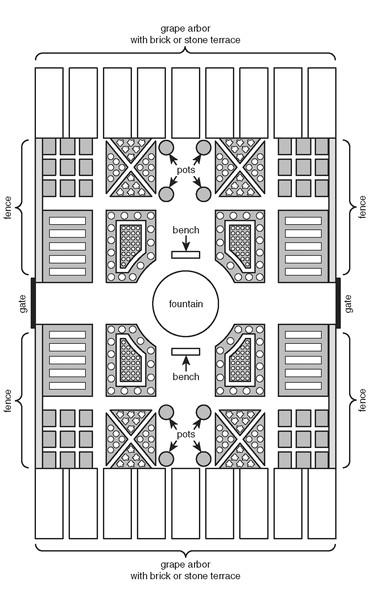
Neatness counts in a formal garden. Everything should be in its place. Planting beds are well defined with well-trimmed, edged borders.
Some of the most beautiful formal vegetable gardens are reproductions of historic gardens like Thomas Jefferson’s kitchen garden at Monticello, George Washington’s kitchen garden at Mount Vernon, and the great potagers in France.

Prof. Price’s Pointers
Potager is the French word for “kitchen garden.” These highly structured gardens were usually laid in perfectly manicured geometric beds intersected by axial paths. Several paths might intersect, forming a series of geometric planting beds. This patterned approach is called a parterre.
Parterre Gardens
Parterre is just a fancy word for describing the layout of paths and beds in a garden. The kitchen gardens at Monticello and Mount Vernon were done in a simple parterre style, while the seventeenth-century kitchen gardens at Versailles and Villandry in France were elaborate affairs that went on for acres and included great fountains and fancy trellising.
Although these gardens require an enormous amount of work to plant and maintain, it is possible to re-create your own. I would, however, recommend a smaller scale than Versailles!
Formal Herb Gardens
Herbs tend to be easy to grow and don’t take up as much space as many vegetables do, so they make the perfect plants for creating a small formal garden.
Some of the most beautiful formal herb gardens are designed as knot gardens. Dating to medieval times, the knot garden features tiny hedges of evergreen herbs forming intersecting lines in simple patterns. Most often, herbs with contrasting colors are used so the intersecting little hedges stand out and the pattern is more vivid.
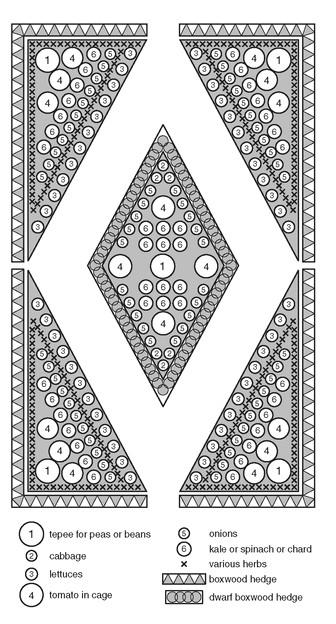
You can easily reproduce a typical eighteenth-century-style American herb garden. Typically a square space, the garden might have had a central space shaped as a diamond or as a square turned on its axis. Straight paths of brick or gravel might form an X at the center square and divide the other spaces into triangular planting beds. Most formal herb gardens are symmetrical.
A smaller parterre garden might not be as overwhelming a project for the home gardener as the Versailles parterre gardens.
Architectural Garden Elements
Any kind of a wall or building in a landscaped area is known as an architectural element, and landscape designers love them. An architectural element creates a framework and a foil for plants.
If you already have an architectural element on your property and it’s in an appropriate spot for the garden, give some serious thought to putting your garden nearby or even bordering it.
Consider some of these structures if you want to add architectural elements to your design. Any one of these would add architectural interest to your edible garden space:
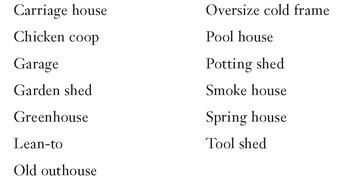
So let’s imagine that you’re fortunate enough to have one of these architectural elements in close proximity to your garden. How do you use it?
If you have a small building, use one wall, preferably not facing north, as one side of your garden. Enclose the other three sides with fence and your garden becomes a more important feature in the landscape. Add espaliered fruit, vining vegetables, hanging baskets, or window boxes along the wall, and it becomes even lovelier.
Out of Sight
If you’re doing a down-and-dirty garden, you might as well skip this section. Here, we’re going to look at ways to hide or disguise the less-attractive—but necessary—elements of the garden like compost piles, equipment, supplies, and other not so pretty but essential things.
Take Out the Garbage
Compost piles can be unsightly. I mean, let’s face it. A compost pile is basically a pile of garbage! But that garbage eventually becomes compost, and there’s nothing like it to make your soil rich. So in a garden where aesthetics are important, the compost pile is a liability.
There are a number of ways to hide or disguise the compost. You can put it on the other side of the garage or garden shed, if your yard is blessed with these structures. You can create a screen with panels of fence or trellis. Or you can grow a screen with bamboo, forsythia, evergreens, or another thick hedge.
Food for Thought
Be sure your compost pile is easily accessible from the house. You’ll be far more inclined to take a pail of eggshells, coffee grounds, potato peelings, and the wilted remains of a head of lettuce to a compost pile when it’s only a few feet from the kitchen door. If that’s not possible, treat yourself to one of those cute little compost pails with a built-in odor filter. Then you only need to make a trip to the compost pile when it’s full.
Another way to hide or disguise the compost pile is to keep it in nice tidy containers. You can either build your own, perhaps with recycled materials, or buy one of the many different styles available commercially. A large wooden compost bin can actually become an architectural element in your garden.
A clever and fruitful method of disguising your compost pile is to grow a vining vegetable or fruit like pumpkin, squash, or melons right on top of the pile. The vines grow rapidly, produce large leaves, and sprawl all over the pile. You can still add more scraps, clippings, and other stuff to the pile just by moving the vines around a little bit. Although this won’t completely hide the pile of compost, it will cover it up a little. And when the pumpkins, squash, or melons start to grow and ripen, they’ll take center stage.
Storage
Large gardens might require large quantities of mulch and fertilizer, a mower or tractor, lots of tools and hoses, and other equipment and products. Most of these things aren’t all that decorative, so you might want to think about having some sort of structure for storage.
Custom-made or prefab tool and storage sheds are the ideal answer to garden storage problems. Some are more attractive than others, but even the ugliest prefab metal shed will look better than a big pile of peat moss and fertilizer bags, mower parts, mulch cloth, and any of the other stuff that seems to accumulate around the garden.
Garden Guru Says
An out-of-use outhouse can make a very attractive little tool shed. They might not be easy to find, but they’re sometimes available when a developer takes over a country property. Old chicken coops also make great garden sheds.
To improve the look of a garden shed that’s more practical than pretty, you can always attach a few sections of lattice along the walls and encourage vines to grow. The disguised wall then becomes a nice backdrop for other plantings, and voilà, the ugly old garden shed becomes an architectural element.
A Decorative Touch
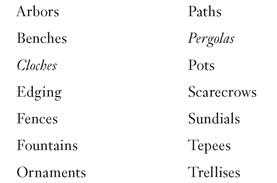
If you like lots of stuff around your house, you might feel comfortable with decorative items in your garden as well. Here are some things you might add to your garden to give it that homey feel:
Prof. Price’s Pointers
Cloche is French for “bell jar,” a bell-shape glass jar often placed over a delicate seedling to protect it from cold. A pergola is an arborlike structure with upright supports and cross pieces overhead that create a roomlike space underneath.
As your garden matures and your skills increase, you can incorporate new design ideas, omit those you find less appealing, and “grow” it into the perfect space for your needs and tastes, both visual and culinary.
The Least You Need to Know
• Let your personality help define your garden style.
• If feng shui’s your thing, you can call on an expert to utilize feng shui in your garden.
• Look for an architectural element to enhance your garden’s design.
• Try to disguise unsightly elements in your garden like compost piles or storage areas.