
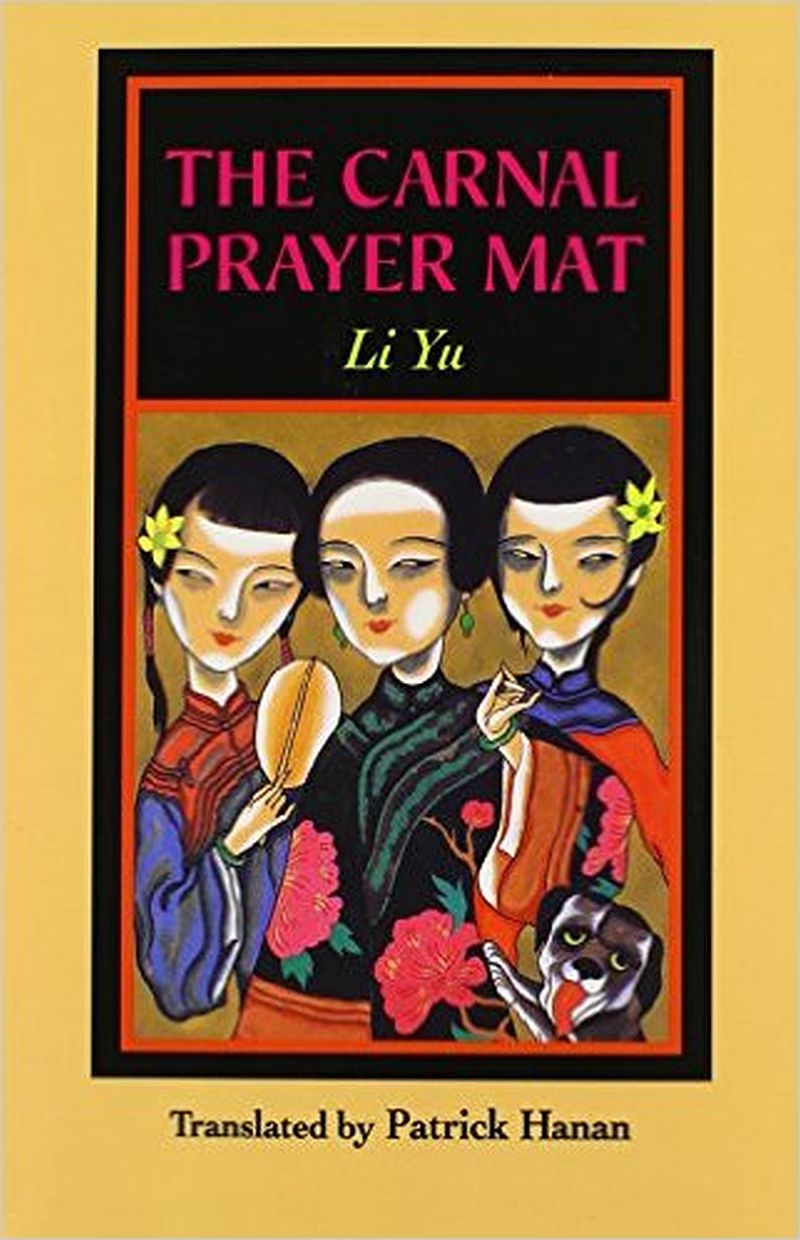
Li Yu
The Carnal Prayer Mat
TRANSLATED, WITH AN INTRODUCTION AND NOTES, BY PATRICK HANAN
INTRODUCTION
What first attracted me to Li Yu was his love of comic invention. "Broadly speaking," he once wrote to a friend, "everything I have ever written was intended to make people laugh." He was never content, as other writers were, to make minor variations upon the standard literary themes. Instead he submitted those themes to a drastic overhaul and created a new comedy of his own, claiming all the while that his version of reality was the true one and that everybody else was deluded. He thus belongs to that rare breed of comic writer-rare in any culture-who discovers or invents the terms of his own reality. [1]
Let me give two obvious examples, both of them discoveries rather than inventions. In its most general outline a Chinese romantic comedy consisted of a handsome youth with brilliant literary gifts falling in love with a beautiful and talented girl and, after overcoming a number of vicissitudes, marrying her. By the seventeenth century countless stories and plays, some of them masterpieces, had been written to this formula. But Li Yu would have none of it. In his first play (or opera, both terms apply), Lianxiang ban, a title freely translatable as Women in Love, he adapted the formula and applied it-for the first, and perhaps only, time in the history of Chinese literature-to a love affair between two women. Eventually the lovers are united as wives to the same man-the only solution open to them. Similarly, in Li Yu's Silent Operas (Wusheng xi) collection, there is a story about a love affair between two men that derives its comic power from the way it parallels a perfect heterosexual marriage, all the way from courtship to widowhood. Examples of comic discovery and invention abound also in his novel, The Carnal Prayer Mat (Rou putuan).
Invention and discovery, together with the implied virtue of originality, were stressed more by Li Yu than by any writer before him. "Newness is a term of approbation for everything in the world," he wrote, "but above all for literature." Copying is taboo, of course, even from the ancients, but so is echoing other writers, and not merely other writers but ourselves; we are not permitted even to echo ourselves-an impossible ideal, and one that Li Yu himself did not come close to realizing.
His passion for invention carried over from literature to life. He was a designer and practical inventor as well as a writer, and his essays ring with the (slightly self-mocking) refrain: "Is it not strange that the world had to wait for Li Yu to invent this?" A version of the refrain occurs in Chapter Ten of the novel, too, after Vesperus has shown his savoir-faire with pillows: "The general principle is known to all, but… that particular formula has never been understood before." So strong was Li Yu's passion for novelty that he was also quite capable of shocking his readers for sensational effect.
A second unique quality is his voice or persona. Strictly speaking, he had not one voice but a range of them, mostly humorous, that he employed in his fiction and essays. The narrator in the traditional Chinese novel had always been a strong vocal presence anyway, in vague simulation of an oral storyteller, and Li Yu exploits that convention-openly manipulating the narrative, commenting on the action, addressing his readers as if they were an audience, and even answering questions posed by a fictitious member of that audience. A passage in Chapter One of his novel exemplifies this last convention:
"Storyteller, since you want people to suppress their lecherous desires, why not write a tract promoting morality?"
"Gentle readers [or audience], there is something of which you are evidently unaware…"
The difference is that Li Yu is substituting a voice of his own for the voice of the traditional narrator. Every Chinese novelist had to make some accommodation with the figure of the traditional narrator-a history of the genre could be written in terms of their accommodations-but Li Yu's solution was the most personal, and perhaps the most satisfying. He was a noted wit and pundit in life, and I suggest that he managed to create in the voice of his fictional narrator a perfect literary correlative for his oral wit and punditry.
Few people realize that a lively tradition of erotic fiction existed in China, particularly in the sixteenth and seventeenth centuries. It was a superior tradition, in my opinion, to its somewhat later counterparts in England and France. Granted, Fanny Hill is a small miracle, but it seems a miracle precisely because it is isolated; and Sade's novels, as fiction, are second-rate at best-full of philosophizing as well as ludicrous cruelties and blasphemies. In China, by contrast, several novels of undeniable power were written. The Jin Ping Mei (The Golden Lotus) is only a partial member of the genre, being much else besides. If there is a classic example of the Chinese erotic novel, it is surely Li Yu's Carnal Prayer Mat.
It is in the nature of erotic fiction to seek out forbidden territory to explore. In China that was likely to mean adultery, not defloration as in the corresponding European genre. (In Europe adultery was left to the bourgeois novel.) The reason is clear enough: adultery violated the husband-wife ethic, one of the key Confucian social obligations. In a family-centered morality, it was a natural choice as the crucial sin, but for precisely the same reason, it also posed an intolerable threat to society. The libertine's adulterous adventures may enthrall the reader with their glimpse of forbidden pleasure, but ultimately they must fail. Sexuality for the Chinese writer, unlike Western apostles of eroticism from Sade to Lawrence, was a drive that had to lose when it collided with social values. That is why Chinese libertines are generally the objects of satire-as they certainly are in Prayer Mat. And it also explains why the Chinese novels can end only with the libertine's punishment and repentance.
But although the libertine adventure may be headed for disaster, the erotic novels obviously cannot be taken at their face value as the dire warnings they profess to be. For all its obsessiveness, the libertine adventure is presented to us with so much gusto that we are surely meant to enjoy it. I suggest that there is an inevitable-and artistically quite justifiable-tension in much visual and literary art on erotic subject matter. In Chinese fiction at least, the reader plays voyeur as well as judge as he watches the tale unfold, observing, with both pleasure and foreboding, its exploration of forbidden territory and its inescapable end.
The agency of punishment varies from novel to novel. A common one is retribution according to the doctrine of karma-that is to say, punishment in the next life for sins committed in this one. In Chapter Two of Prayer Mat, Li Yu takes the extraordinary step of introducing the Buddhist priest Lone Peak to explain this notion to us. The priest calls it "otherworldly" retribution and pairs it with a "thisworldly" retribution by which one's sins are repaid in this life. The second kind of retribution is an age-old, popular notion unrelated to Buddhism proper. (The novel's views are eclectic, embracing Heaven, the Principle of Heaven, the Creator, and the ancient sages, as well as Buddha.) The priest goes on to quote the adage "If I don't seduce other men's wives, my wife won't be seduced by others," and then erects it into a general principle by which an adulterer's wives and daughters are condemned to "redeem" his sins with their own-a characteristic Li Yu twist to an old idea.
The retribution plot fascinated the Chinese novelist, and one can see why; it allowed him to work human experience into newer and more meaningful shapes. He did not need to believe in the actual possibility of metaphysical retribution, for both he and his readers accepted it as part of the machinery of causation in fiction. But although Li Yu himself adopts the retribution plot gratefully enough in Prayer Mat, he cannot suppress his skepticism about it, as witness the debate between hero and priest in Chapter Two. The possibility of self-mockery must always be kept in mind while reading Li Yu.
The typical qualities of the erotic novel are almost all to be found in Prayer Mat, often in exaggerated form: the relentless quantification of sex, a feature perhaps derived from the sex manuals; the fascination with women's sexuality; the emphasis on penis size, in which Li Yu's idea of the animal implant outdoes all other novels; the trivial games, petty jealousies, and revenges that preoccupy the characters; and even the orgy, in which Li Yu's wine-and-cards party again outdoes all others.
At the same time Prayer Mat gives a far more prominent place to warnings against libertinism; Chapter Two is taken up with the libertine's debate with the priest, and Chapter Twenty with the former's repentance and redemption. Li Yu is using Buddhism as the ascetic alternative to libertinism-and also as a handy means of atonement. In comparison with the other novels, too, his language is not lubricious; he tends more to ribaldry than sensuality. Nor are the sexual techniques he describes particularly eye-opening by the standards of other novels.
His prime values of novelty and structural ingenuity are everywhere apparent, and there is no need to detail them here. In any case they have been adequately described in the critiques. (The critiques are short passages that follow each chapter and assess its moral implications and literary technique.) But one quality that must be stressed is his discursiveness, which the critique to Chapter Five singles out for special mention. Although other novelists may use discourse in their prologues, we are told, they abandon it once the narrative begins, lest the reader become confused. Li Yu, however, continues to alternate discourse and narrative throughout his novel, to the reader's delight. The critique is correctly pointing to discursiveness as one of the most striking features of the novel. Li Yu not only gives up his whole first chapter to a discussion of sex in society, together with an account of the aims and methods of his book, he also constantly intervenes as narrator to explain a principle or give a reason, often conducting a simulated dialogue with his readers to do so. Sometimes the interventions are intended to tease the reader, particularly when they occur just before or during a sexual encounter. But more often they spring from Li Yu's irrepressible, inventive punditry. The opinions are his own, not those of some generalized narrator; some of them actually resemble the ideas we find in his sharp, witty, highly personal essays.
Chapter One is an extraordinary innovation, for in it Li Yu offers us a personal approach to sex. This is Li Yu the essayist speaking, as he offers us a reasonable, if reductive-love is not mentioned once-approach that prepares us for the two contrasting attitudes presented in the next chapter: Vesperus's libertinism and the priest's asceticism. Li Yu's reasonable views thus dominate the novel, even though its narrative ends on an ascetic note. But does Li Yu claim to have resolved the tension between erotic desire and social and moral values? Not at all. The epilogue to his last chapter makes it clear that he regards such tension as a permanent part of the human condition.
However, Prayer Mat's greatest difference from other erotic novels lies in its wholehearted comic spirit. The other works often leave room for ribaldry, even in their most intense moments, and at least one of them is told in a wry, semihumorous tone, but none is as obviously comic as Prayer Mat, which is why I have labeled it a sexual comedy. Admittedly, some of the humor is facetious; Li Yu was always reluctant to pass up a comic idea, and some of his ideas worked better than others. As the final critique remarks, "This is a book that mocks everything!" But the novel as a whole-by turns humorous, witty, outrageous, vulgar, shocking-remains the ultimate comedy on that forbidden subject: unrestrained sexual desire at large in society.
Prayer Mat was written at the beginning of 1657 and, like most Chinese novels, was published under a pseudonym. (For this book, perhaps because of its controversial nature, Li Yu chose a fresh pseudonym.) He was in Hangzhou at the time, making a living as a writer. His plays or operas, with their audacious brand of social comedy, had caused a great stir, and his stories-a second volume of Silent Operas had appeared-were also extremely popular, so popular, indeed, that they were soon pirated.
Over the next three centuries Prayer Mat was banned many times, but seldom with much success. A dozen editions survive from the eighteenth and nineteenth centuries alone, some in only one copy; it seems likely, therefore, that still more editions once existed. The novel has circulated freely in Japan ever since an abridged (but unexpurgated) version, adapted for Japanese readers, was published there in 1705. Prayer Mat circulates now in several Chinese-speaking countries, but not in China itself, where it is deemed unsuitable, not merely for the general reader but even for the scholar. The earlier generation of Chinese scholars, who were able to read the novel, recognized its literary merits even if they deplored its subject matter. The first edition has not survived, but we know a good deal about it from a manuscript copy and from the other editions. Like the first editions of Li Yu's stories, it must have been a fine woodblock edition with illustrations by a leading illustrator. The title-page attributed the authorship of the novel to a certain Master "Secrets of Passion." The preface, with a date corresponding to 1657, was written by a Hangzhou friend using a Buddhist pseudonym, Layman "Eternal Absolute." Curiously the table of contents and the first page of text, places where the author's name is customarily repeated, give a different pseudonym:
Composed by the Man of the [Buddhist] Way Who, After Being Crazed with Passion, Returned to the True Path
Commented upon by a Society Friend Who, After Dying of Passion, Was Restored to Life
Society Friend means a fellow member of the same literary society. It is possible that the commentator was Sun Zhi, a Hangzhou writer and close friend, who wrote prefaces to some of Li Yu's plays, in one of which he signed himself Society Brother.
Like some other Chinese novels published at the time, Prayer Mat carried its own commentary, in fact, two kinds of commentary: the critiques that are mentioned above, as well as upper-margin notes that comment on particular expressions or passages, often in a flippant or humorous way. The notes do not survive in the editions, only in the manuscript. Since I have not included them in my translation, I shall give a few examples here:
In Chapter Three, when the narrator explains that a woman's feet without their leggings on look like flowers with no leaves about them, the note runs, "The author must be considered the leading romantic of all time. Others who talk about sex are like Yiyang actors performing Kun opera. All you hear is the drumbeat." Yiyang was a raucous popular form of opera, much despised by Li Yu and other writers of the more artistic and melodious Kun form.
In Chapter Five, when the narrator remarks that a painting-like a woman's beauty-is worthless if it lacks power, the note runs, "The insight of a romantic genius!"
In Chapter Six, when the woman whom we later know as Fragrance is described as not wearing heels, the note runs, "These days women with big feet have to use raised heels in order to hide their defect. Not wearing heels is a way of flaunting small feet."
Again in Chapter Six, when Vesperus needles the Knave by suggesting that he finds poor people easier to take advantage of, the note runs, "Brilliant provocation!" And soon afterward, when Vesperus boasts of his sexual prowess by using the analogy of a banquet, a matching note runs, "Fine hyperbole!"
In Chapter Twelve, when Cloud explains to Vesperus her jealous feelings toward her "sisters," the note runs, "If anyone tries to tell me there has ever been a better novel than The Carnal Prayer Mat, I shall spit in his face!"
Finally, in Chapter Seventeen, when Flora explains how she and her husband used to involve the maids in their lovemaking, the note runs, "If this method were applied generally, there would be no jealous wives left in the world."
Although the Society Friend was nominally responsible for all of the critiques and notes, it is highly likely, judging from their nature and tone, that some of them were written by Li Yu himself.
The novel shares the familiar features of the traditional Chinese novel. Each chapter begins with a pair of matched headings that hint at its contents. Next comes a poem or lyric (a different poetic genre with lines of irregular length) that reflects on the chapter's theme. Here and there within the chapter are poems, lyrics, and set pieces (unrhymed passages of strict parallelism) that comment on the action or describe a scene. The chapter closes with some anticipatory remarks. Li Yu's chapters characteristically end with an epilogue that reflects humorously on the novel's progress.
There is no good text of the novel; all of the reasonably well-edited editions prove to be abridgments. The fullest text is a manuscript preserved in the Institute of Oriental Culture of Tokyo University. It is the only one to contain either the 1657 date or the upper-margin notes and, for that reason among others, I believe that its copyist utilized a manuscript copy of Li Yu's original edition. In making my translation, I have relied on this manuscript and also on the fullest printed edition, one that is best identified by its page format (ten columns of twenty-five characters each). The Harvard-Yenching Library at Harvard University has two of several surviving copies.
CHAPTER ONE
Make use of lechery in putting a stop to lechery; start off with sex in treating the subject of sex.
Lyric:
Raven hair so quickly gray,
Ruddy cheeks soon past.
Man's unlike the ageless pine —
His fame and fortune, e'er in flux,
Gone in the flower-destroying blast.
How sad if youth is deprived of joy!
(From the courts of love the old are cast.)
So once you hear the siren song,
Young masters,
Rush to enjoy the flowers' throng.
True paradise on earth,
All things considered well,
Is found in bedroom bliss.
Unlike the realm of fame and glory,
Here joy begins and troubles cease.
Each day is spent in slippered ease, each night
In drunken slumber till the morning bell.
So open your eyes, take this to heart:
All the world's
A vast erotic work of art.
This lyric, to the tune of "Fragrance Filling the Courtyard," points out that our lives would be so filled with toil and worry as to leave no room for pleasure-had not the Sage who separated Heaven from Earth created in us the desire for sexual intercourse to alleviate our toil and worry and save us from despair.
In the parlance of our Confucian sticklers for morality, a woman's loins are the entrance through which we come into the world and also the exit by which we leave it. But the way wise men see these things is that, without those loins, our hair might go white a few years sooner than otherwise, and our deaths occur a few years sooner too. If you doubt their word, consider how few priests there are whose hair has not turned white by the age of forty or fifty, and whose bodies have not succumbed entirely by seventy or eighty. Of course the objection might be raised that, although priests have joined the order, they still have a way open to them, either through adultery or by having relations with their disciples, and that they may be no more apt to preserve their vital energies than the laity, all of which would explain their failure to live to a ripe old age.
But if that is true, consider the case of the eunuchs in the capital, who, far from committing adultery, have lost even the basic equipment for it and who, far from having relations with their disciples, lack even a handle on such things. In theory they ought to retain their delicate, youthful looks over a lifetime of several centuries. Why, then, do they have even more wrinkles than anybody else? And why does their hair go white even sooner? Granddad may be our name for them, but the truth is they look far more like grannies. [2] Plaques are put up in the capital to honor ordinary folk who have lived to a great age, but no centenary arch has ever been erected to commemorate a eunuch.
It would thus appear that the activity we call sex is not harmful to mankind. However, because the Materia Medica failed to include it, we lack a definitive explanation. [3] One view holds that it is good for us, another that it does us harm. But if we compare both views in the light of the above argument, we must conclude that sex is beneficial. In fact its medicinal effects closely resemble those of ginseng and aconite, two substances with which it can be used interchangeably. But there is a point to be noted here. Potent tonics as they are, ginseng and aconite should be taken only in small doses and over long periods of time. In other words they should be treated as medicine, not as food. When swallowed indiscriminately, without regard to dosage or frequency, they can prove fatal.
Now, sex has precisely the same advantages and disadvantages. Long-term use results in the mutual reinforcement of yin and yang, whereas excessive use brings the water and fire elements into conflict. [4] When treated as medicine, sex relieves us from pent-up emotion, but when treated as food it gravely depletes our semen and blood.
If people knew how to treat it as a medicine, they would behave toward it with a degree of detachment, liking it, but well short of addiction. Before first engaging in it, they would reflect, "This is a medicine, not a poison. Why be afraid of it?" And after engaging in it, they would reflect, "That was a medicine, not a food. Why become addicted to it?" If they did this, their yang would not be too exuberant nor their yin too depressed. No one would die an early death, and what is more, no girls would be left without husbands nor men without wives, a development that would contribute substantially to the institution of Royal Government. [5]
But there is one further point to consider. The properties of sex as a medicine are the same as those of ginseng and aconite in every respect save the location in which it occurs and the criteria by which it is selected; in both of those respects there are contrasting features of which users should be apprised. In the case of ginseng and aconite, the genuine variety is the superior one, while the local product brings no benefit; [6] whereas with sexual activity, it is the local variety that is superior and the genuine one that not only brings no benefit but can even do harm.
What do I mean by local product and genuine variety? The term local product refers to the women you already possess, your own wives and concubines; you have no need to look further afield or to spend your money; you simply take what is at hand. There is no one to stop you, no matter how you choose to sleep, nor any need for alarm, no matter who knocks on your door. Sex under such circumstances does no damage to your vital energies; it even benefits your ancestral shrine. If a single encounter results in such physical harmony, surely we can agree that sex does us good!
Genuine variety refers to the dazzling looks and glamour that are found only in the boudoirs of rich men's houses. Just as the bland domestic fowl lacks the refreshing tang of the game bird, so our wives' faded looks can hardly compare with the youth and glamour of these fledglings of the boudoir. When you set eyes on a girl of this kind, you dream about her; you strive to win her at all costs; you make advances, then follow them up with presents; and you scale walls to get to secret assignations or clamber through tunnels to declare your passion. But no matter how emboldened you are by lust, you'll still be as terrified as a mouse; even if no one has seen you, you'll always think someone is coming; you'll sweat more from fear than from love, and semen will seep from every pore. The desire for love exceeds the heroic spirit; when you're taken in adultery, you'll lose your beard and eyebrows. A plunge into the abyss will result in a frightful disaster. In the other world you'll have destroyed your moral credit; in this world you'll have broken the law and will be put to death. Since there is no one left to pay for your crime, your wife will have to live on and develop her own desires, engaging in unchaste behavior and doing all kinds of harm-an unbearable tragedy. In the case of sex it is obvious that people must on no account sacrifice the near in favor of the far, the coarse in favor of the fine, or spurn the commonplace in order to seek what is rare.
The author of this novel has been motivated solely by compassion in his desire to expound the doctrine. His hope is to persuade people to suppress their desires, not indulge them; his aim is to keep lechery hidden rather than to publicize it. Gentle readers, you must on no account misconstrue these intentions of his.
Storyteller, since you want people to suppress their lecherous desires, why not write a tract to promote morality? Why write a romantic novel instead?[7]
Gentle readers, there is something of which you are evidently unaware. Any successful method of changing the current mores must resemble the way in which Yu the Great controlled the floods: channeling current trends into a safe direction is the only way to get a hearing. People these days are reluctant to read the canonical texts, but they love fiction. Not all fiction, mind you, for they are sick of exemplary themes and far prefer the obscene and the fantastic. How low contemporary morals have sunk! Anyone concerned about public morality will want to retrieve the situation. But if you write a moral tract exhorting people to virtue, not only will you get no one to buy it; even if you were to print it and bind it and distribute it free along with a complimentary card, the way philanthropists bestow Buddhist scriptures on the public, people would just tear the book apart for use in covering their winepots or in lighting their pipes and refuse to bestow a single glance upon its contents.
A far better solution is to captivate your readers with erotic material and then wait for some moment of absorbing interest before suddenly dropping in an admonitory remark or two to make them grow fearful and sigh, "Since sexual pleasure can be so delightful, surely we ought to reserve our pleasure-loving bodies for long-term enjoyment instead of turning into ghosts beneath the peony blossoms, [8] sacrificing the reality of pleasure for its mere name?" You then wait for the point at which retribution is manifested and gently slip in a hortatory word or two designed to provoke the revelation "Since adultery is always repaid like this, surely we ought to reserve our wives and concubines for our own enjoyment instead of trying to shoot a sparrow with the priceless pearl, [9] repaying worthless loans with real money?" Having reached this conclusion, readers will not stray, and if they don't stray, they will naturally cherish their wives, who will in turn respect them. The moral education offered by the Zhounan and Shaonan songs [10] is really nothing more than this: the method of "fitting the action to the case and the treatment to the man." It is a practice incumbent not only upon fiction writers; indeed, some of the sages were the first to employ it, in their classical texts.
If you doubt me, look at how Mencius in Warring States times addressed King Xuan of Qi on the subject of Royal Government. [11] The king was immersed in sensual pleasures and the pursuit of wealth, and Royal Government did not figure among his interests, and so to Mencius's speech he returned only a perfunctory word of praise: "Well said." To which Mencius replied, "If Your Majesty approves of my advice, why not follow it?" "I have an affliction," said the king. "I love wealth." To whet his interest, Mencius told him the story of Liu the Duke's love of wealth, which is on the theme of frugal management. But the king then said, "I have another affliction. I love sex." By this remark he meant that he was interested in becoming another King Jie or Zhou. [12] It was tantamount to sending Mencius a formal note rejecting the whole idea of Royal Government.
Now, if a puritan had been there in Mencius's place, he would have remonstrated sternly with the king along these lines: "Rulers from time immemorial have admonished us against sexual license. If the ordinary folk love sex, they will lose their lives; if the great officers love sex, they will lose their positions; if the feudal lords love sex, they will lose their states; and if the Son of Heaven loves sex, he will lose the empire." To which King Xuan, even though he might not actually have voiced the sentiment, would certainly have replied mentally along these lines: "In that case, my affliction has penetrated so deep that it is incurable, and I have no further use for you."
Mencius, however, did not reply like that. Instead he used the romantic tale of King Tai's love of sex to gain the king's interest and get him so excited that he could hardly wait to start. From the fact that King Tai, although fleeing on horseback, still took his beautiful consort along with him, he deduced that the king's lifelong love of sex made him loath to be parted from his women for a moment. Such a dissolute ruler ought surely to have lost both his life and his kingdom, but this king practiced a love of sex that allowed all the men in his country to bring their women with them in their flight, and while he was making merry with his consort, his men were able to make merry with their women. It was a case of moral influence exerted by a king who "brought springtime with him wherever he went and was unselfish in all things." Everyone was moved to praise him and none dared criticize.
Naturally from this point on, King Xuan was perfectly willing to practice Royal Government and made no further I have an affliction excuses. Otherwise he might well have demurred again with trite excuses such as I love wine or I have a bad temper. Mencius's ploy may truly be said to have made a "lotus emerge from the flames" [13]-a technique from which the author of this novel drew his inspiration. If only the entire reading public would buy this book and treat it as a classic or as a history rather than as fiction! Its addresses to the reader are all either admonitory or hortatory, and close attention should be paid to their underlying purpose. Its descriptions of copulation, of the pleasures of the bedchamber, do indeed come close to indecency, but they are all designed to lure people into reading on until they reach the denouement, at which point they will understand the meaning of retribution and take heed. Without these passages the book would be nothing but an olive that, for all its aftertaste, would be too sour for anyone to chew and hence useless. [14] My passages of sexual description should be looked upon as the date wrapped around the olive that induces people to keep on eating until they reach the aftertaste. But please pardon the tedium of this opening; the story proper will begin in the next chapter.